Reshoring, Nearshoring, and the Industrial Investment Thesis That Is Quietly Repricing Sectors
April 22, 2026 | By GenRPT Finance
Reshoring and nearshoring are no longer policy talking points. They are capital allocation decisions that are starting to change how entire sectors are valued. What looks like a logistics shift on the surface is actually an investment cycle underneath. Companies are rebuilding capacity closer to demand, governments are subsidizing strategic industries, and supply chains are being redesigned for resilience instead of just cost efficiency.
For equity research, this matters because valuation frameworks that were built around globalized cost arbitrage are now being tested. The industrial investment thesis is being rewritten in real time, and markets are slowly repricing companies exposed to this shift.
What Reshoring and Nearshoring Actually Mean in Today’s Context
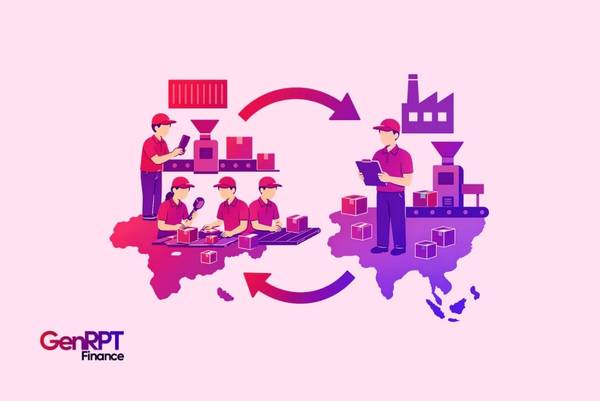
Reshoring refers to bringing production back to the home country, while nearshoring shifts production to geographically closer regions. The definitions are simple, but the drivers today are more complex than they were a decade ago.
This is not just about labor cost differences anymore. It is about supply chain risk, geopolitical alignment, trade policies, and access to critical inputs. Companies are not asking where production is cheapest. They are asking where production is most reliable.
A key shift is that supply chains are being optimized for continuity, not just efficiency. That change alone has implications for margins, capital expenditure, and ultimately valuations.
Why This Shift Is Happening Now
Several forces are converging at the same time.
First, supply chain disruptions exposed fragility in global networks. Events like the pandemic and geopolitical tensions showed that long-distance supply chains can fail in ways that are hard to predict and even harder to recover from.
Second, governments are actively pushing for domestic manufacturing in critical sectors. Incentives, subsidies, and trade barriers are encouraging companies to localize production. In the United States alone, industrial policy measures have triggered hundreds of billions in announced manufacturing investments over the last few years.
Third, automation has changed the cost equation. Labor cost advantages in offshore locations are less decisive when production is increasingly automated. This reduces the gap between producing in low-cost regions and producing closer to end markets.
According to industry estimates, global foreign direct investment into manufacturing has been shifting toward regional hubs, with North America and Southeast Asia seeing a significant rise in project announcements post-2020.
The Capex Cycle That Is Being Underestimated
One of the most important implications of reshoring and nearshoring is the scale of capital expenditure required.
Building new factories, upgrading infrastructure, and creating regional supply networks is not a short-term adjustment. It is a multi-year investment cycle. This includes not just manufacturing plants but also logistics, warehousing, energy infrastructure, and digital systems.
For example, semiconductor investments alone have crossed hundreds of billions globally, driven by both private sector demand and government incentives. Similar patterns are emerging in sectors like automotive, energy equipment, and advanced manufacturing.
The key insight for equity research is that this is not a one-time spike in capex. It is a structural shift that can sustain investment cycles across industrial sectors for years.
How This Is Quietly Repricing Industrial Sectors
Markets do not always react immediately to structural shifts. Instead, repricing happens gradually as earnings visibility improves and capital flows adjust.
Companies that are positioned to benefit from reshoring are seeing changes in how they are valued. This includes manufacturers of industrial equipment, construction and engineering firms, logistics providers, and even software companies enabling supply chain visibility.
At the same time, companies that were heavily reliant on global cost arbitrage are facing pressure. Their margins may come under scrutiny as production costs increase and supply chains become more complex.
The repricing is subtle because it is happening through expectations. Analysts are adjusting long-term growth assumptions, margin profiles, and capital intensity. Over time, these adjustments translate into valuation changes.
Sector-Level Impacts That Are Emerging
The impact of reshoring and nearshoring is not uniform across sectors. Some industries are directly exposed, while others are indirectly affected through supply chain linkages.
Industrial machinery and equipment manufacturers are seeing increased demand as companies invest in new production capacity. Construction and engineering firms are benefiting from large-scale infrastructure and factory projects.
Logistics and warehousing providers are gaining from the need to redesign distribution networks. Regional supply chains require more nodes, more storage, and more coordination.
Energy and utilities are also part of this story. New manufacturing capacity requires reliable power, which is driving investment in both traditional and renewable energy infrastructure.
Even technology companies are involved. Supply chain software, data platforms, and automation tools are becoming essential as operations become more complex.
Margin Trade-Offs and the New Cost Structure
One of the key debates around reshoring is whether it is margin dilutive. Producing closer to home markets often comes with higher labor and regulatory costs.
However, this view can be too simplistic. While operating costs may increase, companies can benefit from lower transportation costs, reduced inventory risks, and faster response times. These factors can improve overall efficiency in ways that are not always captured in traditional cost models.
There is also a strategic premium attached to resilience. Companies are willing to accept slightly lower margins if it reduces the risk of major disruptions.
For analysts, this means that margin analysis needs to evolve. It is no longer just about cost minimization. It is about risk-adjusted profitability.
The Role of Policy in Shaping Investment Flows
Government policy is playing a significant role in accelerating reshoring and nearshoring trends.
Subsidies, tax incentives, and regulatory frameworks are influencing where companies invest. In some cases, policy support is the deciding factor in location decisions.
This introduces a new variable into equity research. Analysts need to track policy developments as closely as they track company fundamentals. Changes in incentives or trade rules can quickly alter the attractiveness of certain regions or sectors.
Policy-driven investment cycles also tend to be long-lasting. Once infrastructure is built and supply chains are established, they create inertia that sustains economic activity over time.
What This Means for Equity Research Frameworks
Traditional equity research models often assume stable global supply chains and predictable cost structures. Reshoring and nearshoring challenge these assumptions.
Analysts need to incorporate several new dimensions into their models.
Capital intensity is becoming more important as companies invest in local capacity. This affects free cash flow and return on invested capital.
Geographic exposure needs to be analyzed differently. Revenue and cost structures are increasingly tied to regional dynamics rather than global averages.
Supply chain resilience is emerging as a qualitative factor that can influence valuations. Companies with more robust and flexible supply chains may command a premium.
This is where tools like GenRPT Finance become relevant. With the ability to process large volumes of financial and operational data, analysts can better track capex trends, supply chain shifts, and their impact on earnings.
Early Signals Analysts Should Watch
The repricing of sectors does not happen overnight. It starts with small signals that build over time.
Rising capital expenditure guidance from industrial companies is one such signal. When multiple companies in a sector start increasing capex, it often indicates a broader investment cycle.
Changes in order backlogs for equipment manufacturers can also provide insights into future demand.
Geographic shifts in revenue or production can reveal how companies are repositioning their operations.
Finally, policy announcements and subsidy allocations can indicate where future investment is likely to flow.
Tracking these signals consistently can help analysts stay ahead of market repricing.
Risks That Could Disrupt the Thesis
While the reshoring and nearshoring trend is strong, it is not without risks.
Execution risk is significant. Building new supply chains is complex and can lead to delays, cost overruns, and operational challenges.
Policy risk is another factor. Changes in government priorities or fiscal constraints can impact incentives and investment flows.
There is also the risk of overcapacity. If too many companies invest in similar capabilities at the same time, it could lead to excess supply and margin pressure.
Finally, global economic conditions can influence demand. A slowdown in growth could reduce the need for new capacity and delay investment plans.
Conclusion
Reshoring and nearshoring are not just operational adjustments. They are part of a broader industrial investment thesis that is reshaping how sectors are valued.
The shift toward regional supply chains is driving a multi-year capex cycle, altering cost structures, and introducing new variables into equity research. The repricing of sectors is happening quietly, through changes in expectations rather than sudden market reactions.
For analysts, the challenge is to adapt frameworks to capture these shifts early. Tools like GenRPT Finance can help by turning complex data into actionable insights, making it easier to track how these structural changes are influencing financial performance.
The companies that understand and execute on this transition effectively are likely to define the next phase of industrial growth. The market is starting to recognize this, even if the full repricing is still unfolding.
