
Equity Research on Global Coverage Gaps Across Markets
May 15, 2026 | By GenRPT Finance
More than 43,000 publicly listed companies exist globally, yet nearly 70% of active analyst coverage is concentrated in North America and Western Europe. This imbalance is creating major blind spots in the global equity market. Many companies across Southeast Asia, Africa, Latin America, and smaller European exchanges remain under-researched despite strong revenue growth and improving fundamentals. As a result, equity research teams, investment research firms, and institutional investors are increasingly focusing on coverage gaps as a source of hidden opportunity.
Why Global Coverage Gaps Exist in Equity Markets
The global financial system is heavily biased toward developed markets. Large investment banks and research houses prioritize regions with high trading volumes, better disclosure standards, and stronger investor participation. This leaves many companies in smaller economies with little institutional visibility.
According to Bloomberg and Refinitiv estimates, US-listed firms receive nearly 15 times more analyst coverage than similarly sized firms in parts of Africa or Southeast Asia. In India, China, Brazil, and frontier economies, analyst concentration is mostly limited to large-cap companies. Mid-cap and small-cap firms often receive very limited attention despite improving profitability.
This imbalance affects the quality of equity research reports available to investors. It also impacts price discovery, valuation efficiency, and capital allocation across the global equity market.
How Coverage Gaps Affect Equity Valuation
When companies lack institutional analyst attention, information asymmetry increases. Investors struggle to access detailed financial reports, sector comparisons, or forward-looking estimates. This often leads to pricing inefficiencies.
In developed markets, a company may have coverage from 20 to 40 analysts. In contrast, a profitable manufacturing company in a frontier market may have coverage from only one or two local firms.
Limited coverage affects:
Market liquidity
Stocks with lower research visibility often have lower trading volumes.
Equity Valuation accuracy
Without broad analyst participation, valuation models may fail to capture long-term growth potential.
Institutional participation
Large asset managers and portfolio managers may avoid poorly researched stocks because of internal compliance requirements.
Risk perception
Weak coverage increases uncertainty during periods of market volatility and weakens overall market risk analysis.
This creates opportunities for firms that specialize in deep equity analysis and regional market expertise.
The Rise of AI in Equity Research Coverage
Artificial intelligence is starting to reduce the cost of global research expansion. Many firms now use ai for data analysis and ai for equity research to process large amounts of financial information across markets.
Traditional analyst teams cannot manually track thousands of listed firms across multiple countries. AI systems are helping solve this problem through automation.
Modern research workflows now use:
- Automated earnings extraction
- AI-driven transcript summarization
- Multi-language document analysis
- Real-time market monitoring
- Automated peer comparisons
- Predictive trend detection
This shift is improving the scalability of equity research automation and enabling research firms to cover regions previously considered uneconomical.
According to Deloitte, AI-assisted research operations can reduce manual research time by nearly 40%. McKinsey estimates that financial institutions adopting AI-based research systems could improve productivity by up to 30%.
Why Emerging Markets Need Different Research Frameworks
Many global research models were designed for mature Western markets. Applying the same frameworks to emerging economies often produces inaccurate conclusions.
For example, standard valuation assumptions may not account for:
- Currency instability
- Commodity dependency
- Political transitions
- Infrastructure limitations
- Family-owned business structures
- Informal economic activity
This makes localized investment strategy development extremely important.
Strong fundamental analysis in emerging markets often requires:
Local industry understanding
Sector dynamics can differ significantly across regions.
Geopolitical context
Regional policy changes strongly influence growth expectations.
Customized valuation methods
Analysts may need different discount rates and growth assumptions.
Flexible financial forecasting
Macroeconomic volatility changes long-term earnings visibility.
As global capital flows expand, firms specializing in regional investment insights are becoming increasingly valuable.
Geographic Exposure and Portfolio Risk
Global investors are paying more attention to geographic exposure because market concentration risk has increased sharply in recent years.
Today, a large percentage of global index performance is driven by a small group of US technology companies. This concentration creates structural risk for diversified portfolios.
Coverage gaps create both risk and opportunity:
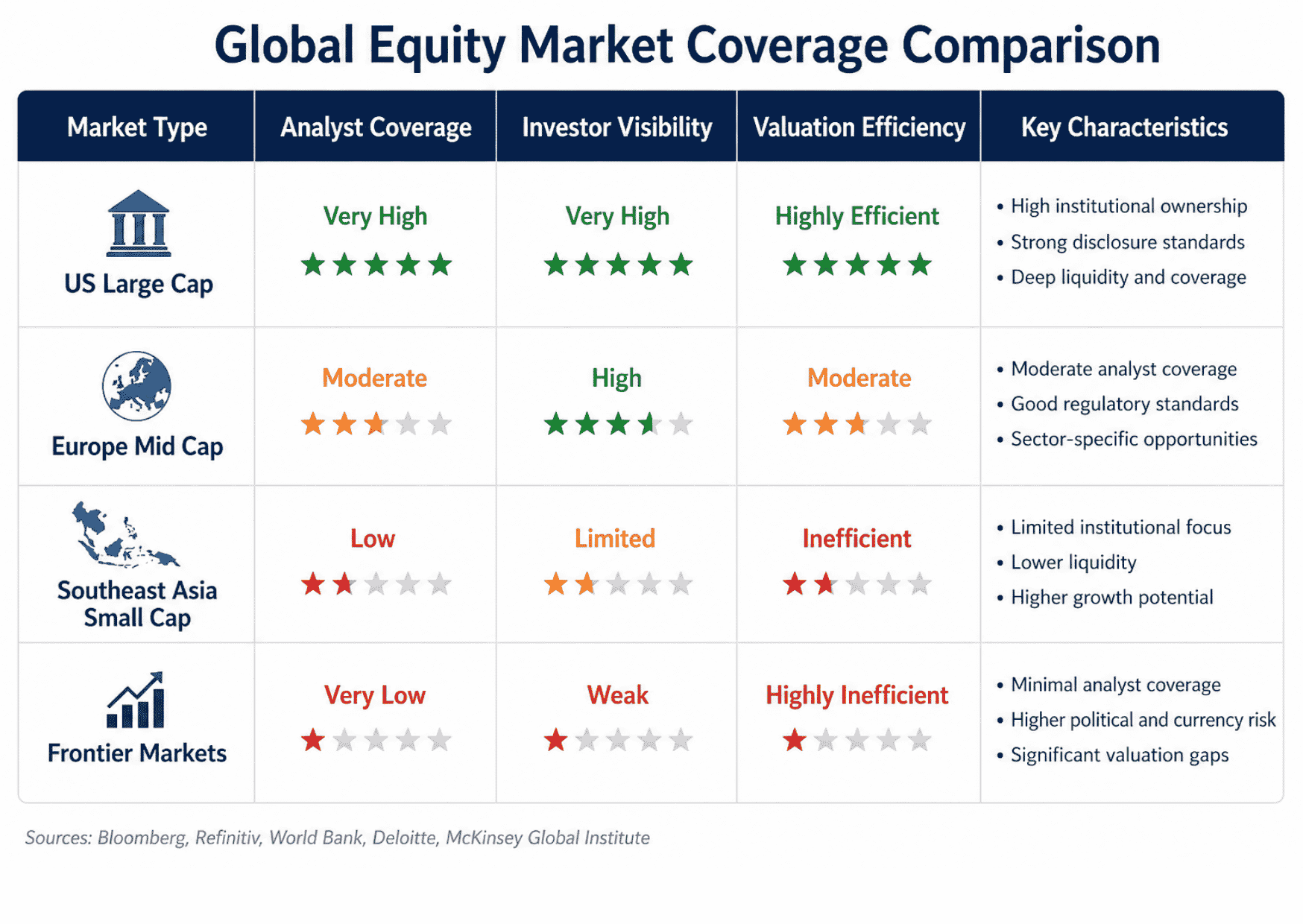
Institutional investors increasingly use portfolio risk assessment systems to identify markets where research coverage remains weak but growth potential remains strong.
This approach helps diversify exposure and improve long-term equity performance.
The Role of Financial Research Tools
Technology platforms are transforming global research accessibility. Modern financial research tool platforms can aggregate structured and unstructured information from multiple exchanges and regulatory systems.
Advanced platforms now integrate:
- Earnings call transcripts
- Regulatory filings
- News analysis
- Social sentiment tracking
- Multi-currency comparisons
- AI-generated summaries
This improves the speed of financial research while reducing dependence on manual analyst workflows.
Many firms also use ai report generator systems to create first-draft research summaries for analysts. These systems do not replace analysts entirely, but they significantly improve research efficiency.
Research teams can now focus more on interpretation, scenario building, and investment decision-making rather than repetitive data collection.
Why Coverage Gaps Create Investment Opportunities
Undercovered companies often trade below intrinsic value because institutional visibility remains weak. Historically, many high-growth companies were discovered early by specialized regional research firms before gaining mainstream attention.
Coverage inefficiencies create opportunities for:
Value investing strategies
Under-researched companies may remain undervalued for long periods.
Long-term institutional investors
Investors with longer holding periods can benefit from delayed market recognition.
Specialized investment analysts
Niche expertise becomes more valuable in fragmented markets.
Multi-market research firms
Cross-border research capabilities improve competitive advantage.
This trend is increasing demand for independent research providers and AI-assisted analysis systems.
Climate Risk and Global Research Expansion
Climate exposure is becoming a major factor in global research models. Many undercovered markets are highly exposed to environmental risks, supply chain disruptions, and infrastructure instability.
According to the World Bank, climate-related economic losses in developing markets could exceed $1.7 trillion annually by 2050 if adaptation investments remain weak.
Research firms are now incorporating:
- Climate-adjusted valuation models
- Supply chain risk mapping
- Carbon exposure scoring
- Physical infrastructure assessments
This is changing how financial risk assessment is conducted across international markets.
Firms that combine climate analytics with regional equity research may gain a major advantage in identifying resilient long-term investments.
How AI Could Close the Global Coverage Gap
AI-driven systems may significantly reduce the global research imbalance during the next decade.
Future systems will likely include:
Multi-language research automation
AI can process local-language filings and media content at scale.
Automated peer benchmarking
Firms can compare global companies instantly across sectors.
Real-time macroeconomic tracking
Dynamic macroeconomic outlook models can improve regional forecasting.
Faster scenario analysis
AI systems can rapidly evaluate multiple valuation outcomes.
Improved financial transparency
Automated data extraction can improve access to difficult-to-analyze markets.
These developments may dramatically improve global investment accessibility.
Challenges Still Remain
Despite advances in AI and automation, several challenges continue to affect global research quality.
These include:
- Weak disclosure standards in some regions
- Inconsistent accounting frameworks
- Limited data availability
- Political instability
- Currency volatility
- Regulatory fragmentation
Even the best AI systems still depend on reliable source data. Human expertise remains critical in interpreting local economic and political conditions.
This means future research models will likely combine AI automation with specialized regional analyst teams.
Conclusion
Global market coverage gaps are becoming one of the most important themes in modern investment research. Large parts of the world remain under-analyzed despite improving economic growth and expanding capital markets. This creates inefficiencies that sophisticated investors increasingly view as opportunity rather than risk.
AI-driven research systems, automated analytics, and scalable financial intelligence platforms are helping firms expand global coverage more efficiently than ever before. However, successful global equity analysis still requires regional expertise, strong judgment, and localized understanding.
As research workflows continue evolving, platforms like GenRPT Finance are helping organizations improve global market intelligence through AI-powered reporting, scalable analytics, and faster access to actionable investment insights.
FAQs
Why do global equity coverage gaps exist?
Coverage gaps exist because research firms focus heavily on developed markets with larger trading volumes and institutional demand. Smaller and emerging markets often receive limited analyst attention.
How does AI help improve equity research coverage?
AI improves scalability by automating data extraction, summarization, transcript analysis, and market monitoring. This allows research firms to cover more companies with lower operational cost.
Why are undercovered markets important for investors?
Undercovered markets may contain undervalued companies that have strong fundamentals but limited institutional visibility. This creates long-term investment opportunities.
What role does geographic exposure play in portfolio construction?
Geographic exposure helps investors diversify market concentration risk. Expanding across multiple regions can improve portfolio resilience during economic downturns.
Can AI replace human equity analysts completely?
No. AI improves efficiency and data processing, but human analysts remain important for interpreting political, economic, and regional market conditions.
