
Equity Research on Innovation and Long-Term Company Value
May 15, 2026 | By GenRPT Finance
Innovation has become one of the strongest drivers of long-term company valuation in modern financial markets. Investors are no longer evaluating businesses only through short-term earnings or quarterly performance. Companies that consistently invest in research, technology, operational efficiency, and product development are increasingly receiving valuation premiums across the global equity market. Strong innovation pipelines now influence long-term growth expectations, market positioning, and investor confidence.
Today, many of the world’s highest-valued companies maintain their leadership because they continuously invest in innovation even during economic slowdowns. This shift is changing how equity research teams evaluate company quality, future cash flows, and competitive durability.
Why Innovation Matters in Equity Research
Traditional equity analysis focused heavily on historical financial performance. While profitability, margins, and balance-sheet strength remain important, investors now pay greater attention to a company’s ability to adapt and innovate.
According to PwC, companies classified as innovation leaders outperform industry peers by nearly 30% in long-term shareholder returns. McKinsey also estimates that organizations investing heavily in digital transformation and R&D generate significantly stronger revenue resilience during economic uncertainty.
This makes innovation an important factor in modern investment research.
Research teams now evaluate:
Research and development spending
Companies with consistent R&D investment often maintain stronger competitive advantages.
Product innovation cycles
Faster product iteration improves long-term market relevance.
Technology adoption
AI, automation, and cloud adoption influence future operational scalability.
Market expansion capability
Innovative firms often enter new markets faster.
Intellectual property strength
Patents and proprietary systems create long-term barriers to competition.
These indicators increasingly influence equity valuation and long-term investment insights.
How Innovation Impacts Long-Term Company Value
Innovation improves company value by strengthening revenue growth potential, operational efficiency, customer retention, and competitive positioning.
Businesses that fail to innovate often lose market share even if short-term financial reports appear stable.
Several areas are directly affected:
Revenue growth
Innovative companies are more likely to create new revenue streams.
Profitability improvement
Automation and operational innovation reduce long-term cost structures.
Market share expansion
Companies introducing differentiated products often capture larger customer segments.
Investor confidence
Markets reward firms that demonstrate future growth capability.
Valuation premiums
Innovative firms frequently trade at higher earnings multiples.
For example, technology-focused companies consistently maintain higher enterprise-value-to-earnings ratios than slower-moving industries because investors price future innovation into current valuations.
Innovation Across Different Industries
Innovation is no longer limited to the technology sector. Nearly every industry now depends on continuous improvement and digital transformation.
Financial Services
Banks and fintech firms are investing heavily in AI, automation, and digital payment systems. This improves operational efficiency and customer experience.
Healthcare
Biotechnology, AI-assisted diagnostics, and personalized medicine are transforming healthcare business models.
Manufacturing
Automation, robotics, and smart factories are improving productivity and supply-chain resilience.
Retail
Retail companies are adopting predictive analytics, inventory automation, and digital commerce systems.
Energy
Renewable-energy innovation and energy-storage technology are reshaping long-term valuation models.
Strong equity research reports increasingly evaluate how companies adapt to technological and operational disruption across these industries.
The Role of AI in Equity Research
AI is transforming how financial firms analyze innovation-driven businesses.
Traditional analyst workflows often struggle to process large volumes of financial disclosures, patent filings, earnings transcripts, and market data. Modern ai for equity research systems are helping firms improve scalability and research speed.
AI platforms now support:
- Automated earnings analysis
- Patent and R&D tracking
- Market sentiment analysis
- Financial forecasting
- Competitive benchmarking
- Predictive analytics
According to Deloitte, AI-driven financial analysis can improve research productivity by nearly 40%.
This growth in equity research automation allows firms to evaluate innovation trends across thousands of companies more efficiently.
Why Innovation Creates Valuation Gaps
Markets do not always price innovation correctly.
Some companies receive high valuations based on future expectations, while others remain undervalued despite strong innovation pipelines.
This creates geographic and sector-specific valuation inefficiencies.
Research firms increasingly use:
Fundamental analysis
To evaluate whether innovation investment is translating into financial performance.
Financial modeling
To estimate long-term cash-flow expansion.
Scenario analysis
To assess future growth outcomes under different economic conditions.
Market sentiment analysis
To understand investor perception around innovation narratives.
Strong investment strategy development now depends heavily on separating genuine innovation capability from short-term hype.
Challenges in Measuring Innovation
Innovation can be difficult to quantify consistently.
Several factors complicate innovation-focused equity analysis:
Intangible asset valuation
Intellectual property and software investments are difficult to measure accurately.
Delayed profitability
Some innovation investments take years to generate returns.
Industry differences
Innovation cycles vary significantly across sectors.
Market speculation
High-growth companies may become overvalued during optimistic cycles.
Financial transparency limitations
Companies may not fully disclose innovation strategy details.
Because of this, strong risk analysis remains essential in evaluating long-term innovation potential.
Geographic Differences in Innovation Valuation
Innovation valuation differs significantly across global markets.
US technology firms often receive premium valuations because of strong investor confidence and institutional participation. Meanwhile, innovative firms in emerging markets may trade at lower multiples because of weaker analyst coverage or limited investor familiarity.
This creates opportunities for investors focused on geographic exposure and long-term value creation.
Many emerging economies are now producing:
- Digital-payment platforms
- AI-driven software firms
- Renewable-energy companies
- Manufacturing automation providers
- Healthcare technology startups
Yet several of these firms remain undercovered in global investment research.
Innovation and Long-Term Competitive Advantage
Sustainable innovation creates long-term competitive durability.
Companies that continuously improve products, operations, and customer experience are more likely to maintain pricing power and market leadership.
Key indicators of long-term innovation strength include:
Consistent R&D intensity
Steady investment signals long-term strategic focus.
Talent acquisition
High-quality engineering and technical teams support innovation culture.
Platform scalability
Technology-driven systems improve operational expansion capability.
Customer retention
Innovative companies often maintain stronger customer loyalty.
Adaptability
Flexible business models respond faster to market disruption.
These factors increasingly influence portfolio insights and long-term investment decisions.
Innovation Trends Driving Future Equity Markets
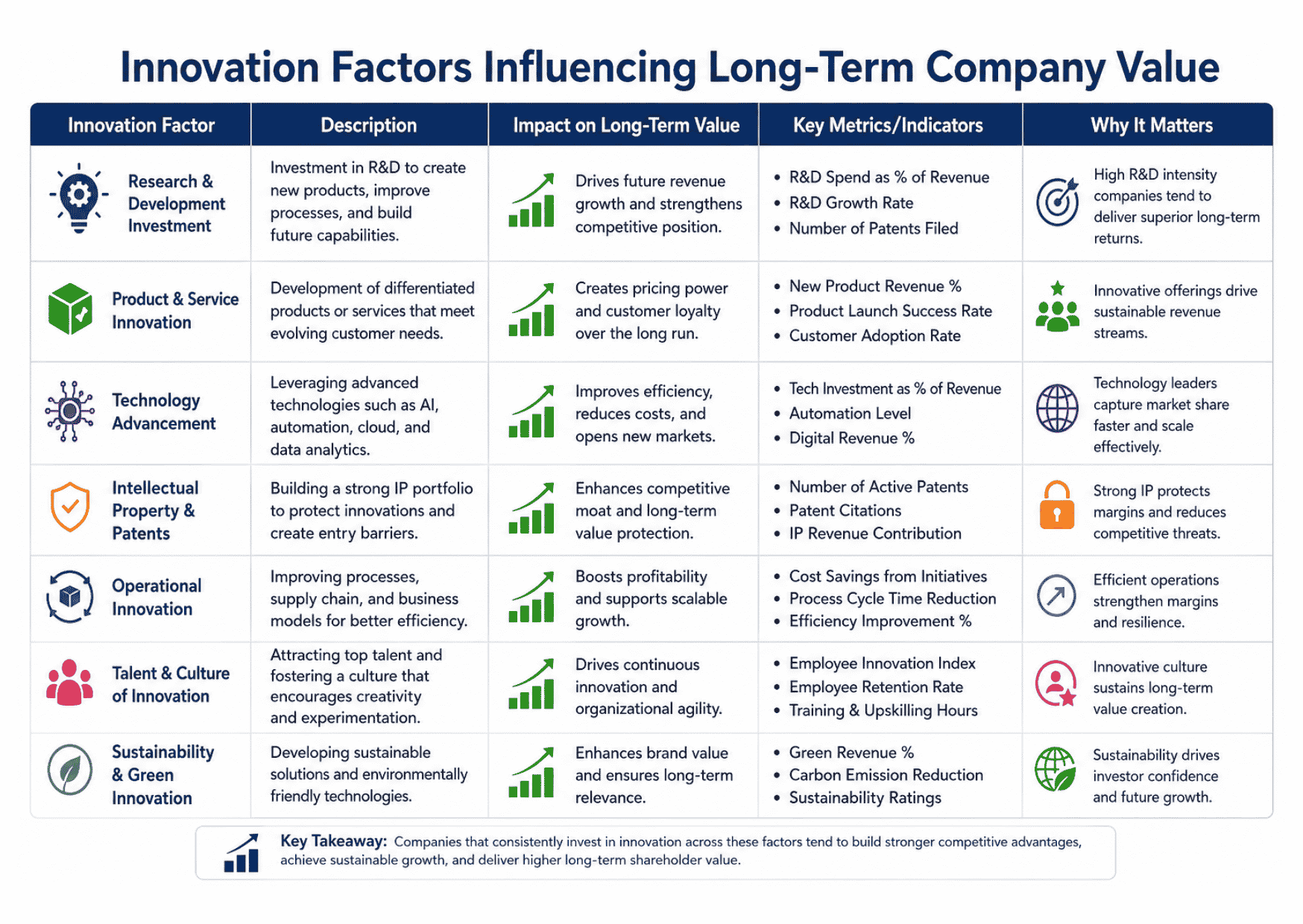
Several major innovation themes are reshaping global equity markets:
- Artificial intelligence adoption
- Automation and robotics
- Clean-energy infrastructure
- Semiconductor expansion
- Biotechnology development
- Digital financial services
- Data analytics platforms
- Supply-chain automation
According to IDC, global digital-transformation spending could exceed $4 trillion by 2027.
Investors are increasingly using ai for data analysis systems to monitor these trends across sectors and geographies.
Why Financial Research Tools Matter
Modern financial research tool platforms help investors evaluate innovation trends more efficiently.
These systems improve access to:
- Earnings transcripts
- Patent analysis
- Market-share data
- R&D spending trends
- Industry comparisons
- Macroeconomic outlook indicators
Advanced AI systems can now process structured and unstructured financial information simultaneously.
This improves the speed and quality of global financial research.
The Future of Innovation-Focused Equity Research
Innovation-driven investing is likely to become even more important during the next decade.
Several trends are accelerating this shift:
- Faster technology adoption
- AI-driven business transformation
- Global digital infrastructure growth
- Automation expansion
- Increasing data accessibility
- Stronger institutional focus on long-term value creation
Research firms that successfully combine AI automation with deep sector expertise may gain a major advantage in identifying future market leaders.
Conclusion
Innovation is now one of the most important drivers of long-term company value across global equity markets. Investors increasingly evaluate businesses based on their ability to adapt, scale, automate, and create sustainable competitive advantages.
AI-powered analytics, advanced financial forecasting, and scalable research systems are helping firms improve innovation-focused equity analysis across industries and geographies. Strong equity research supported by long-term innovation tracking will remain critical for identifying durable market leaders in an increasingly technology-driven economy.
Platforms like GenRPT Finance are helping organizations improve investment intelligence through AI-powered reporting, scalable analytics, and faster research workflows focused on long-term value creation.
FAQs
Why is innovation important in equity research?
Innovation influences long-term growth potential, competitive advantage, and valuation expansion.
How does AI improve innovation-focused equity analysis?
AI automates financial analysis, patent tracking, market monitoring, and predictive analytics.
Why do innovative companies receive higher valuations?
Investors often expect stronger future revenue growth and market leadership from innovative firms.
What risks exist in innovation investing?
Overvaluation, delayed profitability, execution risk, and speculative market behavior are major risks.
Why are emerging-market innovators often undervalued?
Limited analyst coverage and lower institutional participation reduce market visibility.
