
What Are Economic Moats in Equity Research?
July 10, 2026 | By GenRPT Finance
Economic moats are sustainable competitive advantages that help a company protect its market position, maintain profitability, and generate long-term shareholder value despite increasing competition. In equity research, analysts use economic moats to evaluate whether a business can continue outperforming competitors over many years. Rather than focusing only on current financial performance, economic moats help investors understand whether a company’s success is built on durable strengths that competitors find difficult to replicate.
A company may report strong revenue growth and healthy profit margins, but that does not necessarily mean it has a lasting competitive advantage. If competitors can easily copy its products, reduce prices, or attract its customers, those financial results may not be sustainable. On the other hand, businesses with strong brands, patented technology, loyal customers, or cost advantages often continue generating consistent profits even as industries evolve.
This is why economic moats are an important part of investment research, fundamental analysis, and long-term investment strategy. They provide a deeper understanding of business quality beyond what financial statements alone can reveal.
According to Morningstar, companies with wide economic moats have historically generated stronger long-term risk-adjusted returns than companies with limited competitive advantages. While every investment carries risk, durable competitive strengths often improve a company’s ability to perform consistently across different market conditions.
Economic Moats Are More Than Competitive Advantages
The terms competitive advantage and economic moat are often used interchangeably, but they are not always the same.
A competitive advantage may be temporary.
An economic moat is designed to last.
For example, launching a successful product can provide a competitive advantage for a short period.
However, if competitors quickly introduce similar products, that advantage disappears.
An economic moat exists when the company has characteristics that make it difficult for competitors to reduce its market position over an extended period.
These characteristics may include:
- Strong brand recognition
- Proprietary technology
- Cost leadership
- Customer loyalty
- Efficient distribution
- Network effects
The stronger and more sustainable these advantages become, the stronger the company’s economic moat.
The Main Types of Economic Moats
Analysts generally evaluate several types of economic moats when assessing long-term business quality.
Cost Advantage
Some companies operate more efficiently than their competitors.
Lower production or operating costs allow them to maintain healthy profit margins while offering competitive prices.
Examples include large retailers, manufacturers, and logistics businesses that benefit from economies of scale.
A cost advantage often allows businesses to remain profitable even when market conditions become challenging.
Intangible Assets
Intangible assets can create powerful competitive advantages.
These include:
- Brands
- Patents
- Trademarks
- Licences
- Proprietary technology
For example, pharmaceutical companies often benefit from patented medicines that prevent competitors from producing identical products for several years.
Similarly, globally recognized brands allow businesses to charge premium prices while maintaining strong customer loyalty.
Network Effects
Some businesses become more valuable as more people use them.
Payment networks, digital marketplaces, and communication platforms often benefit from network effects.
As their customer base grows, new users gain greater value from joining the platform, making it increasingly difficult for competitors to attract customers.
Network effects are among the strongest economic moats because they reinforce themselves over time.
Switching Costs
Customers sometimes continue using a product or service because changing providers is expensive, time-consuming, or operationally disruptive.
Examples include enterprise software, cloud infrastructure, banking relationships, and accounting systems.
High switching costs create stable customer relationships while reducing competitive pressure.
Efficient Scale
Some industries naturally support only a small number of competitors.
Utilities, airports, rail infrastructure, and specialised industrial businesses often operate in markets where demand is insufficient for many providers.
This limits competition while allowing existing businesses to maintain stable market positions.
Why Economic Moats Matter in Equity Research
Financial statements describe how a company has performed.
Economic moats explain why that performance may continue.
Consider two businesses with identical operating margins.
One company maintains premium pricing because customers trust its brand.
The other relies on temporary cost reductions that competitors can easily match.
Although both businesses currently generate similar profits, the first company is more likely to maintain those profits over the long term.
Understanding this difference strengthens equity research analysis while improving long-term investment decisions.
Economic Moats Support Better Business Quality Assessment
Economic moats are closely linked to business quality.
Analysts combine moat analysis with other important factors such as:
- Financial strength
- Corporate governance
- Management quality
- Operational efficiency
- Market Share Analysis
- Competitive positioning
Together, these factors help determine whether a business possesses the characteristics needed to generate sustainable shareholder value.
Instead of evaluating historical performance alone, analysts assess whether competitive advantages remain strong enough to support future growth.
AI Makes Economic Moat Analysis More Efficient
Evaluating economic moats requires reviewing information from many different sources.
Analysts study annual reports, earnings calls, regulatory filings, competitor announcements, industry reports, patent activity, and market news before forming conclusions.
Modern ai for equity research simplifies this process.
Using ai data analysis, AI platforms organize information, compare competitors, identify emerging trends, and highlight changes that may strengthen or weaken a company’s competitive position.
An ai report generator combines financial analysis with competitive intelligence, governance evaluation, and market developments to produce comprehensive equity research reports.
This allows analysts to focus on interpreting competitive advantages rather than spending significant time collecting information.
Economic Moats Change Over Time
An economic moat is not permanent.
Customer expectations evolve.
Technology advances.
Competitors innovate.
Regulations change.
A business with a strong competitive position today may lose its advantage if it fails to adapt.
Likewise, companies investing consistently in innovation, customer relationships, and operational excellence may strengthen their economic moats over time.
For this reason, analysts continuously monitor competitive developments rather than assuming that existing advantages will last indefinitely.
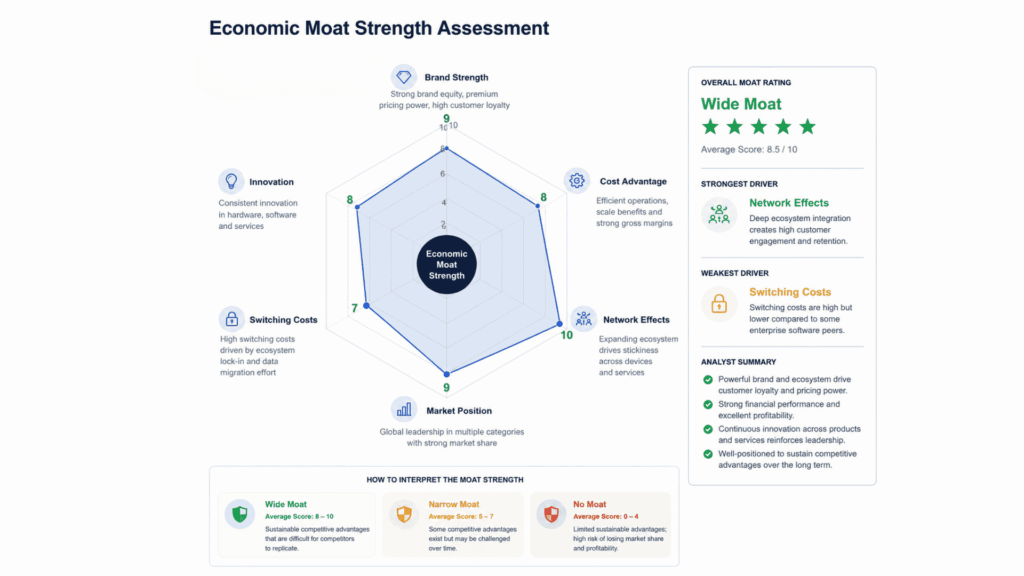
Conclusion
Economic moats help investors identify businesses capable of protecting their competitive position and generating sustainable long-term value. By evaluating competitive advantages such as brand strength, cost leadership, network effects, switching costs, and intangible assets, analysts gain a deeper understanding of business quality beyond financial statements. This broader perspective improves equity research, strengthens valuation, and supports more informed investment decisions.
GenRPT Finance simplifies economic moat analysis by combining financial statements, annual reports, earnings calls, competitor benchmarking, regulatory filings, market intelligence, and AI-powered analytics into comprehensive research reports. Powered by Yodaplus Agentic AI services, the platform helps investment professionals identify durable competitive advantages, benchmark businesses against industry peers, and generate deeper investment insights with greater speed and consistency.
FAQs
An economic moat is a sustainable competitive advantage that helps a company maintain profitability, protect its market position, and generate long-term shareholder value despite increasing competition.
The most common economic moats include cost advantages, intangible assets such as brands and patents, network effects, switching costs, and efficient scale.
They help analysts determine whether a company’s financial performance is supported by durable competitive advantages that are likely to sustain future growth and profitability.
Yes. Changes in technology, customer preferences, regulation, or competition can weaken a company’s competitive advantage if it fails to adapt.
AI analyzes financial reports, competitor data, earnings calls, patent activity, market trends, and industry developments to identify and monitor sustainable competitive advantages.
GenRPT Finance combines AI-powered financial analysis, competitive intelligence, market research, and business quality assessment into comprehensive equity research reports, helping investment professionals evaluate economic moats more efficiently.
