
Why Does Corporate Strategy Analysis Matter?
July 15, 2026 | By GenRPT Finance
Corporate strategy analysis matters because it helps investors understand whether a company’s long-term decisions are likely to create sustainable growth, strengthen its competitive position, and increase shareholder value. In equity research, financial performance explains how a company has performed in the past, while corporate strategy provides insight into where the business is headed. By evaluating management’s strategic direction alongside financial results, analysts can make better-informed investment decisions and develop more realistic expectations about future performance.
Many successful businesses do not become market leaders overnight.
Their competitive position is often the result of years of disciplined capital allocation, innovation, market expansion, and operational improvements.
Similarly, companies with strong financial performance today may struggle tomorrow if they fail to adapt to changing customer expectations, new technologies, or increasing competition.
This is why professional investment research extends beyond financial statements and examines the quality of a company’s long-term strategy.
According to PwC’s Global CEO Survey, nearly 45% of CEOs believe their businesses may not remain economically viable over the next decade without significant strategic changes. For investors, this highlights the importance of evaluating management’s ability to adapt and execute long-term plans.
Corporate Strategy Explains Future Growth
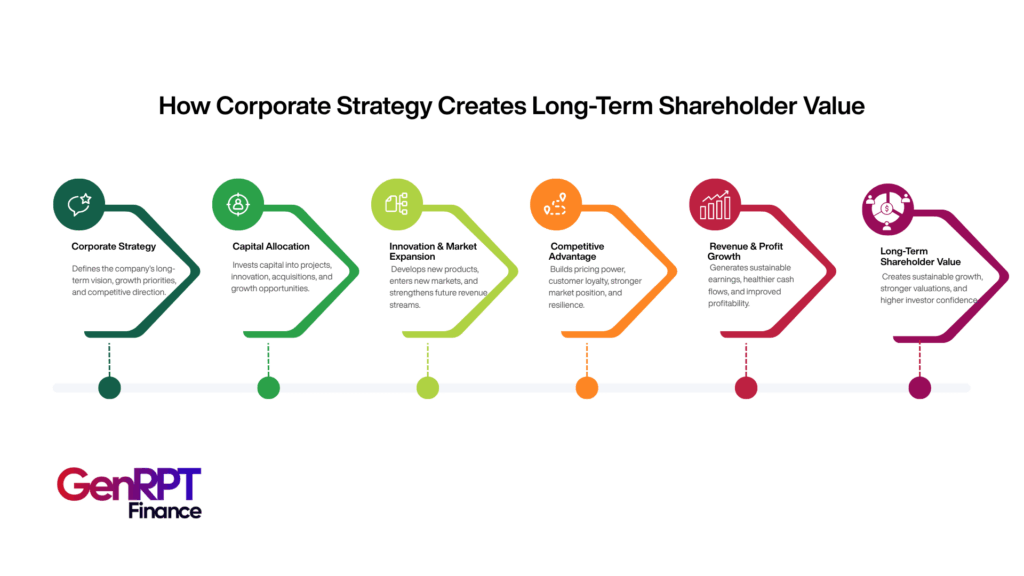
Historical financial performance is important, but investors ultimately buy future earnings rather than past results.
Corporate strategy helps analysts understand where future growth may come from.
They evaluate whether management plans to achieve growth through:
- New products
- Geographic expansion
- Digital transformation
- Strategic acquisitions
- Product diversification
- New customer segments
Businesses with well-defined and realistic growth strategies are generally better positioned to deliver sustainable long-term performance.
It Helps Assess Management Quality
Corporate strategy reflects how management thinks about the future.
Strong leadership is demonstrated not only by delivering quarterly earnings but also by making disciplined decisions that strengthen the business over many years.
Analysts evaluate management’s ability to:
- Allocate capital efficiently
- Execute strategic initiatives
- Respond to market changes
- Balance risk and growth
- Deliver on long-term commitments
Companies with consistent execution often earn greater investor confidence than businesses that frequently change direction or fail to achieve strategic objectives.
Better Capital Allocation Creates Shareholder Value
One of the strongest indicators of good corporate strategy is effective capital allocation.
Management continuously decides how available resources should be invested.
These decisions may include:
- Research and development
- Capital expenditure
- Acquisitions
- Debt reduction
- Dividend payments
- Share repurchases
Strong capital allocation improves business quality while supporting sustainable earnings growth and long-term shareholder returns.
Poor capital allocation, however, can reduce profitability even when revenue continues growing.
Corporate Strategy Strengthens Business Quality Assessment
Corporate strategy is closely connected to business quality.
Analysts combine strategy evaluation with:
- Corporate governance
- Financial strength
- Competitive intelligence
- Operational efficiency
- Innovation
- Risk assessment
Together, these factors help determine whether a company’s success is sustainable or driven by temporary market conditions.
A business with strong financial performance but weak strategic direction may face greater long-term challenges than a company making disciplined investments for future growth.
Competitive Position Depends on Strategy
Every strategic decision influences how a company competes.
Analysts evaluate whether management is improving competitive positioning through:
- Product differentiation
- Pricing strategy
- Customer experience
- Technology investment
- Operational excellence
- Market Share Analysis
Businesses with effective strategies often strengthen their competitive advantages while maintaining healthier profitability over time.
Corporate Strategy Influences Equity Valuation
Corporate strategy directly affects valuation assumptions.
Businesses with clear strategic direction often receive stronger long-term growth expectations because investors have greater confidence in future earnings.
Analysts incorporate strategic assessment into:
- Equity Valuation
- Financial modeling
- Revenue projections
- Scenario Analysis
- cost of capital
For example, a company investing successfully in high-growth markets may receive higher valuation multiples than a competitor with similar current earnings but limited future growth opportunities.
Strategy Helps Investors Understand Risk
Every corporate strategy introduces both opportunities and risks.
Analysts evaluate whether strategic initiatives expose businesses to:
- Execution risk
- Financial risk
- Regulatory risk
- Competitive pressure
- Market uncertainty
- Technology disruption
Understanding these risks strengthens market risk analysis and supports better long-term investment decisions.
AI Makes Strategy Analysis More Efficient
Evaluating corporate strategy requires reviewing significant amounts of qualitative information.
Analysts study:
- Annual reports
- CEO letters
- Earnings calls
- Investor presentations
- Regulatory filings
- Industry reports
- Competitor announcements
Modern ai for equity research simplifies this process.
Using ai data analysis, AI platforms compare management commentary across reporting periods, identify strategic priorities, benchmark competitors, and summarize major business developments.
An ai report generator combines these findings with financial analysis to produce comprehensive equity research reports that provide deeper strategic insights.
Better Strategy Analysis Leads to Better Investment Decisions
Companies rarely succeed because of financial performance alone.
Long-term success depends on making the right strategic decisions consistently over many years.
Investors who understand corporate strategy gain a better perspective on future earnings, competitive positioning, business quality, and long-term value creation.
This broader understanding improves investment insights while reducing reliance on short-term financial results.
Conclusion
Corporate strategy analysis matters because it helps investors understand how management plans to create long-term value rather than simply evaluating historical financial performance. By assessing growth initiatives, capital allocation, competitive positioning, innovation, and execution alongside financial metrics, analysts develop a more complete picture of business quality and future earnings potential. This strengthens equity research, improves valuation accuracy, and supports better long-term investment decisions.
GenRPT Finance simplifies corporate strategy analysis by combining annual reports, earnings calls, investor presentations, financial statements, regulatory filings, competitor benchmarking, and AI-powered analytics into comprehensive research reports. Powered by Yodaplus Agentic AI services, the platform enables investment professionals to evaluate strategic direction, monitor execution, benchmark competitors, and generate deeper investment insights with greater speed, consistency, and analytical depth.
FAQs
Corporate strategy analysis helps analysts evaluate whether a company’s long-term plans are likely to improve growth, strengthen competitive advantages, and create sustainable shareholder value.
A company’s strategy influences future earnings, competitive positioning, capital allocation, and business quality, all of which affect investment returns and valuation.
Analysts examine growth plans, capital allocation, innovation, market expansion, competitive positioning, mergers and acquisitions, management execution, and corporate governance.
Yes. A company may report healthy financial performance in the short term while making strategic decisions that weaken its long-term competitive position or growth potential.
Strong strategies improve confidence in future earnings and cash flows, often resulting in higher valuation multiples and stronger long-term investment prospects.
AI analyzes annual reports, earnings calls, investor presentations, competitor activity, and market intelligence to identify strategic priorities, benchmark companies, and automate research workflows.
GenRPT Finance combines AI-powered financial analysis, strategy evaluation, competitor benchmarking, governance assessment, and market intelligence into comprehensive equity research reports, helping investment professionals evaluate corporate strategy more efficiently and consistently.
