
How Do Analysts Evaluate Corporate Strategy Analysis?
July 15, 2026 | By GenRPT Finance
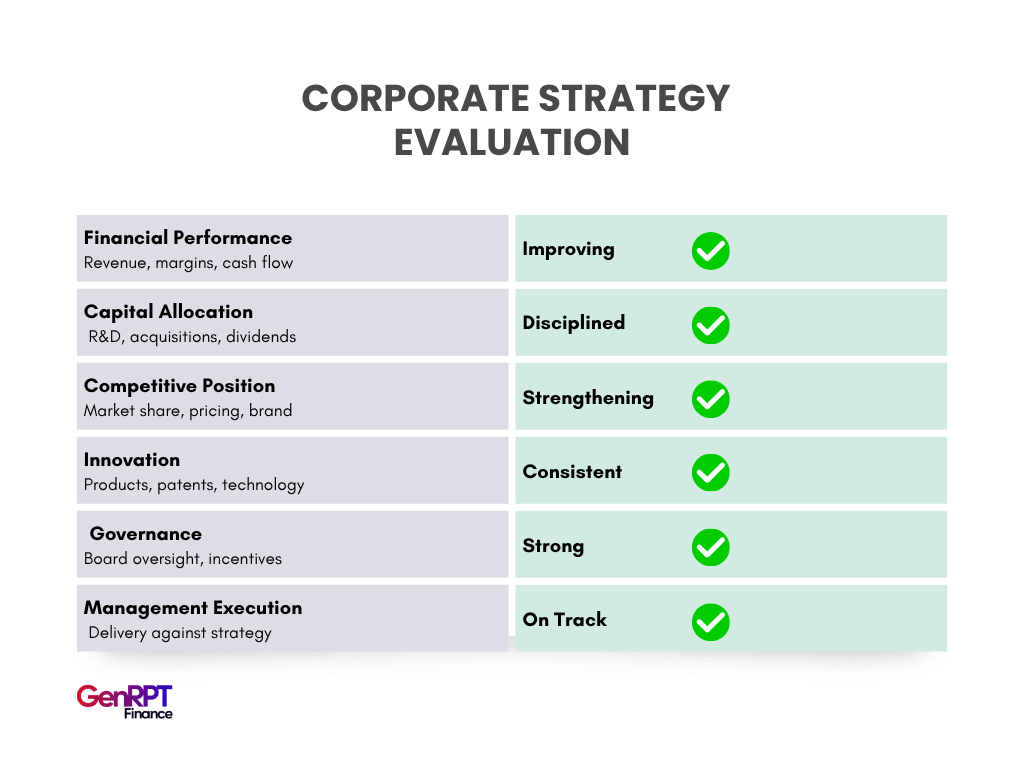
Analysts evaluate corporate strategy by examining whether a company’s long-term decisions are creating sustainable competitive advantages, improving financial performance, and strengthening shareholder value. Rather than relying on management presentations or strategic announcements alone, they combine financial analysis, competitive intelligence, business quality assessment, and industry research to determine whether a company’s strategy is realistic, well executed, and capable of delivering long-term growth. This structured approach helps investors distinguish between ambitious plans and strategies that consistently create measurable business results.
Every company claims to have a growth strategy.
The important question for investors is whether that strategy is actually working.
A business may announce expansion plans, acquisitions, or digital transformation initiatives, but unless these decisions improve market position, profitability, and operational performance, they create little long-term value.
This is why corporate strategy evaluation has become a key component of equity research, investment research, and fundamental analysis.
According to Bain & Company, companies with disciplined strategic execution consistently outperform peers that frequently change priorities or fail to execute long-term initiatives effectively. For analysts, execution is often just as important as strategy itself.
Analysts Begin With Financial Performance
The first step is understanding whether strategic decisions are producing measurable financial improvements.
Analysts evaluate:
- Revenue growth
- Profitability Analysis
- Operating margins
- Cash flow generation
- Return on invested capital
- Earnings consistency
Financial improvement alone does not confirm a successful strategy, but consistent performance over several years often indicates that management is executing effectively.
Capital Allocation Is Closely Examined
Strategy becomes visible through capital allocation.
Analysts evaluate where management invests the company’s financial resources.
This includes:
- Research and development
- Capital expenditure
- Strategic acquisitions
- Debt repayment
- Dividend policy
- Share buybacks
Strong businesses allocate capital toward opportunities that improve long-term growth rather than simply boosting short-term financial performance.
Consistent capital allocation also strengthens Equity Valuation because it improves confidence in future earnings.
Growth Strategy Is Evaluated
Growth should be realistic, measurable, and aligned with market opportunities.
Analysts assess whether management plans to grow through:
- New products
- Geographic expansion
- Digital transformation
- Strategic partnerships
- Product diversification
- New customer segments
Rather than rewarding aggressive expansion, analysts determine whether management has the operational and financial capability to execute those plans successfully.
Competitive Position Is Measured
Corporate strategy should improve a company’s position within its industry.
Analysts compare businesses across:
- Market Share Analysis
- Pricing strategy
- Product differentiation
- Customer acquisition
- Brand strength
- Industry leadership
A strategy that consistently improves competitive positioning often creates stronger long-term shareholder value.
Innovation Supports Strategic Execution
Innovation is an important indicator of long-term strategic thinking.
Research teams monitor:
- Research and development spending
- Patent activity
- Product launches
- Technology investment
- Digital capabilities
Companies that consistently innovate are generally better prepared to respond to changing customer expectations and competitive pressures.
Innovation also improves long-term financial forecasting by creating additional growth opportunities.
Management Execution Matters
Even the strongest strategy fails without effective execution.
Analysts compare management’s promises with actual business performance.
They evaluate:
- Achievement of announced objectives
- Financial performance against guidance
- Operational improvements
- Market expansion progress
- Acquisition integration
- Long-term consistency
Companies that consistently deliver on strategic commitments generally receive greater investor confidence.
Corporate Governance Strengthens Strategy
Strong corporate governance improves strategic decision-making.
Analysts evaluate:
- Board oversight
- Executive incentives
- Shareholder alignment
- Capital allocation discipline
- Risk management practices
Good governance reduces the likelihood of poor strategic decisions while supporting sustainable long-term execution.
Competitive Intelligence Provides Context
Corporate strategy should always be evaluated relative to competitors.
Analysts study:
- Competitor investments
- Industry innovation
- Pricing trends
- Customer preferences
- Market expansion
- Strategic acquisitions
This competitive perspective helps determine whether management’s strategy is strengthening or weakening the company’s market position.
Without competitive intelligence, strategy analysis remains incomplete.
Industry Conditions Influence Strategy
The same strategy may produce different results across industries.
Analysts therefore evaluate:
- Industry growth
- Competitive intensity
- Regulatory environment
- Customer demand
- Technology adoption
- Barriers to entry
Understanding industry dynamics helps determine whether a company’s strategic decisions are appropriate for its operating environment.
AI Improves Corporate Strategy Analysis
Corporate strategy generates significant amounts of qualitative information.
Analysts review annual reports, CEO letters, investor presentations, earnings calls, regulatory filings, and market news before forming conclusions.
Modern ai for equity research significantly improves this process.
Using ai data analysis, AI platforms compare management commentary across reporting periods, benchmark competitors, identify strategic priorities, and summarize important business developments.
An ai report generator combines financial analysis, corporate strategy, governance assessment, business quality evaluation, and competitive intelligence into comprehensive equity research reports.
This allows analysts to spend more time evaluating strategic quality rather than gathering information manually.
Strategy Evaluation Is Continuous
Corporate strategy should never be assessed only once.
Markets evolve.
Technology advances.
Competitors respond.
Customer expectations change.
Analysts continuously monitor strategic execution to ensure investment recommendations remain aligned with changing business conditions.
Conclusion
Analysts evaluate corporate strategy by examining financial performance, capital allocation, competitive positioning, innovation, governance, management execution, and industry dynamics together rather than in isolation. This structured approach helps determine whether management’s long-term decisions are translating into sustainable business performance and shareholder value. Combining strategy analysis with equity research provides investors with a clearer understanding of future growth potential and long-term investment quality.
GenRPT Finance simplifies corporate strategy analysis by combining annual reports, earnings calls, investor presentations, financial statements, competitor benchmarking, regulatory filings, and AI-powered analytics into comprehensive research reports. Powered by Yodaplus Agentic AI services, the platform enables investment professionals to evaluate management strategy, monitor execution, benchmark competitors, and generate deeper investment insights with greater speed, consistency, and analytical depth.
FAQs
Analysts assess financial performance, capital allocation, growth initiatives, competitive positioning, innovation, governance, management execution, and industry conditions to determine whether a company’s strategy supports long-term value creation.
Financial results show past performance, while strategy evaluation determines whether management’s long-term decisions are likely to sustain or improve that performance in the future.
Capital allocation shows how management invests company resources. Disciplined investment in innovation, acquisitions, and growth opportunities often leads to stronger long-term shareholder value.
Competitive intelligence helps analysts compare a company’s strategic decisions with those of its peers, providing context on market positioning, innovation, and long-term competitiveness.
Corporate strategy should be evaluated continuously because market conditions, technology, competition, and customer preferences evolve over time.
AI analyzes annual reports, earnings calls, investor presentations, regulatory filings, competitor activity, and market intelligence to identify strategic priorities, benchmark businesses, and automate research workflows.
GenRPT Finance combines AI-powered financial analysis, strategy evaluation, governance assessment, competitive intelligence, and business quality analysis into comprehensive equity research reports, helping investment professionals evaluate long-term corporate strategy more efficiently.
