
Capital Allocation Excellence in Equity Research: A Complete Guide
July 16, 2026 | By GenRPT Finance
Capital allocation excellence is the ability of a company’s management to invest its financial resources in ways that maximize long-term shareholder value. In equity research, analysts evaluate how businesses deploy capital through research and development, capital expenditure, acquisitions, debt reduction, dividends, and share buybacks to determine whether management consistently makes decisions that strengthen business quality and improve future financial performance. A company can generate significant cash, but its long-term success depends on how effectively that cash is invested.
Two companies may generate identical profits and cash flows.
One reinvests capital into innovation, expands into attractive markets, acquires complementary businesses, and improves operational efficiency.
The other spends aggressively on acquisitions with poor returns, underinvests in product development, and accumulates debt.
Although both companies appear financially healthy today, their long-term value creation may be very different.
This is why capital allocation is one of the most important areas of investment research, fundamental analysis, and Equity Valuation.
According to McKinsey & Company, companies that consistently allocate capital toward their highest-return opportunities significantly outperform peers in total shareholder returns over the long term. For investors, understanding management’s capital allocation decisions is often just as important as analyzing financial performance.
What Is Capital Allocation Excellence?
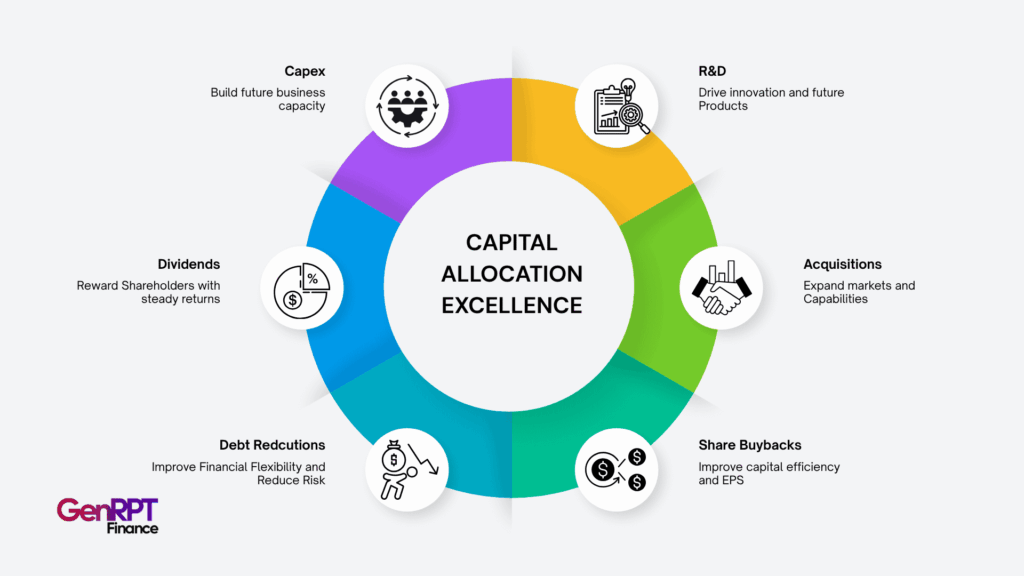
Capital allocation refers to the decisions management makes about where the company’s financial resources should be invested.
Capital allocation excellence means making those decisions in a disciplined, data-driven, and shareholder-focused manner.
Rather than simply spending available cash, management evaluates where each investment can generate the highest long-term return.
Every business generates capital through operations.
Management must then decide how that capital should be used to strengthen the business.
Typical allocation decisions include:
- Investing in new products
- Expanding manufacturing capacity
- Funding research and development
- Acquiring other businesses
- Reducing debt
- Paying dividends
- Repurchasing shares
Each decision affects future earnings, business quality, competitive positioning, and shareholder returns.
Why Capital Allocation Matters
Many businesses fail not because they lack profitability but because they invest capital inefficiently.
Poor acquisitions, unnecessary expansion, excessive borrowing, or underinvestment in innovation can gradually weaken a company’s competitive position.
Strong capital allocation helps companies:
- Improve long-term profitability
- Strengthen competitive advantages
- Increase operational efficiency
- Support innovation
- Improve shareholder returns
- Reduce financial risk
For investors, capital allocation provides valuable insight into management quality because every retained dollar reflects a strategic decision.
The Major Areas of Capital Allocation
Management has several options when deploying capital.
Each serves a different business objective.
Capital Expenditure (CapEx)
Capital expenditure supports long-term business growth.
Examples include:
- Manufacturing facilities
- Technology infrastructure
- Equipment
- Distribution centres
- Digital platforms
Analysts evaluate whether these investments improve productivity, support revenue growth, or strengthen competitive positioning.
High capital expenditure is not automatically positive.
The quality of investment matters more than the amount invested.
Research and Development
Innovation requires continuous investment.
Research and development spending often creates future products, improves operational efficiency, and strengthens competitive advantages.
Analysts monitor:
- R&D expenditure
- Product launches
- Technology investments
- Patent development
- Innovation pipeline
Businesses that invest consistently in innovation are generally better positioned to maintain long-term growth.
Strategic Acquisitions
Acquisitions allow companies to expand more quickly than organic growth alone.
Successful acquisitions may provide:
- New technologies
- New customers
- Geographic expansion
- Operational synergies
- Product diversification
However, acquisitions also introduce integration risk.
Analysts evaluate whether acquired businesses improve future earnings and strengthen competitive positioning rather than simply increasing revenue.
Debt Reduction
Reducing debt improves financial flexibility.
Lower leverage can:
- Reduce interest costs
- Improve credit quality
- Increase resilience during economic downturns
- Support future investments
Analysts often compare debt reduction with other investment opportunities to determine whether management is making balanced capital allocation decisions.
Dividends
Dividend payments return excess capital directly to shareholders.
Stable dividend policies often indicate:
- Healthy cash flow
- Financial discipline
- Mature business models
However, analysts also examine whether dividend payments limit investment opportunities that could generate higher long-term returns.
Share Buybacks
Share repurchases reduce the number of outstanding shares.
When executed appropriately, buybacks can:
- Improve earnings per share
- Return capital efficiently
- Increase shareholder value
However, buybacks completed at excessive valuations or funded through debt may destroy shareholder value instead of creating it.
Capital Allocation Reflects Management Quality
Financial statements show the results of management decisions.
Capital allocation explains how those results were achieved.
Strong management teams consistently invest in projects that generate attractive long-term returns.
Poor management often focuses on:
- Empire building
- Short-term earnings
- Aggressive acquisitions
- Inefficient expansion
- Excessive leverage
Analysts therefore view capital allocation as one of the clearest indicators of leadership quality.
Capital Allocation Shapes Business Quality
Business quality extends beyond revenue and profitability.
Companies with disciplined capital allocation often demonstrate:
- Strong financial discipline
- Consistent innovation
- Sustainable competitive advantages
- Efficient operations
- Long-term strategic thinking
These characteristics strengthen overall business quality and improve long-term investment potential.
Capital allocation is therefore closely connected with:
- Corporate governance
- Corporate strategy
- Competitive intelligence
- Economic moats
- Risk assessment
Rather than evaluating these areas separately, professional equity research considers them together to develop a comprehensive understanding of business performance.
Capital Allocation Influences Equity Valuation
Valuation depends on future cash generation rather than historical profits alone.
Companies that allocate capital effectively often produce:
- Higher returns on invested capital
- Better free cash flow
- Stronger earnings growth
- Improved operating margins
- Sustainable competitive advantages
Analysts incorporate capital allocation into:
- Financial modeling
- Equity Valuation
- Revenue projections
- Scenario Analysis
- cost of capital
For example, two companies may generate similar earnings today, but the one investing consistently in high-return projects may deserve a higher valuation because investors expect stronger future growth.
Capital Allocation Supports Long-Term Investing
Successful investing often depends on identifying businesses capable of compounding value over many years.
Those businesses usually share one characteristic:
They consistently allocate capital better than competitors.
Rather than chasing short-term opportunities, disciplined management teams invest in projects that strengthen long-term competitive positioning while maintaining financial flexibility.
This explains why many of the world’s highest-performing companies have demonstrated exceptional capital allocation over decades rather than simply reporting strong quarterly earnings.
How Analysts Evaluate Capital Allocation Excellence
Professional analysts do not judge capital allocation by looking at one investment or one year’s financial performance.
Instead, they evaluate whether management consistently deploys capital in ways that improve business quality and create long-term shareholder value.
This involves combining financial analysis with business strategy, competitive intelligence, and industry research.
Return on Invested Capital (ROIC)
One of the most important indicators of capital allocation excellence is Return on Invested Capital (ROIC).
ROIC measures how efficiently a company converts invested capital into operating profit.
A consistently high ROIC often indicates that management invests in projects capable of generating attractive long-term returns.
Analysts compare ROIC across:
- Historical performance
- Industry peers
- Capital-intensive businesses
- Different business segments
Companies that maintain high ROIC over long periods generally demonstrate disciplined capital allocation.
Free Cash Flow Generation
Strong businesses generate cash.
Excellent businesses use that cash effectively.
Analysts evaluate:
- Free cash flow growth
- Cash conversion
- Operating cash flow
- Cash reinvestment
Rather than focusing only on accounting profits, analysts examine whether cash generated by the business is creating additional value.
Capital Allocation Trends
A single investment decision rarely determines management quality.
Instead, analysts study capital allocation patterns across several years.
They ask questions such as:
- Has management consistently invested in innovation?
- Have acquisitions improved earnings?
- Has debt been reduced responsibly?
- Have buybacks created shareholder value?
- Are dividend payments sustainable?
Long-term consistency is often a stronger indicator than individual transactions.
Acquisition Performance
Acquisitions consume significant amounts of capital.
Analysts therefore evaluate whether acquisitions deliver their intended objectives.
Areas commonly reviewed include:
- Revenue contribution
- Margin improvement
- Cost synergies
- Market expansion
- Customer growth
- Return on acquisition investment
Acquisitions that consistently strengthen competitive positioning generally reflect disciplined management.
Capital Efficiency
Capital efficiency measures how effectively management converts investment into business growth.
Analysts evaluate:
- Asset utilisation
- Revenue per invested dollar
- Return on assets
- Operating efficiency
- Productivity improvements
Efficient businesses often require less capital to generate additional earnings, improving long-term shareholder returns.
Industry Benchmarking
Capital allocation should never be evaluated in isolation.
Analysts compare companies with direct competitors across:
- Capital expenditure
- Research and development
- Acquisition strategy
- Dividend policy
- Share buybacks
- Return metrics
Benchmarking provides valuable context by showing whether management is allocating capital more effectively than competitors.
Strategy and Capital Allocation Should Align
Every capital allocation decision should support the company’s broader strategy.
For example:
A technology company investing heavily in research and development may be strengthening its competitive advantage.
A mature consumer business may create more value through dividends and disciplined share repurchases.
Analysts therefore assess whether capital allocation decisions support long-term strategic objectives rather than simply increasing spending.
AI Is Improving Capital Allocation Analysis
Evaluating capital allocation requires reviewing years of financial information, management commentary, and strategic decisions.
Modern ai for equity research significantly improves this process.
Using ai data analysis, AI platforms automatically analyze:
- Annual reports
- Financial statements
- Earnings calls
- Capital expenditure trends
- Acquisition history
- Dividend policy
- Share repurchase activity
- Management commentary
Rather than manually comparing years of disclosures, analysts receive structured insights that highlight changes in capital allocation priorities.
An ai report generator combines financial analysis, corporate strategy, governance evaluation, business quality assessment, and capital allocation trends into comprehensive equity research reports.
This enables investment professionals to identify management strengths and weaknesses much faster while maintaining analytical consistency.
Common Mistakes Investors Make
Capital allocation is often misunderstood.
Some common mistakes include:
- Assuming higher capital expenditure always creates value.
- Focusing only on dividend yield.
- Ignoring return on invested capital.
- Rewarding acquisition activity without evaluating integration success.
- Confusing revenue growth with shareholder value creation.
- Evaluating one year’s investment decisions instead of long-term capital allocation patterns.
Avoiding these mistakes leads to stronger investment research and more balanced investment decisions.
gram and is visually different from the flywheel, dashboard, value chain, radar chart, and timeline you’ve already used.
Conclusion
Capital allocation excellence is one of the strongest indicators of management quality because it reveals how effectively a company converts financial resources into long-term shareholder value. By evaluating capital allocation alongside financial performance, business quality, corporate strategy, governance, and competitive positioning, analysts gain a much deeper understanding of a company’s ability to sustain growth and outperform competitors. This structured approach strengthens equity research, improves valuation accuracy, and supports more informed investment decisions.
GenRPT Finance simplifies capital allocation analysis by combining financial statements, annual reports, earnings calls, cash flow trends, capital expenditure, acquisition history, dividend policies, and AI-powered analytics into comprehensive equity research reports. Powered by Yodaplus Agentic AI services, the platform helps investment professionals evaluate management quality, benchmark capital allocation decisions, identify long-term value creators, and generate deeper investment insights with greater speed, consistency, and analytical depth.
FAQs
Capital allocation excellence is the ability of management to invest company resources in projects and initiatives that generate sustainable long-term shareholder value while maintaining financial discipline.
Capital allocation reveals how management deploys cash through investments, acquisitions, dividends, debt reduction, and share buybacks. These decisions significantly influence future earnings, business quality, and company valuation.
Analysts commonly evaluate Return on Invested Capital (ROIC), free cash flow, capital efficiency, acquisition performance, operating margins, cash conversion, and long-term shareholder returns.
ROIC measures how efficiently a company generates profits from invested capital. Consistently high ROIC often indicates disciplined investment decisions and effective capital allocation.
AI analyzes financial statements, annual reports, earnings calls, capital expenditure, acquisitions, dividends, and management commentary to identify capital allocation trends, benchmark companies, and automate research workflows.
GenRPT Finance uses Agentic AI to evaluate financial performance, capital allocation, corporate strategy, governance, business quality, and competitive intelligence, helping investment professionals generate institutional-grade equity research reports with greater speed, consistency, and analytical depth.
