
What Is Capital Allocation Excellence in Equity Research?
July 16, 2026 | By GenRPT Finance
Capital allocation excellence is the ability of a company’s management to deploy capital in ways that maximize long-term shareholder value. Instead of simply generating profits, successful businesses know how to reinvest those profits into projects, acquisitions, innovation, debt reduction, or shareholder returns that create sustainable growth. In equity research, analysts evaluate capital allocation excellence to understand whether management consistently makes investment decisions that strengthen business quality, improve financial performance, and increase long-term company value.
Every business generates cash.
The real challenge begins after that.
Management must decide whether the company should invest in new factories, develop innovative products, acquire competitors, reduce debt, repurchase shares, or return cash to shareholders through dividends.
Each decision affects the company’s future growth and competitive position.
This is why investors often say they are investing in management as much as they are investing in the business itself.
According to McKinsey & Company, organizations that consistently allocate capital toward their highest-return opportunities generate significantly stronger total shareholder returns than peers over long periods. This makes capital allocation one of the clearest indicators of management quality.
Capital Allocation Is More Than Spending Money
Capital allocation is often misunderstood as simply deciding where company funds should be spent.
In reality, it is about choosing investments that generate the highest long-term returns while balancing growth, financial stability, and shareholder expectations.
Every decision involves trade-offs.
For example, should a company:
- Build a new manufacturing facility?
- Invest in artificial intelligence?
- Acquire a competitor?
- Expand internationally?
- Pay higher dividends?
- Reduce debt?
Management cannot pursue every opportunity simultaneously.
Capital allocation excellence lies in selecting the opportunities that create the greatest long-term value.
Where Companies Allocate Capital
Businesses typically allocate capital across several major areas.
Each supports different strategic objectives.
Capital Expenditure
Capital expenditure (CapEx) refers to investments in long-term assets.
Examples include:
- Manufacturing plants
- Warehouses
- Equipment
- Technology infrastructure
- Distribution centres
These investments are intended to improve productivity, increase capacity, or support future growth.
Analysts evaluate whether CapEx generates measurable improvements in revenue, efficiency, or profitability.
Research and Development
Innovation requires sustained investment.
Research and development spending supports:
- Product innovation
- Technology development
- Process improvements
- Intellectual property
- Digital transformation
Businesses that invest consistently in research often maintain stronger competitive advantages over time.
Strategic Acquisitions
Many companies accelerate growth by acquiring other businesses.
Acquisitions may provide:
- New customers
- New markets
- New technologies
- Skilled talent
- Additional production capacity
However, successful acquisitions depend on disciplined valuation and effective integration.
Analysts therefore assess whether acquisitions improve business performance rather than simply increasing company size.
Debt Reduction
Reducing debt improves financial flexibility.
Lower leverage can:
- Reduce interest costs
- Improve cash flow
- Strengthen credit quality
- Increase resilience during economic downturns
For some businesses, reducing debt creates greater long-term value than expanding aggressively.
Returning Capital to Shareholders
When attractive investment opportunities are limited, companies may return capital directly to shareholders through:
- Dividends
- Share buybacks
Dividend payments reward investors with regular income.
Share repurchases reduce the number of outstanding shares, potentially increasing earnings per share and shareholder ownership.
Analysts evaluate whether these decisions are supported by strong cash flows and appropriate business conditions.
Why Capital Allocation Reflects Management Quality
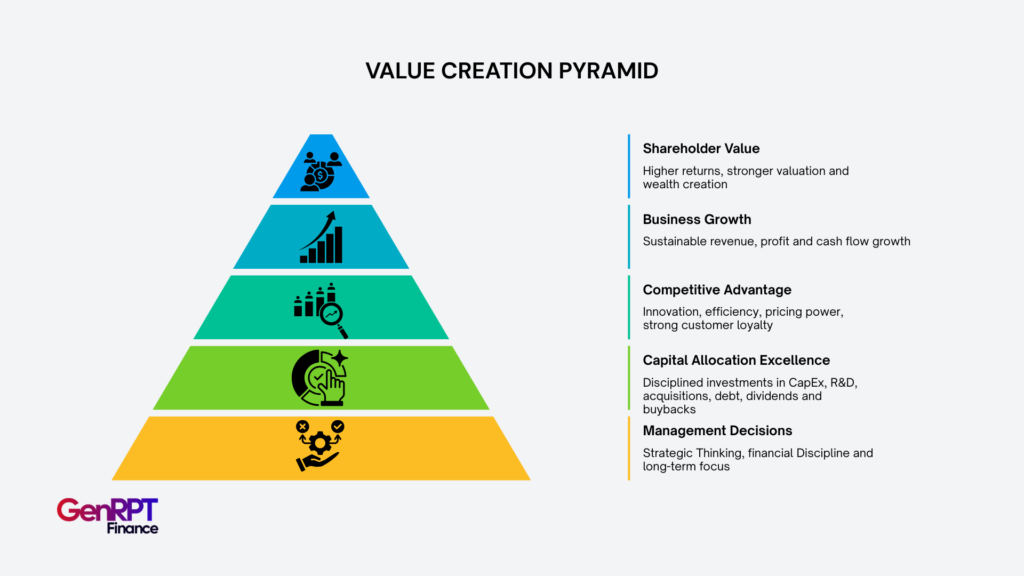
Financial statements reveal business performance.
Capital allocation reveals management’s judgment.
Two companies with similar earnings can create very different shareholder outcomes depending on how they invest available capital.
Strong management teams typically demonstrate:
- Financial discipline
- Long-term thinking
- Balanced risk management
- Consistent investment decisions
- Strategic focus
Poor capital allocation, on the other hand, may involve:
- Overpriced acquisitions
- Excessive borrowing
- Unnecessary expansion
- Underinvestment in innovation
- Returning capital while neglecting future growth
Because these decisions shape future performance, analysts closely examine management’s capital allocation record.
Capital Allocation Supports Business Quality
Capital allocation is closely connected with overall business quality.
Businesses that consistently allocate capital effectively often demonstrate:
- Strong corporate governance
- Clear corporate strategy
- Sustainable competitive advantages
- Healthy financial performance
- Disciplined risk management
These characteristics contribute to stronger long-term business performance and improve investor confidence.
Capital Allocation Influences Valuation
Investors value companies based on their ability to generate future cash flows.
Capital allocation directly affects those future expectations.
Companies investing in high-return projects often experience:
- Higher earnings growth
- Better profitability
- Stronger free cash flow
- Greater operational efficiency
- Improved competitive positioning
Analysts therefore incorporate capital allocation into:
- Financial modeling
- Equity Valuation
- Revenue projections
- Scenario Analysis
- cost of capital
A company with disciplined capital allocation often commands higher valuation multiples because investors expect stronger long-term returns.
AI Makes Capital Allocation Analysis More Efficient
Evaluating capital allocation requires reviewing years of financial information and management decisions.
Modern ai for equity research simplifies this process.
Using ai data analysis, AI platforms analyze:
- Financial statements
- Annual reports
- Earnings calls
- Capital expenditure trends
- Acquisition history
- Dividend policy
- Share repurchase activity
- Management commentary
An ai report generator combines these insights with financial analysis, governance assessment, business quality evaluation, and strategic analysis to produce comprehensive equity research reports.
This allows analysts to identify long-term capital allocation trends much faster while maintaining research consistency.
Capital Allocation Is a Long-Term Competitive Advantage
Businesses rarely create shareholder value through one exceptional investment.
Instead, they build long-term success by making hundreds of disciplined capital allocation decisions over many years.
Companies that consistently invest in innovation, strengthen competitive positioning, maintain financial flexibility, and deploy capital responsibly are generally better positioned to outperform competitors and deliver sustainable returns.
Understanding these decisions gives investors a clearer picture of management quality and future business potential.
Conclusion
Capital allocation excellence is one of the strongest indicators of management quality because it determines how effectively a company converts financial resources into sustainable business growth and shareholder value. By evaluating investment decisions alongside financial performance, corporate strategy, governance, and business quality, analysts gain a more complete understanding of a company’s long-term potential. This disciplined approach strengthens equity research, improves valuation accuracy, and supports better investment decisions.
GenRPT Finance simplifies capital allocation analysis by combining financial statements, annual reports, earnings calls, cash flow trends, capital expenditure, acquisition history, dividend policies, and AI-powered analytics into comprehensive equity research reports. Powered by Yodaplus Agentic AI services, the platform enables investment professionals to evaluate management quality, benchmark capital allocation decisions, and generate deeper investment insights with greater speed, consistency, and analytical depth.
FAQs
Capital allocation excellence is the ability of management to invest company resources in ways that maximize long-term shareholder value while maintaining financial discipline and supporting sustainable business growth.
Capital allocation helps analysts evaluate management quality by showing how a company invests cash through innovation, acquisitions, capital expenditure, debt reduction, dividends, and share buybacks.
The primary areas include capital expenditure, research and development, acquisitions, debt reduction, dividend payments, and share repurchase programmes.
Effective capital allocation improves future earnings, cash flow, profitability, and competitive positioning, leading to stronger valuation assumptions and long-term investor confidence.
Yes. A company may generate strong profits but destroy shareholder value through poor acquisitions, inefficient investments, excessive borrowing, or underinvestment in future growth.
GenRPT Finance uses Agentic AI to analyze financial statements, capital allocation trends, governance, business quality, and strategic decisions, helping investment professionals generate faster, more comprehensive, and institutional-grade equity research reports.
