
What Analysts Look for in Annual Reports and Company Filings
October 13, 2026 | By GenRPT Finance
Annual reports and company filings are among the most valuable sources of information in equity research analysis. They provide far more than revenue, profit, and balance sheet figures. For investment analysts, these documents reveal how a business operates, the risks it faces, the decisions management is making, and whether the company is likely to create long-term shareholder value.
Professional analysts do not read annual reports simply to collect financial data. They read them to answer important questions. Is the company’s strategy working? Are profits sustainable? Is management delivering on previous commitments? Are there new risks that investors should know about?
As companies become more transparent and disclosure requirements continue to evolve, annual reports have become increasingly detailed. Reviewing hundreds of pages of financial statements, notes, management discussions, governance disclosures, and regulatory filings is now a standard part of investment research. AI can help organize and summarize this information, but identifying meaningful insights still depends on careful analysis.
This article explains what analysts look for when reviewing annual reports and company filings.
Why annual reports matter
Annual reports provide a comprehensive overview of a company’s performance over the previous financial year.
Unlike quarterly earnings releases, they contain detailed explanations that help analysts understand not only what happened, but also why it happened.
Annual reports help analysts:
- Evaluate business performance
- Understand management’s strategy
- Assess financial health
- Identify business risks
- Compare historical performance
- Build long-term investment theses

GenRPT Financegenrptfinance-adminEdit Profile
For many institutional investors, the annual report is the starting point for equity research.
Understanding the business
Before reviewing financial numbers, analysts try to understand the business itself.
The business overview usually explains:
- Products and services
- Revenue sources
- Customer segments
- Geographic presence
- Competitive positioning
- Growth strategy
This section helps analysts understand how the company generates revenue and whether its business model is likely to remain competitive.
The Chairman’s and CEO’s message
Many investors overlook the opening letter from company leadership.
Analysts do not.
Management’s discussion often provides valuable insight into:
- Strategic priorities
- Business challenges
- Capital allocation plans
- Industry outlook
- Future opportunities
Experienced analysts also compare current statements with previous years to determine whether management is consistently delivering on its commitments.
Management Discussion and Analysis (MD&A)
The Management Discussion and Analysis (MD&A) section is one of the most closely reviewed parts of an annual report.
Here, management explains the reasons behind financial performance rather than simply presenting the numbers.
Analysts examine:
- Revenue drivers
- Margin changes
- Operating performance
- Capital expenditure
- Cash flow trends
- Business outlook
The MD&A often provides context that cannot be found in the financial statements alone.
Financial statements
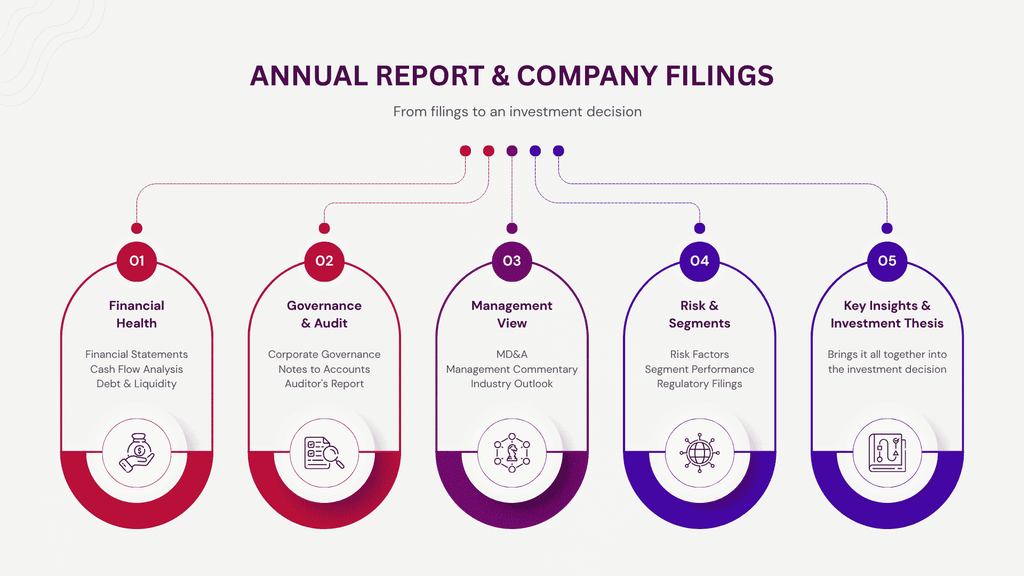
Financial statements remain the foundation of every equity research report.
Analysts review:
Income Statement
To evaluate:
- Revenue growth
- EBITDA
- Operating income
- Net income
- Earnings Per Share (EPS)
Balance Sheet
To understand:
- Cash reserves
- Debt levels
- Assets
- Liabilities
- Shareholders’ equity
Cash Flow Statement
To determine:
- Operating cash flow
- Investing activities
- Financing activities
- Free cash flow
Rather than analysing one year in isolation, analysts compare multiple reporting periods to identify long-term trends.
Notes to the financial statements
Many of the most important insights are found in the notes rather than the primary financial statements.
Analysts review disclosures relating to:
- Revenue recognition
- Debt maturity
- Lease obligations
- Contingent liabilities
- Pension obligations
- Asset impairments
- Accounting policy changes
These disclosures often explain significant changes that are not immediately visible in the headline numbers.
Risk factors
Annual reports include detailed descriptions of the risks facing the business.
Analysts assess:
- Operational risks
- Regulatory risks
- Market risks
- Currency risks
- Supply chain risks
- Cybersecurity risks
- Litigation
Understanding these risks helps analysts determine how resilient the business may be under different economic conditions.
Corporate governance
Governance quality plays an increasingly important role in institutional investing.
Analysts evaluate:
- Board independence
- Executive compensation
- Audit committee structure
- Shareholder rights
- Internal controls
- Compliance practices
Strong governance often reflects better decision-making and lower operational risk.
Capital allocation
How management deploys capital provides valuable insight into long-term strategy.
Analysts examine:
- Capital expenditure
- Research and development
- Acquisitions
- Dividends
- Share buybacks
- Debt reduction
Disciplined capital allocation often indicates management’s confidence in the business.
Segment performance
Many large companies operate across multiple business segments.
Analysts review segment disclosures to understand:
- Revenue contribution
- Profitability
- Geographic performance
- Business unit growth
- Capital allocation across segments
This helps identify which parts of the business are creating the most value.
Management guidance
Forward-looking guidance often receives as much attention as historical performance.
Analysts compare guidance with:
- Historical performance
- Industry expectations
- Analyst consensus
- Economic conditions
Consistently accurate guidance generally improves management credibility.
Auditor’s report
The independent auditor’s report provides another layer of confidence.
Analysts look for:
- Qualified opinions
- Material weaknesses
- Going concern issues
- Internal control observations
An unqualified audit opinion generally increases confidence in the reported financial statements.
Regulatory filings
Annual reports are only one part of the research process.
Analysts also review regulatory filings for information on:
- Insider transactions
- Material acquisitions
- New share issuances
- Legal proceedings
- Changes in ownership
- Major business developments
These filings often contain important information that may not receive significant attention during earnings announcements.
Comparing multiple years
Professional analysts rarely evaluate a single annual report in isolation.
Instead, they compare several years of disclosures to identify:
- Revenue trends
- Margin improvements
- Debt changes
- Capital allocation patterns
- Management consistency
- Strategic execution
Long-term comparisons often reveal trends that are difficult to identify within a single reporting period.
How AI supports annual report analysis
Large public companies can publish annual reports exceeding several hundred pages.
Research teams must also review:
- Quarterly reports
- Regulatory filings
- Earnings call transcripts
- Investor presentations
- Industry research
AI helps accelerate this process by supporting:
- Financial statement analysis
- Document summarisation
- Earnings call analysis
- Peer benchmarking
- Trend identification
- Draft research report generation
Rather than replacing analysts, AI reduces manual effort so research teams can spend more time interpreting disclosures and building investment insights.
Best practices for analysing annual reports
Professional analysts follow a structured review process.
Best practices include:
- Read the business overview before reviewing financial statements.
- Compare multiple years of annual reports.
- Review notes to the financial statements carefully.
- Evaluate management guidance against historical performance.
- Compare company disclosures with industry peers.
- Analyse both financial and qualitative information.
- Monitor regulatory filings throughout the year.
- Validate findings using multiple sources.
A disciplined approach leads to more reliable investment research and stronger investment decisions.
Conclusion
Annual reports and company filings provide far more than financial statements. They explain how a business operates, how management makes decisions, the risks facing the company, and the opportunities that could influence future performance. Professional analysts use these documents to build a comprehensive understanding of a company before developing an investment thesis.
As corporate disclosures become more detailed, AI is helping analysts review large volumes of information more efficiently. GenRPT Finance supports institutional research by using Agentic AI to automate financial statement analysis, annual report summarisation, earnings call interpretation, peer benchmarking, trend analysis, and institutional research report generation. This enables analysts to extract meaningful insights faster while maintaining the quality and depth of equity research.
FAQs
Annual reports provide detailed information about a company’s financial performance, strategy, risks, governance, and future outlook, helping analysts make informed investment decisions.
While every section is valuable, analysts pay particular attention to the Management Discussion and Analysis (MD&A), financial statements, notes to the accounts, risk disclosures, and auditor’s report.
The notes explain accounting policies, debt obligations, contingent liabilities, and other disclosures that provide context behind the reported financial numbers.
Analysts review regulatory filings to monitor significant events such as acquisitions, insider transactions, legal matters, changes in ownership, and other material business developments.
AI helps summarise lengthy reports, analyse financial statements, identify trends, compare disclosures across years, and support research report generation, allowing analysts to focus on deeper analysis.