
Business Quality Frameworks in Equity Research: A Complete Guide
July 2, 2026 | By GenRPT Finance
Business quality frameworks are structured approaches used to evaluate how strong, sustainable, and resilient a company is beyond its financial performance. They help investors assess whether a business can continue creating shareholder value by analyzing financial strength, management quality, corporate governance, competitive advantages, operational efficiency, and long-term growth potential. Rather than relying only on historical numbers, these frameworks provide a complete picture of a company’s ability to succeed under different market conditions.
A company’s financial statements explain what happened during a reporting period. They show revenue, profits, expenses, assets, liabilities, and cash flows. While these figures are essential for equity research, they do not fully explain why a business performs well, whether management consistently makes good decisions, or how prepared the company is for future challenges.
This is why institutional investors increasingly combine financial analysis with business quality assessments. Companies with similar revenue growth can produce very different shareholder returns depending on their leadership, governance, operational discipline, and competitive positioning.
According to Ocean Tomo’s Intangible Asset Market Value Study, intangible assets account for approximately 90% of the market value of companies in the S&P 500. These assets include brand value, intellectual property, customer relationships, innovation capabilities, and management quality. Most of these strengths cannot be measured through financial statements alone, making business quality frameworks an essential part of modern investment research.
What Is a Business Quality Framework?
A business quality framework is a structured model used to evaluate whether a company possesses the characteristics needed to generate sustainable long-term value. Instead of focusing on one financial metric, it combines multiple qualitative and quantitative factors into a comprehensive assessment.
Professional investors use these frameworks to answer questions such as:
- Is management allocating capital effectively?
- Does the company have durable competitive advantages?
- Can profits continue growing sustainably?
- Is governance protecting shareholder interests?
- How resilient is the business during economic downturns?
The answers influence investment strategy, Equity Valuation, and long-term portfolio construction.
Unlike traditional financial analysis, business quality frameworks recognize that successful investing depends on understanding both numbers and business fundamentals.
Why Financial Performance Alone Is Not Enough
Financial statements are historical records.
They explain how a company performed during a specific period.
Business quality explains whether those results can continue.
Consider two companies.
Both report annual revenue growth of 15%.
Both maintain similar operating margins.
Both generate healthy profits.
At first glance, they appear equally attractive.
However, deeper analysis reveals important differences.
The first company has high employee turnover, increasing customer complaints, frequent executive departures, and weak governance.
The second company demonstrates disciplined capital allocation, strong customer retention, stable leadership, continuous product innovation, and transparent reporting.
Although current financial performance looks similar, the long-term investment outlook differs significantly.
Business quality frameworks help investors identify these differences before they become visible in financial results.
The Six Pillars of Business Quality
Business quality is rarely determined by one characteristic.
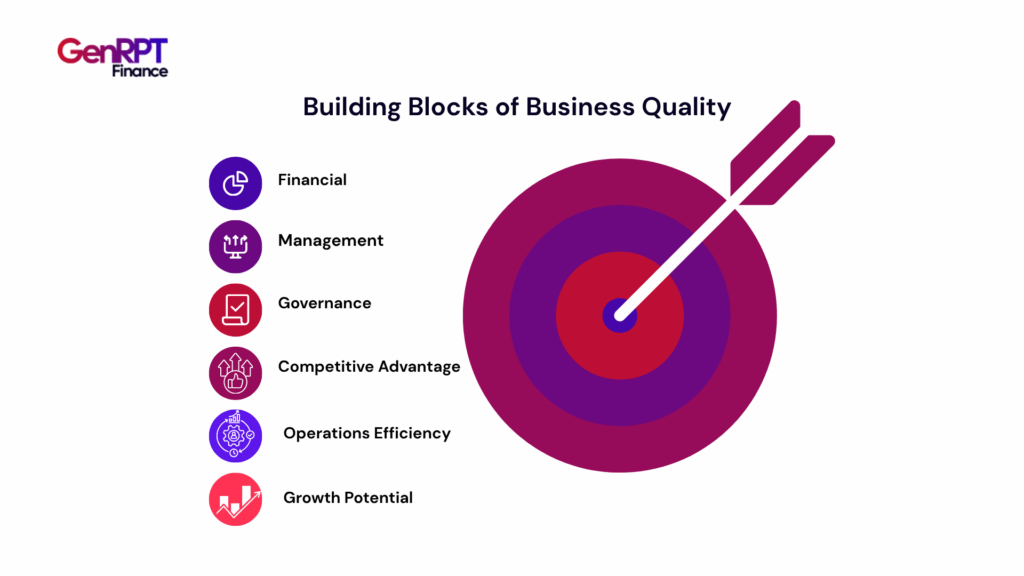
Professional investment analysts evaluate several dimensions together.
Financial Strength
Financial strength remains the starting point of every business quality assessment.
Analysts evaluate:
- Revenue growth
- Profitability Analysis
- Operating margins
- Free cash flow
- Debt levels
- Liquidity analysis
- Return on capital
Rather than reviewing these metrics individually, analysts look for consistency across multiple reporting periods.
Sustainable financial performance often indicates disciplined management and efficient operations.
Management Quality
Leadership has a significant influence on long-term business success.
Strong management teams consistently allocate capital responsibly, execute strategic initiatives effectively, and communicate transparently with shareholders.
Research teams study:
- Capital allocation decisions
- Acquisition strategy
- Leadership stability
- Strategic execution
- Investor communication
- Long-term planning
Management quality often becomes one of the strongest predictors of future performance.
Corporate Governance
Governance protects shareholder interests by ensuring accountability and effective oversight.
Analysts evaluate:
- Board independence
- Executive compensation
- Financial transparency
- Audit reports
- Shareholder rights
- Internal controls
Good governance reduces uncertainty while improving investor confidence.
It also strengthens risk assessment and supports more reliable valuation assumptions.
Competitive Advantage
High-quality businesses possess advantages that competitors struggle to replicate.
Examples include:
- Strong brands
- Pricing power
- Technology leadership
- Distribution networks
- Customer loyalty
- Intellectual property
- Market Share Analysis
Companies with durable competitive advantages generally maintain profitability for longer periods.
This supports stronger financial forecasting and long-term growth expectations.
Operational Efficiency
Operational excellence allows businesses to convert revenue into profits more efficiently.
Analysts evaluate:
- Cost management
- Asset utilization
- Productivity
- Supply chain performance
- Inventory management
- Operating margins
Efficient operations improve resilience during periods of economic uncertainty.
Growth Sustainability
Growth matters only if it can continue.
Business quality frameworks evaluate:
- Revenue projections
- Industry outlook
- Expansion strategy
- Product innovation
- Customer acquisition
- Market opportunities
These factors help analysts estimate future earnings potential beyond historical performance.
How Business Quality Supports Better Investment Decisions
Business quality frameworks improve every stage of equity research analysis.
Instead of focusing exclusively on historical performance, analysts develop a more balanced understanding of future opportunities and risks.
High-quality businesses often demonstrate:
- Stable earnings growth
- Strong governance
- Efficient capital allocation
- Competitive resilience
- Better adaptability during market disruptions
These characteristics reduce uncertainty and improve long-term investment confidence.
For portfolio managers, this translates into stronger portfolio construction and more informed capital allocation decisions.
Business Quality Improves Equity Valuation
Valuation depends on assumptions about the future.
The stronger the business quality, the greater confidence investors have in those assumptions.
High-quality companies frequently receive valuation premiums because investors expect them to generate sustainable cash flows and manage risks effectively.
Business quality influences:
- Enterprise Value
- Discount rates
- cost of capital
- Revenue projections
- Long-term profitability
- Risk premiums
As a result, business quality directly affects Financial modeling and valuation methods rather than serving only as a qualitative consideration.
Business Quality Varies Across Industries
Business quality does not look identical in every industry.
Technology companies may be evaluated based on innovation, customer retention, and product development.
Banks emphasize capital adequacy, risk controls, and governance.
Consumer businesses focus on brand strength, pricing power, and customer loyalty.
Manufacturers prioritize operational efficiency and supply chain performance.
Healthcare companies depend heavily on regulatory compliance, intellectual property, and research capabilities.
Strong business quality frameworks account for these industry differences instead of applying identical criteria to every company.
AI Is Transforming Business Quality Assessment
Evaluating business quality manually requires reviewing thousands of pages of information. Analysts examine annual reports, earnings call transcripts, investor presentations, audit reports, regulatory filings, industry publications, and market news before arriving at an investment conclusion.
As the volume of corporate disclosures continues to grow, manual analysis becomes increasingly time-consuming.
Modern ai for equity research helps solve this challenge by processing large volumes of structured and unstructured data in a fraction of the time.
Instead of reviewing every document individually, AI can extract important information, identify relationships between datasets, summarize key developments, and organize findings into a structured research workflow.
Using ai data analysis, investment teams can monitor changes in financial performance, governance, management commentary, competitive positioning, and external market conditions continuously rather than waiting for quarterly reporting cycles.
This allows analysts to spend more time interpreting insights and less time gathering information.
Connecting Financial Data With Business Context
Numbers rarely tell the complete story on their own.
A company reporting 20% revenue growth may appear attractive until analysts discover that margins are declining, customer acquisition costs are increasing, or competitors are rapidly gaining market share.
Business quality frameworks connect financial performance with broader business developments.
Research teams evaluate information from multiple sources, including:
- Financial statements
- Annual reports
- Earnings call transcripts
- Analyst reports
- Audit reports
- Regulatory filings
- Industry news
- Company announcements
- Economic indicators
Looking at these sources together creates stronger investment insights than reviewing financial metrics in isolation.
For example, improving profitability supported by stronger governance, expanding market share, disciplined capital allocation, and increasing customer retention presents a much stronger investment case than profitability alone.
Similarly, slowing revenue growth may be less concerning if management continues investing in innovation while maintaining a strong balance sheet and healthy cash flow.
Business quality frameworks help analysts understand these relationships instead of focusing on isolated metrics.
How Business Quality Frameworks Strengthen Portfolio Construction
Business quality does not only influence individual stock selection.
It also improves overall portfolio construction.
Professional investors aim to build portfolios that balance growth opportunities with manageable risk.
Business quality frameworks support this process by identifying companies that consistently demonstrate operational discipline, financial resilience, and strong leadership.
These insights contribute to better:
- Portfolio diversification
- Capital allocation
- Long-term investment strategy
- Portfolio risk analysis
- Financial risk assessment
- Risk mitigation
Instead of selecting companies based solely on recent performance, investors gain a broader understanding of which businesses are positioned to create value throughout different market cycles.
This approach supports more resilient portfolios over the long term.
Common Mistakes Investors Make When Assessing Business Quality
Even experienced investors can overlook important aspects of business quality.
One common mistake is placing too much emphasis on revenue growth while ignoring how efficiently that growth is generated.
Another is focusing entirely on profitability without evaluating governance, leadership quality, or capital allocation.
Some investors also rely heavily on short-term earnings surprises while overlooking long-term competitive advantages.
Others underestimate operational risks simply because financial statements appear strong.
Professional analysts avoid these mistakes by evaluating companies across multiple dimensions rather than relying on a single indicator.
Business quality frameworks encourage balanced decision-making by considering financial performance alongside qualitative factors that influence future business success.
Why Business Quality Matters More During Market Uncertainty
Periods of market volatility often reveal the difference between strong businesses and average ones.
Companies with disciplined leadership, healthy balance sheets, efficient operations, and sound governance generally adapt more effectively to economic challenges.
They often maintain profitability, continue investing in growth opportunities, and preserve investor confidence even during uncertain conditions.
Businesses with weaker foundations may struggle with declining cash flow, poor capital allocation, or operational disruptions.
Business quality frameworks help investors identify these differences before they become obvious in financial performance.
This makes them particularly valuable during changing economic conditions and shifting market trends.
Conclusion
Business quality frameworks help investors move beyond financial statements and understand the underlying characteristics that drive long-term business success. By evaluating financial strength, management quality, corporate governance, competitive advantages, operational efficiency, and growth sustainability together, analysts develop a more complete picture of a company’s ability to create shareholder value.
As businesses generate increasing amounts of financial and non-financial data, AI has become an important part of modern investment research. Platforms like GenRPT Finance combine structured financial information with annual reports, earnings calls, audit reports, regulatory filings, and market intelligence to evaluate business quality at scale. Powered by Yodaplus Agentic AI services, GenRPT Finance enables investment teams to automate research workflows, uncover deeper investment insights, and produce comprehensive equity research reports with greater speed, consistency, and analytical depth.
FAQs
A business quality framework is a structured approach used to evaluate a company’s financial strength, management quality, governance, competitive advantages, operational efficiency, and long-term growth potential to support investment decisions.
They provide a broader assessment of a company’s long-term sustainability by combining financial analysis with qualitative factors such as leadership, governance, and competitive positioning.
They help investors identify companies with durable competitive advantages, stronger leadership, healthier financial positions, and greater resilience during changing market conditions.
Yes. AI can analyze financial statements, annual reports, earnings calls, audit reports, regulatory filings, and market news to identify patterns, summarize insights, and support more efficient business quality assessments.
GenRPT Finance automates the analysis of financial and non-financial data, combining governance, financial performance, market intelligence, and competitive analysis into comprehensive equity research reports that help investment professionals evaluate business quality more effectively.
