
Equity Analysis of Revenue Quality in Platform Businesses
May 18, 2026 | By GenRPT Finance
Platform businesses often report fast revenue growth, but equity analysis today focuses more on revenue quality than raw top-line numbers. Investors, asset managers, and portfolio managers are now examining whether platform revenue is recurring, scalable, profitable, and resilient during market volatility. This shift is changing how equity research, investment research, and equity research reports are prepared across technology, fintech, ecommerce, media, and digital infrastructure sectors.
According to Bain & Company, more than 70% of high-performing digital platforms generate a large share of their revenue through recurring ecosystem activity rather than one-time transactions. This matters because stable and diversified revenue streams often lead to better equity valuation, stronger financial forecasting, and lower equity risk.
Why Revenue Quality Matters in Equity Analysis
Revenue quality refers to how sustainable, predictable, and profitable a company’s revenue stream is over time. In platform businesses, analysts are no longer impressed only by gross merchandise value or user growth. They want to know:
- Is the revenue recurring?
- Are margins improving?
- Is customer retention stable?
- Can the business scale profitably?
- How dependent is revenue on subsidies or promotions?
This is now central to equity analysis and investment insights across global equity markets.
Platform businesses can grow quickly through network effects, but poor monetization quality may eventually weaken enterprise value and long-term equity performance.
Key Revenue Quality Metrics Analysts Track
Modern equity research reports use a combination of financial accounting metrics, ecosystem indicators, and ai for data analysis tools to evaluate revenue strength.
Recurring Revenue Stability
Recurring revenue is considered higher quality because it improves predictability. Subscription fees, platform memberships, cloud services, and transaction-based recurring usage often support better financial forecasting.
Investment analysts usually examine:
- Subscription renewal rates
- Active customer retention
- Revenue churn
- User engagement consistency
This helps wealth managers and financial advisors assess long-term business durability.
Diversification of Revenue Streams
Strong platform businesses avoid dependence on a single revenue source.
For example, Amazon generates revenue through:
- Ecommerce commissions
- AWS cloud services
- Advertising
- Prime subscriptions
- Logistics services
Diversified revenue improves financial risk mitigation because weakness in one segment may be offset by strength in another.
Equity research automation systems increasingly track segment-level profitability analysis for this reason.
Gross Margins and Operating Leverage
Platform businesses often achieve higher operating leverage than pipeline businesses once ecosystems mature.
Analysts monitor:
- Gross margin expansion
- Contribution margin trends
- Customer acquisition efficiency
- Incremental operating costs
Companies with scalable ecosystems usually improve profitability faster as user growth increases.
This is an important factor in equity valuation and investment strategy planning.
The Difference Between High Revenue and High-Quality Revenue
Not all revenue growth creates shareholder value.
Some platform companies aggressively subsidize users through discounts, incentives, or marketing campaigns. Revenue may grow rapidly while profitability remains weak.
This is where risk analysis and financial risk assessment become critical.
Analysts often use sensitivity analysis and scenario analysis to test:
- Revenue sustainability
- Margin resilience
- User retention under weaker demand conditions
- Pricing power
A company generating stable recurring revenue with moderate growth may deserve a higher valuation than one growing rapidly with unstable economics.
How AI Improves Revenue Quality Analysis
The rise of ai for equity research is helping analysts evaluate platform businesses more efficiently.
Traditional financial reports may not fully capture ecosystem health. Modern ai report generator and ai data analysis systems can process:
- User reviews
- Merchant activity
- App engagement
- Customer complaints
- Subscription trends
- Earnings call sentiment
This improves portfolio insights and helps financial data analyst teams detect operational weakness earlier.
Equity research software now combines alternative data with traditional fundamental analysis to provide deeper visibility into revenue durability.
Revenue Quality and Market Sentiment Analysis
Market sentiment analysis often changes quickly when investors lose confidence in revenue quality.
A platform company reporting high growth may still see declining stock performance if:
- Customer churn rises
- Profitability weakens
- Monetization slows
- Regulatory risks increase
For example, many delivery and mobility platforms experienced valuation pressure when markets questioned their long-term profitability models despite strong revenue growth.
This demonstrates why investment research today focuses heavily on cash flow quality and financial transparency.
Geographic Exposure and Revenue Risk
Geographic exposure also affects revenue quality.
Platform businesses operating across multiple regions may face:
- Currency fluctuations
- Regulatory changes
- Economic slowdowns
- Different monetization rates
Emerging markets analysis has become increasingly important because user growth in developing economies does not always translate into strong profitability.
Equity research reports now separate:
- High-growth but low-monetization regions
- Mature high-margin markets
- Regulation-sensitive geographies
This supports more accurate market risk analysis and financial modeling.
Revenue Concentration Risk
Another major concern in equity analysis is concentration risk.
Some platforms depend heavily on:
- A few large enterprise customers
- Specific advertisers
- Key merchants
- Limited geographic markets
High concentration increases equity risk during economic disruptions.
Investment banking teams and portfolio managers increasingly evaluate how diversified customer bases affect enterprise value stability.
Why Revenue Quality Impacts Valuation Multiples
Markets often reward companies with strong revenue quality through premium valuation methods.
Businesses with:
- Recurring revenue
- Strong retention
- Diversified monetization
- Healthy margins
- Stable cash flow
usually trade at higher EV/Revenue and EV/EBITDA multiples.
For example, SaaS platforms with predictable subscription revenue frequently command significantly higher valuations than advertising-dependent businesses with volatile cash flow.
This directly influences equity market outlook discussions among wealth advisors and financial consultants.
The Role of Audit Reports and Financial Transparency
Audit reports and financial transparency are becoming more important in platform equity analysis.
Investors now pay closer attention to:
- Revenue recognition policies
- Deferred revenue accounting
- Customer acquisition cost reporting
- Segment disclosures
- Profitability allocation
Concerns around aggressive accounting practices can quickly damage market confidence.
This is why strong governance and transparent financial reporting remain critical in investment research workflows.
Revenue Quality in Different Platform Categories
Revenue quality varies significantly across platform types.
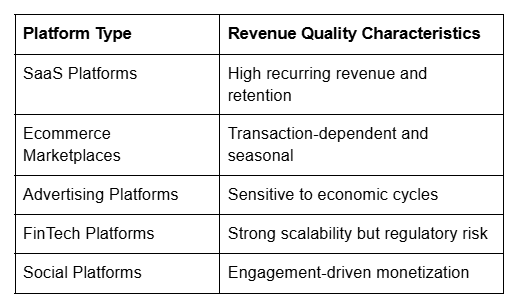
This is why equity analysis cannot apply the same valuation methods across all platform businesses.
FAQs
What is revenue quality in equity research?
Revenue quality measures how sustainable, profitable, predictable, and diversified a company’s revenue streams are over time.
Why do analysts focus on recurring revenue?
Recurring revenue improves predictability, cash flow visibility, and long-term financial forecasting accuracy.
How does AI help analyze revenue quality?
AI tools process large datasets such as customer activity, sentiment, engagement, and operational trends to improve equity research automation.
Why is geographic exposure important?
Different regions may have varying profitability, regulation, and growth conditions, which affect long-term revenue sustainability.
Can high revenue growth still be risky?
Yes. Rapid growth supported by subsidies, weak margins, or poor retention may create financial risk despite strong headline revenue.
Conclusion
Revenue quality has become one of the most important themes in modern equity research and investment research. Investors are moving beyond surface-level growth metrics and focusing more on recurring revenue strength, profitability analysis, customer retention, diversification, and financial transparency.
As ai for data analysis, equity research automation, and ai for equity research continue evolving, analysts can evaluate revenue sustainability with greater depth and speed. Asset managers, portfolio managers, wealth advisors, and investment analysts increasingly rely on advanced financial research tool platforms to understand long-term business durability.
GenRPT Finance helps organizations generate deeper equity analysis, faster equity research reports, and scalable investment insights using AI-powered financial intelligence workflows.
