
Equity Research on Growth Companies Turning Profitable
May 15, 2026 | By GenRPT Finance
Growth companies are a major driver of long-term wealth creation in equity markets. Many of these companies prioritize scaling revenue, building market share, and investing heavily in future capabilities before focusing on profits. However, the inflection point where a growth company becomes profitable is often when long-term value truly unlocks. Investors are increasingly conducting deep equity research to identify companies approaching or achieving this critical transition.
The shift from growth-at-all-costs to sustainable profitability has become one of the most important themes in modern investing, especially after rising interest rates and tighter capital markets forced investors to focus more on financial discipline.
Why Profitability Inflection Matters
When a growth company transitions from high investment mode to positive profitability, it often leads to stronger cash flows, higher investor confidence, and valuation expansion.
According to a BCG study, companies that achieve profitability while maintaining strong revenue growth tend to outperform peers significantly over multi-year periods.
This transition usually signals:
Operational maturity
The business model becomes more efficient at scale.
Stronger market positioning
The company gains pricing power and customer loyalty.
Better capital efficiency
Growth becomes less dependent on external funding.
Long-term sustainability
The company can reinvest profits into future expansion.
This makes profitability transitions an important focus area in modern investment research.
Why Markets Reward Profitable Growth
Markets increasingly favor companies that combine revenue growth with improving margins.
During low-interest-rate environments, investors often prioritize expansion over profitability. However, in tighter economic conditions, companies with sustainable earnings growth receive stronger investor support.
Research shows that profitable growth companies often experience:
- Higher valuation multiples
- Stronger institutional participation
- Lower cost of capital
- Better resilience during economic slowdowns
- Improved long-term equity performance
This shift has changed how equity analysis frameworks evaluate high-growth businesses.
Key Financial Signals Investors Monitor
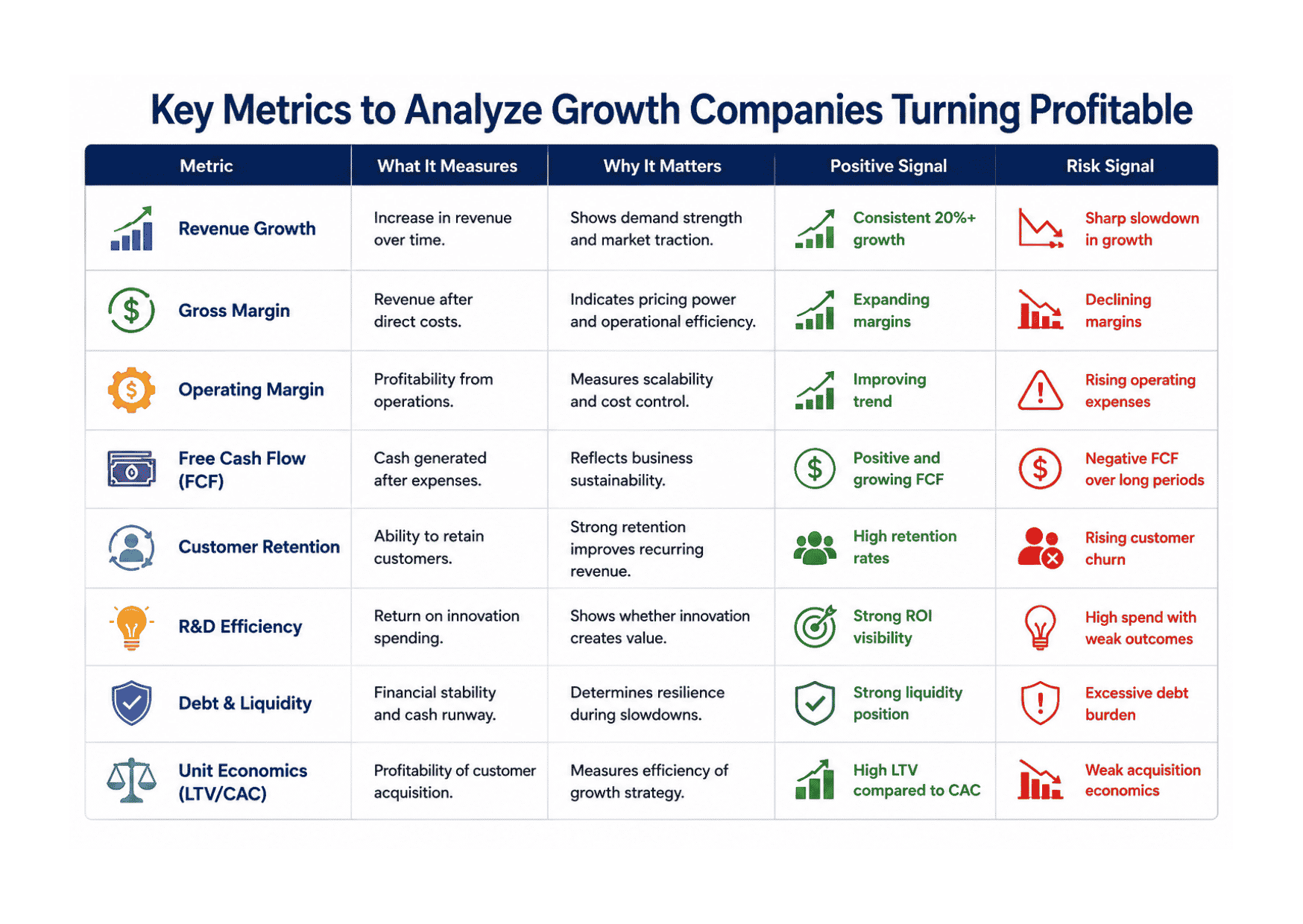
Investors analyze several indicators to determine whether a growth company is approaching sustainable profitability.
Gross-margin expansion
Improving margins suggest operational leverage and pricing power.
Operating-margin improvement
Higher operating margins often indicate scalable business efficiency.
Free-cash-flow trends
Positive cash flow is a major profitability milestone.
Revenue growth quality
Sustainable growth with strong retention rates matters more than temporary expansion.
Customer acquisition efficiency
Lower acquisition costs improve long-term profitability potential.
R&D efficiency
Innovation spending should generate measurable commercial value.
Strong equity research reports increasingly combine these metrics with industry benchmarking and long-term forecasting models.
The Role of AI in Identifying Profitability Transitions
Modern ai for equity research systems are helping firms detect profitability shifts faster than traditional analyst workflows.
AI platforms now support:
- Earnings-transcript analysis
- Margin trend monitoring
- Cost-structure analysis
- Financial forecasting
- Competitive benchmarking
- Market sentiment analysis
According to Deloitte, AI-driven financial-analysis systems can improve analyst productivity by nearly 40%.
This growth in equity research automation helps investors track thousands of growth companies more efficiently.
Industries Leading the Profitable Growth Shift
Several industries are currently experiencing large-scale transitions toward sustainable profitability.
Software and AI
Many software firms are shifting focus toward operational efficiency after years of aggressive expansion.
FinTech
Digital-payment and financial-platform companies are increasingly prioritizing profitability and cash generation.
E-commerce
Retail technology companies are optimizing logistics and customer-acquisition costs.
Healthcare Technology
Health-tech firms are improving monetization and scaling recurring revenue models.
Renewable Energy
Clean-energy firms are benefiting from long-term infrastructure demand and policy support.
Strong financial reports increasingly emphasize profitability metrics alongside growth rates in these sectors.
Why Some Growth Companies Fail to Become Profitable
Not every high-growth company successfully transitions into profitability.
Several challenges often emerge:
Weak unit economics
Revenue growth may not cover long-term operating costs.
Excessive customer-acquisition spending
Marketing expenses can become unsustainable.
Competitive pricing pressure
Intense competition may reduce margins.
Operational inefficiencies
Rapid scaling can create cost-management problems.
Overdependence on external funding
Companies relying heavily on capital markets may struggle during tightening financial conditions.
This is why strong risk analysis remains critical in evaluating growth companies.
Geographic Differences in Growth-Company Valuation
Profitability expectations differ across global markets.
US growth companies often receive premium valuations because investors expect stronger scalability and innovation capacity. Meanwhile, many emerging-market growth firms remain undercovered despite strong operational performance.
This creates valuation inefficiencies across the global equity market.
Investors increasingly analyze geographic exposure because several emerging economies are producing profitable technology and digital-platform companies at a rapid pace.
Regions showing strong profitable-growth trends include:
- India
- Southeast Asia
- Latin America
- Middle East fintech markets
- African digital-payment ecosystems
These markets are attracting increasing institutional attention.
How AI Improves Financial Forecasting
Modern ai for data analysis systems improve profitability forecasting by analyzing both structured and unstructured financial information.
AI-driven systems now evaluate:
- Earnings-call language patterns
- Expense trends
- Hiring activity
- Customer-retention metrics
- Pricing changes
- Product-expansion signals
This improves the speed and quality of global financial research.
Advanced systems can also identify early operational improvements before they become fully reflected in quarterly earnings results.
Why Long-Term Investors Focus on Profitable Growth
Long-term investors increasingly prioritize businesses capable of generating durable profitability rather than short-term revenue acceleration alone.
Profitable growth companies often show:
Stronger cash-flow resilience
Positive cash generation improves stability.
Better reinvestment capability
Profits support future expansion without excessive dilution.
Reduced financial risk
Lower funding dependence improves flexibility.
Sustainable competitive advantage
Operational efficiency strengthens market positioning.
This improves long-term investment insights and portfolio construction strategies.
Challenges in Valuing Growth Companies
Growth-company valuation remains difficult because future profitability assumptions depend heavily on execution quality and market conditions.
Revenue predictability
Fast-growing sectors can experience sudden demand changes.
Margin sustainability
Scaling businesses may face rising operational costs.
Macroeconomic exposure
Interest rates strongly affect growth-company valuations.
Market sentiment volatility
Investor enthusiasm can shift rapidly.
Innovation risk
Technology disruption may affect long-term competitiveness.
Because of this, strong portfolio risk assessment frameworks are essential when evaluating high-growth businesses.
The Future of Profitability-Focused Equity Research
The next decade will likely favor companies that combine innovation, operational discipline, and scalable business models.
Several trends are driving this shift:
- AI-driven operational efficiency
- Automation expansion
- Subscription-based business models
- Data-driven customer retention
- Improved financial transparency
- Scalable cloud infrastructure
As capital markets become more selective, investors will increasingly depend on advanced equity analysis frameworks to identify businesses capable of generating sustainable profitable growth.
Conclusion
Growth companies turning profitable often deliver some of the strongest long-term investment opportunities in financial markets. The key challenge for investors is identifying businesses that can scale efficiently while maintaining operational discipline and sustainable competitive advantages.
AI-powered analytics, scalable research systems, and advanced financial intelligence platforms are helping firms improve profitability-focused investment analysis across industries and global markets. Strong equity research focused on operational efficiency, margin expansion, and long-term scalability will remain essential for identifying future market leaders.
Platforms like GenRPT Finance are helping organizations improve profitable-growth investment intelligence through AI-powered reporting, scalable analytics, and faster research workflows.
FAQs
Why is profitability transition important for growth companies?
It signals stronger operational maturity, sustainable business models, and long-term financial stability.
How does AI improve profitability-focused equity research?
AI automates margin analysis, financial forecasting, transcript monitoring, and operational trend detection.
Why do markets reward profitable growth?
Profitable companies are viewed as lower-risk and more sustainable during uncertain economic conditions.
What risks exist in growth-company investing?
Weak unit economics, rising competition, operational inefficiencies, and valuation volatility are major risks.
Which industries are leading profitable-growth trends?
Software, fintech, healthcare technology, renewable energy, and digital-commerce sectors are leading this shift.
