
How Analysts Evaluate Corporate Governance as an Investment Signal
July 2, 2026 | By GenRPT Finance
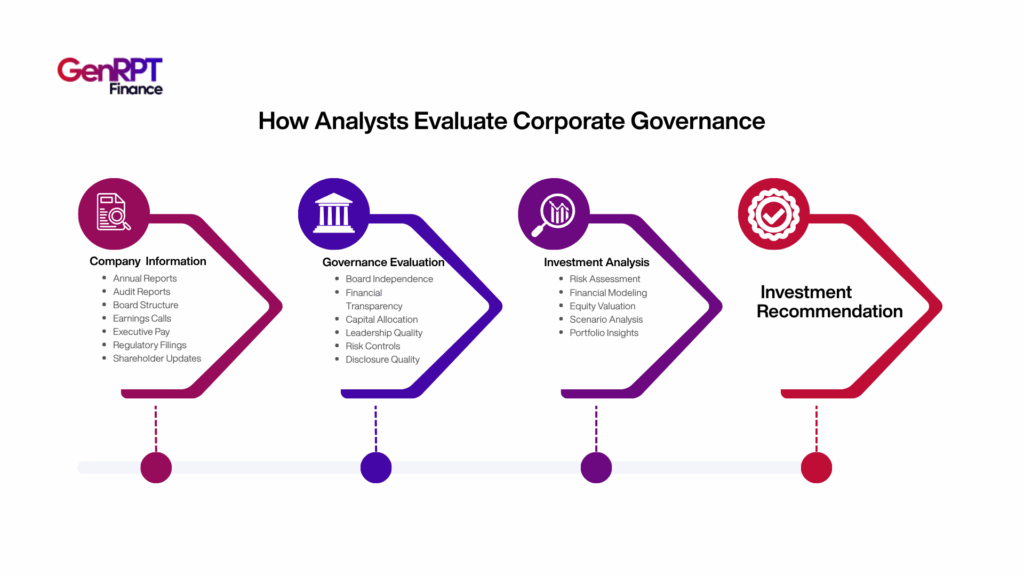
Analysts evaluate corporate governance as an investment signal by examining how a company is led, how decisions are made, how risks are managed, and how accountable management is to shareholders. Rather than treating governance as a compliance exercise, they assess whether the company’s leadership and oversight support sustainable growth, responsible capital allocation, and long-term shareholder value.
A company can report strong revenue growth, healthy margins, and increasing profits while still carrying governance risks that may affect future performance. Weak board oversight, poor financial transparency, aggressive executive incentives, or ineffective internal controls can introduce risks that financial statements alone may not reveal.
This is why governance has become an important part of equity research, fundamental analysis, risk assessment, and Equity Valuation. Professional research teams combine governance analysis with financial performance to develop a more complete understanding of a company’s investment potential.
According to PwC’s Global Investor Survey, nearly 75% of institutional investors believe governance plays a significant role in investment decision-making. Similarly, research from McKinsey has shown that investors often place higher valuations on companies with strong governance practices and effective leadership.
Governance Is Evaluated Alongside Financial Performance
Analysts rarely evaluate governance separately from business performance.
Instead, governance is integrated into broader investment research.
Financial statements explain how a company has performed.
Governance explains whether the people responsible for those results are making decisions that support long-term value creation.
A company with consistent earnings growth, transparent communication, and disciplined capital allocation often receives greater investor confidence than one delivering similar financial performance with governance concerns.
This combination improves investment insights while supporting stronger investment strategy recommendations.
Board Structure Is One of the First Areas Reviewed
The board of directors plays a central role in corporate governance.
Analysts evaluate whether the board has the independence and expertise needed to oversee management effectively.
Areas commonly reviewed include:
- Board independence
- Industry experience
- Diversity of expertise
- Committee structure
- Attendance records
- Separation of CEO and Chairperson roles
An independent and experienced board generally strengthens investor confidence by improving oversight and reducing conflicts of interest.
Executive Compensation Reveals Management Priorities
Executive compensation shows what management is rewarded for achieving.
If bonuses depend mainly on short-term earnings, executives may prioritize quarterly performance over sustainable value creation.
Analysts evaluate whether compensation is linked to:
- Long-term shareholder returns
- Revenue quality
- Profitability
- Return on capital
- Strategic milestones
- Risk management
Well-designed incentive structures encourage responsible decision-making and support long-term business performance.
Financial Transparency Builds Investor Confidence
Transparent companies make it easier for investors to evaluate business performance.
Research teams carefully review:
- Annual reports
- Quarterly financial reports
- Audit reports
- Investor presentations
- Earnings call transcripts
- Regulatory disclosures
Clear disclosures reduce uncertainty and improve financial forecasting.
Analysts also monitor changes in accounting policies, reporting consistency, and disclosure quality over multiple reporting periods.
Strong financial transparency strengthens both equity research analysis and investor confidence.
Capital Allocation Demonstrates Leadership Quality
One of the clearest signs of strong management is disciplined capital allocation.
Analysts evaluate how companies use available capital.
Important questions include:
- Are acquisitions creating value?
- Is debt being managed responsibly?
- Does the company invest efficiently?
- Are dividends sustainable?
- Is excess cash allocated effectively?
These decisions directly influence Enterprise Value, long-term profitability, and shareholder returns.
Capital allocation also supports more accurate Financial modeling and valuation methods.
Analysts Monitor Governance Risks Continuously
Governance is not evaluated only during annual reporting seasons.
Investment teams continuously monitor governance developments.
Important events include:
- Executive departures
- Board changes
- Auditor resignations
- Regulatory investigations
- Insider transactions
- Shareholder disputes
- Legal proceedings
These developments often influence future equity risk before they appear in financial performance.
Continuous monitoring strengthens portfolio risk analysis and broader financial risk assessment.
Governance Is Combined With Market and Industry Analysis
Governance becomes even more valuable when viewed alongside external market conditions.
Analysts combine governance with:
- Market Share Analysis
- Industry competition
- Market Sentiment Analysis
- macroeconomic outlook
- market trends
- geographic exposure
- Regulatory developments
For example, companies with disciplined governance may respond more effectively during economic slowdowns, regulatory changes, or periods of market volatility.
This broader perspective improves Scenario Analysis and long-term investment planning.
AI Is Transforming Governance Evaluation
Governance analysis traditionally required reviewing thousands of pages of documents.
Research teams manually analyzed annual reports, board disclosures, earnings calls, audit reports, and regulatory filings.
Modern ai for equity research automates much of this process.
Using ai data analysis, platforms can identify:
- Governance changes
- Executive appointments
- Board restructuring
- Regulatory actions
- Disclosure updates
- Audit observations
An ai report generator organizes these findings into structured sections within an equity research report, allowing analysts to focus on interpretation instead of manual document review.
This improves efficiency while maintaining research quality.
Governance Strengthens Portfolio Decisions
Corporate governance is valuable because it improves investment decisions across entire portfolios.
Strong governance supports:
- Better diversification decisions
- Lower portfolio risk
- Higher confidence in valuation
- More reliable portfolio insights
- Improved long-term investment performance
Rather than relying solely on historical financial performance, investors gain a clearer understanding of how management quality may influence future business outcomes.
Conclusion
Corporate governance has become an essential investment signal because it provides insight into leadership quality, transparency, accountability, and long-term decision-making. Analysts use governance alongside financial performance to evaluate business resilience, identify hidden risks, and build stronger investment recommendations. Companies with effective governance often inspire greater investor confidence and support more reliable long-term value creation.
GenRPT Finance simplifies governance analysis by bringing together annual reports, audit reports, earnings calls, regulatory filings, market intelligence, and financial data into a single AI-powered research workflow. Combined with Yodaplus Agentic AI services, it enables investment professionals to automate governance evaluation, improve research consistency, and generate comprehensive equity research reports with greater speed and accuracy.
FAQs
Analysts examine board independence, executive compensation, financial transparency, audit quality, capital allocation, shareholder rights, regulatory compliance, and leadership effectiveness to assess governance quality.
Corporate governance helps analysts understand management quality and identify risks that financial statements alone may not reveal, leading to more informed investment decisions.
Strong governance can reduce perceived investment risk, improve investor confidence, and support higher valuation multiples by lowering uncertainty around future business performance.
Analysts review annual reports, audit reports, proxy statements, earnings call transcripts, regulatory filings, investor presentations, and corporate governance disclosures.
Yes. AI can analyze large volumes of governance-related information, detect important developments, summarize findings, and support faster, more consistent equity research.
Investment analysts, portfolio managers, asset managers, wealth managers, financial advisors, family offices, and institutional investors all use governance analysis to improve investment research and portfolio decision-making.
