
How Geographic Exposure Impacts Equity Research and Strategy
October 16, 2025 | By GenRPT Finance
Geographic exposure refers to the countries and regions where a company earns revenue, operates facilities, sources raw materials, or serves customers. It shapes equity research by helping analysts understand how economic conditions, regulations, currencies, and geopolitical events across different markets can influence business performance. Rather than simply identifying where a company is headquartered, analysts evaluate its entire global footprint to estimate future growth opportunities and potential risks.
Businesses have become increasingly international over the last two decades. A technology company based in the United States may manufacture products in Asia, generate most of its sales in Europe, and source components from multiple countries. Similarly, a consumer goods company may rely heavily on emerging markets for revenue while maintaining production facilities elsewhere. Looking only at financial statements does not reveal these complexities.
According to S&P Global, companies in the S&P 500 generate roughly 40% of their total revenue outside the United States. This demonstrates why geographic exposure has become an important factor in investment research, Equity Valuation, and portfolio risk analysis. Investors increasingly want to understand not only how much a company earns, but also where those earnings come from and how regional events may affect future performance.
Geographic Exposure Is More Than Revenue Distribution
Many investors assume geographic exposure simply refers to revenue generated in different countries.
In reality, analysts evaluate several layers of exposure.
These include:
- Revenue by region
- Manufacturing locations
- Supply chain dependencies
- Customer concentration
- Distribution networks
- Research and development centers
- Regulatory environments
For example, a company may generate only 20% of its revenue from Asia but depend on the region for nearly all of its manufacturing capacity. Any disruption affecting production could influence global operations even if sales remain diversified.
Understanding these relationships provides deeper investment insights than revenue analysis alone.
Why Geographic Exposure Matters to Investors
Different regions create different opportunities.
They also introduce different risks.
Countries experience varying levels of economic growth, inflation, consumer demand, taxation, regulation, political stability, and currency movements.
A company with strong exposure to rapidly growing economies may benefit from expanding demand and rising consumer spending.
At the same time, businesses operating across multiple jurisdictions face challenges such as:
- Currency fluctuations
- Regulatory changes
- Trade restrictions
- Political uncertainty
- Supply chain disruptions
- Local competition
These factors influence earnings, profitability, and long-term growth.
This is why professional investment analysts, portfolio managers, and asset managers include geographic exposure within broader risk assessment and fundamental analysis.
Revenue Geography and Operational Geography Are Different
One of the most common mistakes investors make is assuming revenue exposure tells the complete story.
Analysts distinguish between where a company earns money and where it operates.
Consider a multinational manufacturer.
Its largest customer base may be in North America.
However, its factories could be located in Southeast Asia, while key raw materials are sourced from South America.
If shipping routes become disrupted or regional regulations change, production costs may rise even though customer demand remains strong.
Separating revenue geography from operational geography allows analysts to identify risks that are not immediately visible in financial statements.
This strengthens equity research analysis and produces more realistic long-term forecasts.
The Key Areas Analysts Evaluate
Geographic exposure influences almost every part of company analysis.
Research teams typically evaluate several important areas before forming an investment opinion.
Revenue Concentration
Companies generating most of their revenue from one country may face greater economic concentration risk than businesses with diversified customer bases.
Analysts examine how revenue is distributed across regions and whether growth depends too heavily on a single market.
Supply Chain Exposure
Modern businesses rely on global supply chains.
Analysts evaluate manufacturing locations, supplier concentration, transportation routes, and sourcing strategies to understand operational resilience.
Supply chain diversification often becomes a competitive advantage during periods of market disruption.
Currency Exposure
Foreign exchange movements can significantly affect reported earnings.
Businesses earning revenue in multiple currencies must manage exchange-rate fluctuations carefully.
Analysts incorporate these risks into financial forecasting, valuation assumptions, and long-term profitability estimates.
Regulatory and Geopolitical Exposure
Every country has its own regulatory environment.
Tax policies, environmental regulations, labour laws, trade agreements, and reporting requirements can all influence business performance.
Analysts monitor regulatory developments because they directly affect operating costs, profitability, and expansion plans.
Geopolitical events can have an even greater impact.
Trade disputes, sanctions, armed conflicts, elections, and changes in government policy may disrupt supply chains, restrict market access, or increase business costs.
Recent examples include the US-China trade tensions, the Russia-Ukraine conflict, and disruptions in the Red Sea shipping route. Each of these events affected companies across industries by increasing logistics costs, delaying deliveries, or changing sourcing strategies.
Understanding geopolitical factors allows analysts to estimate how regional events may influence future earnings and market risk analysis.
Geographic Exposure Influences Equity Valuation
Geographic exposure directly affects how analysts value companies.
Businesses operating in stable, high-growth markets often receive stronger growth assumptions than companies heavily exposed to regions facing economic or political uncertainty.
When building Financial modeling and Scenario Analysis, analysts adjust assumptions based on regional conditions.
These include:
- Revenue projections
- Cost inflation
- Currency movements
- Tax rates
- Capital expenditure
- Consumer demand
- Regional economic growth
For example, if a retailer plans major expansion into fast-growing Southeast Asian markets, analysts may increase long-term revenue assumptions. On the other hand, if a company depends heavily on regions experiencing economic slowdown or political instability, higher risk premiums may be applied.
Geographic exposure therefore influences Equity Valuation, cost of capital, and long-term investment expectations.
Real-World Examples of Geographic Exposure
Geographic exposure becomes especially important when global events affect business operations.
Apple generates significant revenue from international markets while relying heavily on Asian manufacturing partners. Changes in trade policy, production capacity, or consumer demand across these regions can influence both revenue growth and operating costs.
Similarly, Toyota operates manufacturing facilities across multiple countries while selling vehicles globally. Its diversified production footprint allows the company to reduce dependence on any single manufacturing location, improving operational resilience.
Companies operating across multiple regions often benefit from diversified revenue streams. However, they must also manage more complex regulatory requirements, currency exposure, and geopolitical risks.
These examples show why analysts evaluate both the opportunities and the challenges associated with international operations.
AI Makes Geographic Exposure Analysis More Efficient
Tracking geographic exposure manually requires reviewing large amounts of information across multiple sources.
Analysts study annual reports, earnings calls, investor presentations, regulatory filings, trade developments, and macroeconomic data to understand where a company operates and how regional events may affect performance.
Modern ai for equity research simplifies this process.
Using ai data analysis, research platforms automatically identify:
- Regional revenue distribution
- Manufacturing locations
- Supply chain dependencies
- Country-specific regulatory developments
- Currency exposure
- Geopolitical developments
Instead of manually connecting these data points, AI organizes them into structured insights that support equity research reports.
An ai report generator also combines geographic analysis with financial performance, governance, competitive positioning, and market intelligence, helping analysts develop more comprehensive investment recommendations.
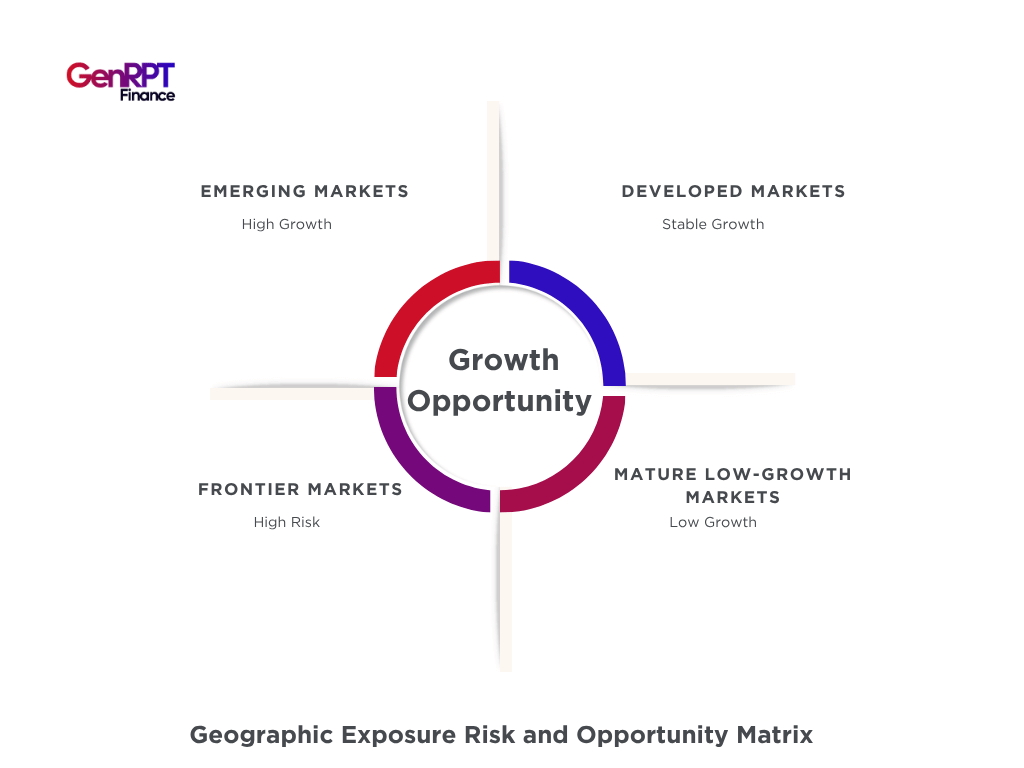
High Growth
- Expanding consumer demand
- Urbanisation
- Infrastructure investment
High Risk
- Political instability
- Currency volatility
- Trade restrictions
Low Risk
- Stable regulations
- Mature economies
- Predictable demand
Use small country or globe icons in each quadrant rather than company logos to keep the graphic evergreen.
Conclusion
Geographic exposure has become an essential part of modern equity research because it helps investors understand how regional opportunities and risks influence long-term business performance. Revenue sources, manufacturing locations, supply chains, regulatory environments, and geopolitical developments all shape a company’s future earnings potential. Looking beyond financial statements enables analysts to build stronger valuation models, improve portfolio risk analysis, and make more informed investment decisions.
GenRPT Finance simplifies geographic exposure analysis by combining financial statements, annual reports, earnings calls, regulatory filings, macroeconomic data, and market intelligence into comprehensive research reports. Powered by Yodaplus Agentic AI services, the platform helps investment teams identify regional risks, evaluate global opportunities, and generate deeper investment insights with greater speed and consistency.
FAQs
Geographic exposure refers to the countries and regions where a company earns revenue, operates facilities, sources materials, or serves customers. Analysts evaluate this information to understand how regional factors influence business performance and investment risk.
It helps investors identify opportunities for growth while understanding risks related to economic conditions, currency movements, regulations, supply chains, and geopolitical events across different regions.
Geographic exposure influences revenue growth assumptions, risk premiums, cost of capital, and long-term cash flow projections, making it an important input in Equity Valuation.
Revenue exposure refers to where a company generates sales, while operational exposure focuses on where it manufactures products, sources materials, and manages its supply chain. Both influence investment decisions in different ways.
AI analyzes financial reports, earnings calls, regulatory filings, news, and macroeconomic data to identify regional trends, monitor geopolitical developments, and generate structured insights for investment research.
Technology, automotive, manufacturing, consumer goods, energy, pharmaceuticals, and logistics are among the industries most influenced by geographic exposure because they operate across multiple countries and depend on global supply chains.
