
Investment Research on Franchise Network Valuation Risks
May 18, 2026 | By GenRPT Finance
Franchise networks are often viewed as stable, scalable, and highly profitable business models, but they also carry important valuation risks that investors increasingly monitor in modern investment research. While franchise systems benefit from recurring royalty revenue, asset-light operations, and strong brand recognition, weak franchisee economics, overexpansion, operational inconsistency, and changing consumer behavior can significantly impact long-term equity performance.
In recent years, equity research and equity analysis have shifted beyond headline growth numbers and started focusing more on franchise ecosystem health, unit economics, and network sustainability. According to KPMG, franchise businesses with weak franchisee profitability often experience valuation compression despite continued expansion because investors become concerned about long-term royalty durability and operational quality.
Why Franchise Networks Receive Strong Valuations
Franchise systems usually attract premium valuation methods because they offer:
- Recurring royalty income
- Lower capital intensity
- Strong operating leverage
- Geographic scalability
- Stable cash flow generation
Unlike traditional pipeline businesses, franchisors often do not directly operate every location. Franchisees absorb much of the operational burden related to:
- Staffing
- Rent
- Daily operations
- Local marketing
- Inventory management
This structure improves profitability analysis and often strengthens Enterprise Value multiples.
Why Valuation Risks Still Exist
Despite these advantages, franchise models are not risk-free.
Investors increasingly recognize that franchise networks depend heavily on the financial strength and operational consistency of independent franchise operators.
Several risks can weaken long-term equity valuation.
Franchisee Profitability Risk
The health of a franchise system depends on whether franchisees remain profitable.
Rising operational costs such as:
- Labor inflation
- Food inflation
- Rent increases
- Supply chain pressure
can weaken franchisee economics.
When operators struggle financially, franchisors may experience:
- Slower royalty growth
- Reduced expansion
- Store closures
- Lower same-store sales
This directly affects revenue projections and financial forecasting.
Overexpansion Risk
Some franchise systems prioritize aggressive growth over operational quality.
Rapid expansion may create:
- Market saturation
- Cannibalization
- Weak franchisee returns
- Lower customer demand per location
Investment analysts increasingly evaluate expansion discipline rather than rewarding unit growth alone.
This is a critical factor in modern equity research reports.
Brand Reputation and Operational Consistency
Franchise businesses rely heavily on customer trust and brand consistency.
Operational problems in even a small number of franchise locations can damage the broader network.
Common risks include:
- Poor service quality
- Food safety incidents
- Labor controversies
- Governance failures
- Inconsistent customer experience
Market sentiment analysis often reacts quickly to these issues, leading to weaker equity performance.
Geographic Exposure and International Expansion Risk
Many franchise businesses pursue global expansion to improve long-term growth.
However, geographic exposure introduces several valuation challenges.
Emerging Markets Analysis often reveals differences in:
- Consumer spending patterns
- Regulatory environments
- Cultural preferences
- Currency volatility
- Competitive intensity
International growth may increase revenue while reducing profitability if local market economics remain weak.
This is why investment research now evaluates regional margin quality alongside global expansion metrics.
Royalty Dependence Risk
Franchise systems usually depend heavily on royalty income.
This creates concentration risk when:
- A small number of franchisees dominate sales
- Specific regions generate most royalty revenue
- Large operators negotiate lower fees
Investment analysts closely monitor diversification within franchise ecosystems to improve financial risk assessment accuracy.
Why AI Is Changing Franchise Research
Ai for equity research is helping analysts evaluate franchise networks with greater operational visibility.
Traditional financial reports often fail to capture real-time ecosystem conditions. Modern ai data analysis tools process:
- Customer reviews
- Consumer sentiment
- Regional sales trends
- Pricing changes
- Store-level engagement
- Competitive positioning
This improves equity research automation and helps portfolio managers identify operational weakness earlier.
AI and Franchise Performance Monitoring
Modern equity research software can analyze:
- Same-store sales patterns
- Customer satisfaction trends
- Regional profitability
- Expansion efficiency
- Franchisee stability
Ai report generator systems also help financial data analyst teams process large-scale operational data faster and generate stronger portfolio insights.
Financial Modeling in Franchise Networks
Financial modeling for franchise businesses differs significantly from traditional operating companies.
Investment analysts focus heavily on:
- Royalty sustainability
- Unit economics
- Expansion quality
- Margin stability
- Cash flow consistency
Scenario Analysis and Sensitivity analysis are commonly used to evaluate how economic slowdowns or operational disruptions affect long-term profitability.
Why Market Sentiment Can Change Quickly
Franchise systems often receive premium equity valuation during periods of stable growth.
However, market sentiment analysis can shift rapidly if investors notice:
- Slowing same-store sales
- Weak franchisee economics
- Reduced expansion efficiency
- Margin pressure
- Operational inconsistency
This volatility is especially important during weaker macroeconomic outlook conditions.
Risks of Weak Franchisee Alignment
Franchise businesses depend on alignment between corporate leadership and independent operators.
Conflicts may emerge around:
- Pricing strategies
- Marketing spending
- Operational standards
- Technology investments
- Supply chain costs
Poor alignment can reduce ecosystem stability and weaken long-term financial transparency.
Technology and Digital Competition Risks
Digital disruption is changing many franchise industries.
Franchise systems now face pressure from:
- Delivery platforms
- Direct-to-consumer brands
- AI-driven personalization
- Ecommerce competition
- Mobile-first consumer behavior
Businesses that fail to adapt digitally may lose market share over time.
This is increasing the importance of ai for data analysis and digital investment strategy planning.
Franchise Valuation Compared to Traditional Retail
Franchise systems often outperform traditional retail businesses because of their asset-light structure.
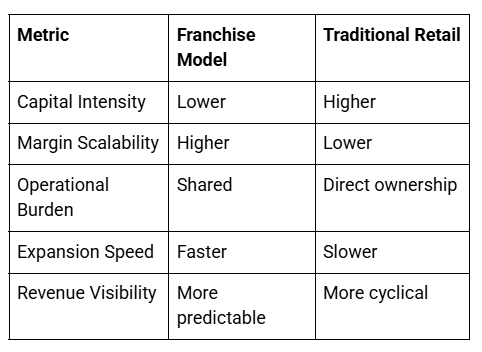
However, valuation premiums may compress if operational quality deteriorates.
The Role of Investment Banking and Financial Advisory Services
Investment banking teams and financial advisory services increasingly assist franchise businesses with:
- Expansion strategy
- Capital allocation
- Franchise restructuring
- International growth planning
- Valuation optimization
Financial consultants also use equity research automation systems and financial research tool platforms to benchmark franchise economics across sectors.
Why Institutional Investors Monitor Franchise Risks Closely
Asset managers, wealth managers, and portfolio managers increasingly evaluate franchise businesses through both operational and financial lenses.
Modern investment research prioritizes:
- Ecosystem durability
- Franchisee health
- Margin consistency
- Geographic diversification
- Long-term royalty sustainability
This reflects a broader shift toward deeper equity analysis rather than relying only on headline earnings growth.
FAQs
Why do franchise businesses receive premium valuations?
Franchise businesses often generate recurring royalty income with lower operational costs and scalable economics.
What are the biggest risks in franchise valuation?
Major risks include franchisee profitability weakness, overexpansion, brand damage, and geographic exposure challenges.
How does AI improve franchise investment research?
AI improves equity research automation by analyzing customer sentiment, regional performance, and operational trends at scale.
Why is franchisee profitability important?
Weak franchisee economics can eventually reduce royalty growth and long-term revenue sustainability.
Why does market sentiment affect franchise valuations quickly?
Investors closely monitor operational quality and customer demand because franchise ecosystems depend heavily on brand trust and consistency.
Conclusion
Franchise network valuation risk has become an important theme in modern investment research and equity analysis. While franchise businesses continue attracting premium valuations due to recurring royalty income and scalable economics, investors are increasingly evaluating operational durability, franchisee profitability, and ecosystem health with greater scrutiny.
As ai for equity research, ai data analysis, and equity research automation continue evolving, analysts can evaluate franchise systems with deeper operational visibility and faster financial analysis capabilities. Asset managers, portfolio managers, financial advisors, and investment analysts increasingly rely on advanced financial research tool systems to generate more accurate investment insights and long-term valuation assessments.
GenRPT Finance supports this evolving research landscape by helping organizations generate scalable equity research reports, AI-powered portfolio insights, and deeper investment analysis for modern financial markets.
