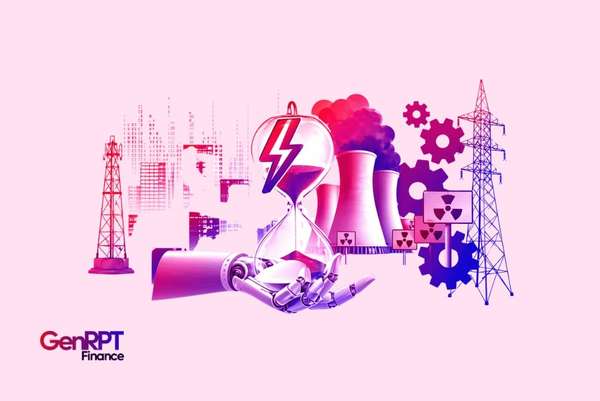
Nuclear Power’s Equity Comeback: How Research Frameworks Need to Adapt to a Technology the Market Forgot
April 22, 2026 | By GenRPT Finance
Nuclear power is making a quiet comeback in equity markets. For years, it was treated as a legacy technology, weighed down by high costs, regulatory challenges, and public perception. Many research frameworks simply moved past it.
That assumption is being revisited. Rising electricity demand, decarbonization goals, and the need for stable baseload power are bringing nuclear energy back into focus.
For equity research, this creates a challenge. Traditional models were not built to evaluate a sector that was largely written off. Now, analysts need to adapt quickly to understand how nuclear fits into the future energy mix.
Why Nuclear Is Back in the Conversation
The return of nuclear power is driven by structural shifts in energy demand and policy priorities.
Electricity demand is rising due to data centers, electrification, and industrial expansion. Renewable energy alone cannot always provide consistent supply, especially during periods of low generation.
Nuclear offers a stable and low-emission source of power, making it attractive in a world focused on both reliability and sustainability.
Governments are also re-evaluating nuclear as part of their energy strategies. Policy support, funding mechanisms, and regulatory adjustments are beginning to create a more favorable environment for investment.
From Legacy Asset to Strategic Infrastructure
Nuclear power plants were traditionally viewed as long-term, low-growth assets. Their valuation was often tied to stable cash flows and regulated returns.
This perception is shifting.
In an environment where energy demand is accelerating, nuclear is being reconsidered as strategic infrastructure. Its ability to provide consistent power makes it valuable for supporting high-demand applications like data centers and advanced manufacturing.
This transition changes how analysts approach valuation. Nuclear is no longer just about maintaining existing capacity. It is about potential expansion and integration into future energy systems.
The Role of New Technologies
Advancements in nuclear technology are also influencing equity narratives.
Small modular reactors (SMRs) and next-generation designs promise lower costs, shorter construction timelines, and improved safety features.
While these technologies are still in various stages of development, they represent a potential shift in how nuclear projects are executed.
For analysts, this introduces optionality. Companies involved in new technologies may have growth opportunities that are not captured in traditional models.
Capital Intensity and Long-Term Returns
Nuclear projects are highly capital intensive. Building new plants requires significant upfront investment and long development timelines.
This creates challenges for valuation. Cash flows are often delayed, and project risks can be substantial.
At the same time, once operational, nuclear plants can generate stable and predictable revenue over long periods.
Analysts need to balance these factors. The focus shifts to understanding project timelines, financing structures, and expected returns over the life of the asset.
Policy Support and Regulatory Dynamics
Policy plays a central role in the viability of nuclear investments.
Government support can take many forms, including subsidies, loan guarantees, and streamlined regulatory processes.
These factors can significantly impact project economics and risk profiles.
However, policy environments can change. Regulatory delays or shifts in political priorities can affect timelines and costs.
For equity research, tracking policy developments is essential for assessing both opportunities and risks.
Market Perception and Valuation Gaps
One of the interesting aspects of nuclear’s comeback is the gap between perception and reality.
Because the sector was overlooked for years, market understanding is still evolving.
This can create valuation inefficiencies. Companies with exposure to nuclear may be underappreciated if their growth potential is not fully recognized.
At the same time, enthusiasm around new technologies can lead to overvaluation if expectations are not grounded in execution realities.
Analysts need to navigate this balance carefully.
Integration With Broader Energy Systems
Nuclear power does not operate in isolation. It is part of a broader energy ecosystem that includes renewables, storage, and grid infrastructure.
Its role is often to provide stability and complement variable energy sources.
Understanding how nuclear fits into this system is important for valuation.
For example, regions investing heavily in renewable energy may also require nuclear to ensure reliability. This creates interdependencies that influence demand and pricing.
Risks That Cannot Be Ignored
Despite its renewed relevance, nuclear power comes with significant risks.
Construction delays and cost overruns are common in large-scale projects.
Regulatory hurdles can extend timelines and increase uncertainty.
Public perception and political opposition can also impact project viability.
Analysts must incorporate these risks into their models, rather than assuming smooth execution.
How Research Frameworks Need to Evolve
Traditional equity research frameworks often struggle to capture the complexity of nuclear investments.
Analysts need to incorporate long-term scenarios, including different demand and policy outcomes.
Capital allocation analysis becomes more detailed, focusing on project-level economics.
Risk assessment must account for regulatory, technological, and execution factors.
This requires a more flexible and forward-looking approach compared to standard valuation models.
Early Indicators to Watch
Several signals can indicate how nuclear is evolving as an investment theme.
Project announcements and approvals provide insights into future capacity expansion.
Policy changes can signal increased support or potential challenges.
Partnerships between technology providers and utilities may indicate progress in new reactor designs.
Monitoring these indicators helps analysts stay informed about the pace and direction of change.
Conclusion
Nuclear power’s return to the equity narrative reflects broader changes in energy demand and infrastructure needs. What was once considered a legacy technology is being re-evaluated as a critical component of future energy systems.
For analysts, this requires adapting research frameworks to capture long-term investments, evolving technologies, and complex risk profiles.
Platforms like GenRPT Finance can support this transition by organizing project data, policy developments, and financial metrics into structured insights. This makes it easier to evaluate how nuclear investments are progressing and how they may impact long-term valuations in an increasingly energy-constrained world.
