
What Is Corporate Governance as an Investment Signal?
July 1, 2026 | By GenRPT Finance
Corporate governance is an investment signal because it helps investors judge the quality of a company’s leadership, decision-making, accountability, and long-term sustainability before these strengths or weaknesses become visible in financial performance. It provides insight into how responsibly a business is managed and whether shareholders can trust management to create value over time.
Most investors begin by looking at revenue growth, earnings, profit margins, and cash flow. While these numbers are important, they only tell part of the story. A business can report strong financial performance while hiding governance problems that eventually affect shareholder returns. Governance helps investors understand the people and processes behind those numbers.
This is why equity research, investment research, and fundamental analysis increasingly include governance as a core evaluation criterion. Analysts use governance to strengthen risk assessment, improve Equity Valuation, and build more reliable investment strategy recommendations.
Governance Explains How a Company Creates Value
Every company makes hundreds of strategic decisions each year. These include acquisitions, executive hiring, dividend policies, financing decisions, capital investments, and regulatory compliance.
Corporate governance determines who makes these decisions, how they are reviewed, and whether they benefit shareholders.
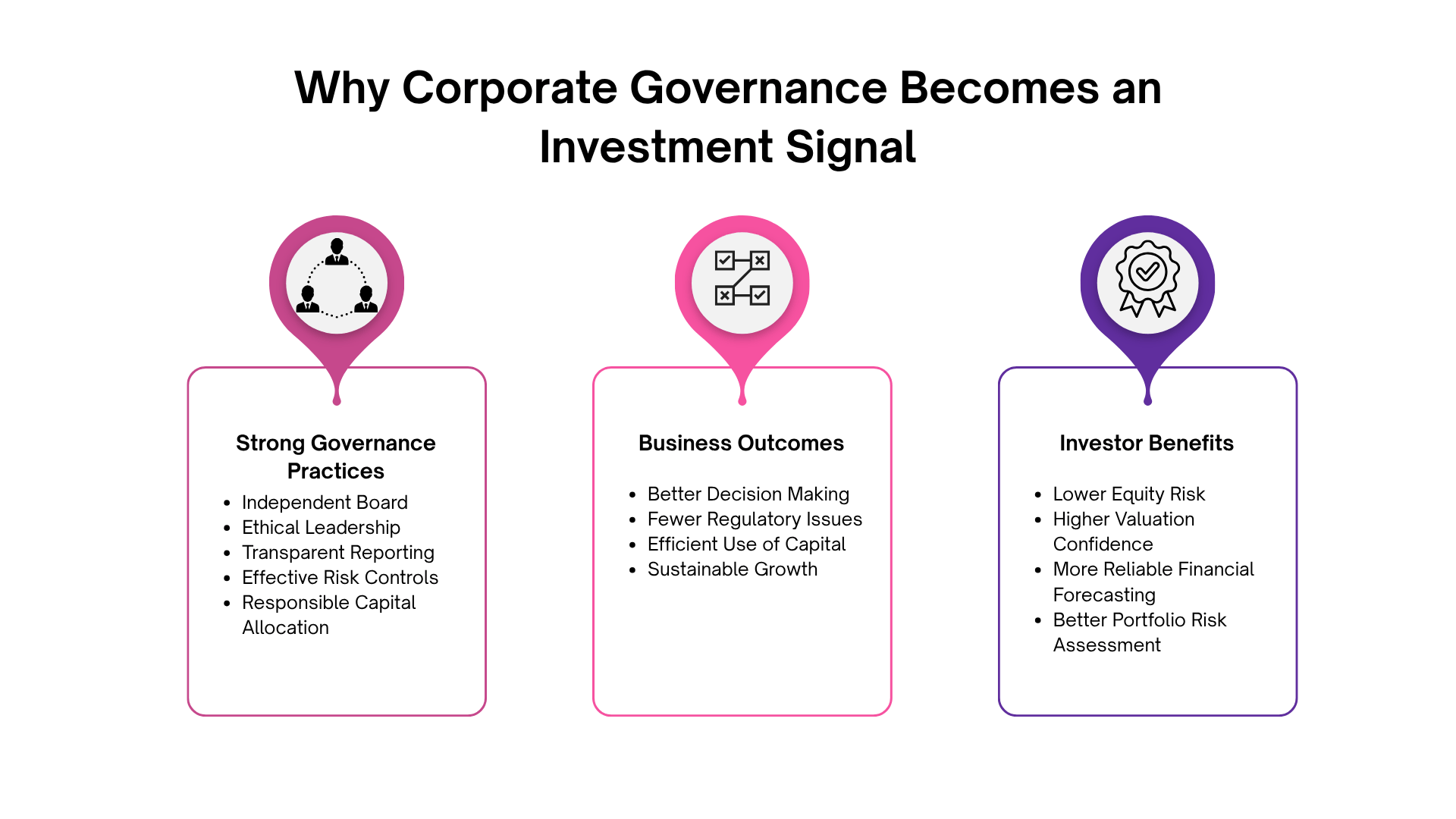
Strong governance usually reflects:
- Independent oversight by the board
- Transparent financial reporting
- Responsible executive compensation
- Ethical business practices
- Effective internal controls
- Clear communication with investors
These factors reduce uncertainty, making it easier for investors to estimate future performance and develop accurate financial forecasting models.
Why Investors Pay Attention to Governance
Imagine two companies with nearly identical financial results.
Both generate similar revenue, maintain comparable profit margins, and operate in the same industry.
However, one company has frequent executive resignations, delayed regulatory filings, related-party transactions, and limited board independence.
The second company publishes detailed disclosures, maintains an experienced independent board, communicates regularly with investors, and has consistent executive leadership.
Most professional investors would view the second company as the lower-risk investment, even if both companies appear equally profitable today.
Governance helps investors identify these differences before financial statements reveal their impact.
Governance Can Reveal Risks Earlier Than Financial Statements
Financial reports summarize completed business activity.
Governance often highlights potential future risks.
For example, investors monitor:
- Auditor resignations
- Changes in board composition
- Executive turnover
- Regulatory investigations
- Shareholder disputes
- Internal control weaknesses
Each of these events can indicate deeper operational or strategic issues.
This makes governance an important input for portfolio risk assessment, market risk analysis, and broader financial risk assessment.
According to PwC’s Global Investor Survey, more than 70% of institutional investors believe governance quality plays a major role in determining investment confidence. Similarly, research from McKinsey has found that investors often assign valuation premiums to companies with strong governance and effective boards.
What Do Equity Analysts Actually Look For?
Governance is evaluated through several measurable factors rather than opinions.
Board Effectiveness
Analysts study whether directors possess relevant industry expertise, attend meetings regularly, and provide independent oversight.
A board that actively challenges management generally supports better long-term decision-making.
Executive Incentives
Compensation structures reveal what management is rewarded for achieving.
If bonuses depend only on short-term earnings, executives may prioritize immediate results instead of sustainable growth.
Well-designed incentive plans encourage responsible capital allocation and shareholder value creation.
Financial Transparency
Companies that provide consistent disclosures allow investors to make more informed decisions.
Research teams review:
- Annual reports
- Quarterly financial reports
- Audit reports
- Earnings presentations
- Investor communications
Higher financial transparency reduces uncertainty during equity research analysis.
Risk Management
Governance also covers how organizations identify and manage operational, financial, and regulatory risks.
Companies with mature governance frameworks generally respond more effectively to unexpected market events.
Real Example: Governance During a Crisis
The COVID-19 pandemic highlighted the importance of governance across industries.
Many companies experienced severe disruptions.
Businesses with disciplined leadership, transparent communication, and structured decision-making adapted more effectively by preserving liquidity, adjusting operations, and communicating realistic expectations to shareholders.
Others struggled with delayed disclosures, inconsistent guidance, and poor crisis management.
The difference was not always stronger products or larger revenues. In many cases, governance quality influenced how effectively companies responded under pressure.
Governance Supports Better Valuation Decisions
Governance influences several assumptions used in Financial modeling and valuation methods.
Analysts often consider governance while estimating:
- Future cash flows
- Revenue projections
- Capital allocation efficiency
- Cost of capital
- Long-term business stability
A company with stronger governance generally carries lower perceived risk, which can positively influence valuation assumptions.
Governance also strengthens Scenario Analysis by helping analysts evaluate how management may respond during economic slowdowns, regulatory changes, or competitive challenges.
Governance Is Especially Important in Global Investing
Investors allocating capital across international markets evaluate governance alongside financial performance.
During Emerging Markets Analysis, governance becomes particularly important because regulatory environments, disclosure standards, and shareholder protections vary significantly across countries.
Research teams examine:
- Ownership concentration
- Family-controlled businesses
- Government influence
- Regulatory compliance
- Minority shareholder rights
- Geographic exposure
These factors contribute to a more complete understanding of investment risk beyond financial ratios alone.
How Technology Is Improving Governance Analysis
Reviewing governance manually requires significant time.
Professional analysts examine thousands of pages across annual reports, proxy statements, regulatory filings, and public disclosures.
Modern ai for equity research simplifies much of this work.
AI systems can identify governance events such as executive appointments, board changes, legal proceedings, accounting policy updates, and disclosure trends.
Using ai data analysis, research teams can continuously monitor governance developments instead of relying only on quarterly reviews.
An ai report generator can organize governance findings into structured sections within an equity research report, allowing analysts to focus on interpretation rather than document collection.
This improves research efficiency while supporting better investment decisions.
Conclusion
Corporate governance is much more than a compliance requirement. It is an investment signal that helps investors understand how a company is managed, how risks are controlled, and whether leadership is positioned to create sustainable shareholder value. When combined with financial analysis, governance strengthens equity research, improves portfolio insights, and supports more informed investment decisions.
As governance data continues to expand across financial reports, regulatory filings, and public disclosures, AI-powered research platforms are making it easier to analyze this information efficiently. GenRPT Finance by Yodaplus brings governance analysis together with financial data, market intelligence, and automated research workflows to generate comprehensive investment reports. Alongside Yodaplus Agentic AI services, it enables analysts, asset managers, and advisory firms to produce faster, deeper, and more consistent investment research.
