
What Is Business Model Analysis in Equity Research?
July 20, 2026 | By GenRPT Finance
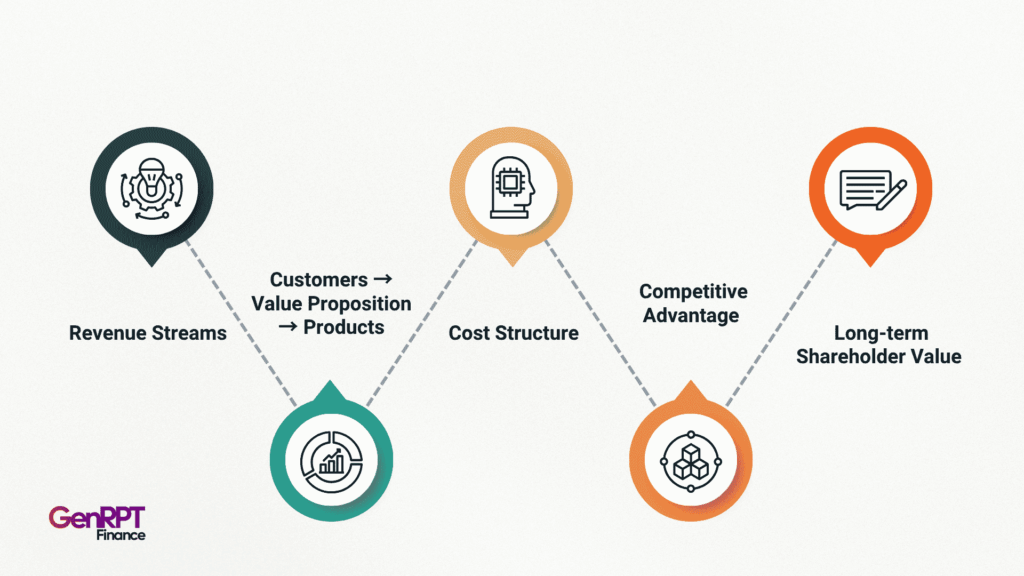
Business model analysis is the process of understanding how a company creates, delivers, and captures value. It goes beyond financial statements to examine how a business generates revenue, manages costs, serves customers, and sustains profitability over time. In equity research, analysts use business model analysis to determine whether a company’s strategy is capable of supporting long-term growth and shareholder value.
A company may report impressive earnings today, but if its business model is difficult to scale or vulnerable to competition, its future performance may be uncertain. Understanding the business model helps investors look beyond short-term financial results.
Why Business Model Analysis Matters
Financial statements explain what happened in the past.
Business model analysis explains why those results occurred and whether they can be repeated in the future.
For example, two software companies may generate the same annual revenue. One earns recurring subscription income, while the other depends on one-time license sales. Although current revenues are similar, the subscription-based business often has greater revenue visibility and stronger long-term growth potential.
This is why business model analysis is one of the first steps in equity research.
The Core Elements of a Business Model
Analysts examine several components to understand how a business operates.
These include:
- Value proposition
- Products and services
- Target customers
- Revenue streams
- Pricing strategy
- Cost structure
- Distribution channels
- Customer relationships
- Key resources
- Competitive advantages
Together, these elements explain how a company earns money and maintains profitability.
Understanding Revenue Generation
One of the primary objectives of business model analysis is understanding how revenue is generated.
Analysts evaluate:
- Primary revenue sources
- Recurring versus one-time revenue
- Customer diversification
- Product diversification
- Geographic exposure
- Pricing power
Businesses with predictable and diversified revenue streams are often viewed as more resilient during changing market conditions.
Evaluating the Cost Structure
Revenue alone does not determine business quality.
Analysts also study how efficiently the company operates.
Important areas include:
- Fixed costs
- Variable costs
- Gross margins
- Operating margins
- Capital expenditure requirements
- Customer acquisition costs
A company that improves profitability as revenue grows often demonstrates a stronger business model.
Assessing Competitive Advantage
Business model analysis also helps determine why customers choose one company over another.
Analysts evaluate competitive strengths such as:
- Brand recognition
- Proprietary technology
- Network effects
- Switching costs
- Distribution capabilities
- Cost advantages
- Intellectual property
Companies with durable competitive advantages generally have a better chance of sustaining long-term growth.
Measuring Scalability
Scalability refers to a company’s ability to grow revenue without proportionally increasing costs.
Analysts assess whether expansion requires significant new investment or whether the business can efficiently serve more customers using existing infrastructure.
Software companies, digital platforms, and subscription businesses often demonstrate high scalability compared to capital-intensive industries.
Identifying Business Model Risks
Every business model has risks.
Analysts evaluate factors that could weaken future performance, including:
- Customer concentration
- Supplier dependence
- Regulatory changes
- Technological disruption
- Competitive pressure
- Commodity price volatility
- Economic cycles
Understanding these risks provides a more balanced view of the company’s long-term prospects.
How Business Model Analysis Supports Equity Research
Business model analysis forms the foundation for many other areas of equity research.
It supports:
- Financial forecasting
- Company valuation
- Business quality assessment
- Competitive intelligence
- Corporate strategy evaluation
- Capital allocation analysis
- Portfolio risk assessment
Without understanding the business model, analysts may struggle to interpret financial results accurately.
How AI Improves Business Model Analysis
Modern equity research involves reviewing annual reports, earnings call transcripts, regulatory filings, investor presentations, market news, and industry research.
Manually analyzing all this information takes significant time.
AI helps analysts by:
- Summarizing business models
- Identifying revenue drivers
- Comparing competitors
- Tracking strategic changes
- Monitoring industry developments
- Highlighting operational risks
- Organizing research into structured reports
This allows analysts to focus on evaluating opportunities instead of gathering information.
How GenRPT Finance Simplifies Business Model Analysis
Business model analysis requires combining financial data with strategic insights from multiple sources.
GenRPT Finance uses Agentic AI to analyze annual reports, financial statements, earnings call transcripts, investor presentations, regulatory filings, market news, competitive intelligence, corporate strategy, governance, and business quality.
The platform generates institutional-grade equity research reports that help analysts, portfolio managers, wealth managers, asset managers, and financial advisors evaluate business models more efficiently, compare companies consistently, and make faster investment decisions.
Conclusion
Business model analysis helps investors understand how a company creates value and whether its growth is sustainable. By evaluating revenue generation, cost structures, competitive advantages, scalability, and business risks, analysts build a stronger foundation for financial forecasting and company valuation.
As equity research becomes increasingly data-intensive, AI-powered platforms like GenRPT Finance enable investment professionals to automate research, uncover deeper insights, and evaluate business models with greater speed, consistency, and confidence.
FAQs
Business model analysis is the process of evaluating how a company creates value, generates revenue, manages costs, and maintains profitability. It helps analysts understand whether the business can sustain long-term growth and deliver shareholder value.
Business model analysis provides context behind a company’s financial performance. It helps investors assess growth potential, competitive advantages, operational efficiency, and long-term business sustainability before making investment decisions.
Analysts evaluate a company’s value proposition, revenue streams, pricing strategy, customer base, cost structure, competitive positioning, scalability, operational efficiency, and business risks to understand how it creates and captures value.
AI analyzes financial statements, annual reports, earnings calls, regulatory filings, market news, and industry research to identify trends, compare companies, summarize business models, and generate investment insights more efficiently than manual research.
GenRPT Finance uses Agentic AI to analyze financial performance, business models, corporate strategy, competitive intelligence, governance, and risk factors. It generates institutional-grade equity research reports that help analysts, portfolio managers, asset managers, and wealth managers evaluate companies faster and make more informed investment decisions.
