
Why Business Model Analysis Matters in Equity Research
July 20, 2026 | By GenRPT Finance
Business model analysis matters because it helps investors understand whether a company’s success is sustainable. Financial statements show how a company has performed in the past, but the business model explains how it generates revenue, serves customers, manages costs, and competes in the market. By understanding the business model, analysts can better evaluate growth potential, identify risks, and make more informed investment decisions.
Many companies can deliver strong financial results for a few quarters. However, businesses with resilient, scalable, and well-designed business models are more likely to sustain growth over the long term.
It Explains How a Company Creates Value
Every successful company has a system for creating value.
Business model analysis helps analysts understand:
- What products or services the company offers
- Who its customers are
- How it earns revenue
- What differentiates it from competitors
- How profits are generated
This provides a much deeper understanding than financial metrics alone.
It Supports Better Financial Forecasting
Revenue forecasts become more reliable when analysts understand the underlying business model.
For example, recurring subscription businesses often produce more predictable cash flows than companies relying on one-time product sales.
By understanding revenue drivers, pricing models, customer behavior, and market demand, analysts can build more realistic financial forecasts.
It Helps Evaluate Growth Potential
Not every growing company has a scalable business model.
Business model analysis helps determine whether future growth can be achieved efficiently.
Analysts assess factors such as:
- Market opportunity
- Expansion strategy
- Customer acquisition
- Revenue scalability
- Operational efficiency
Companies that can grow without significantly increasing costs often generate stronger long-term returns.
It Identifies Competitive Advantages
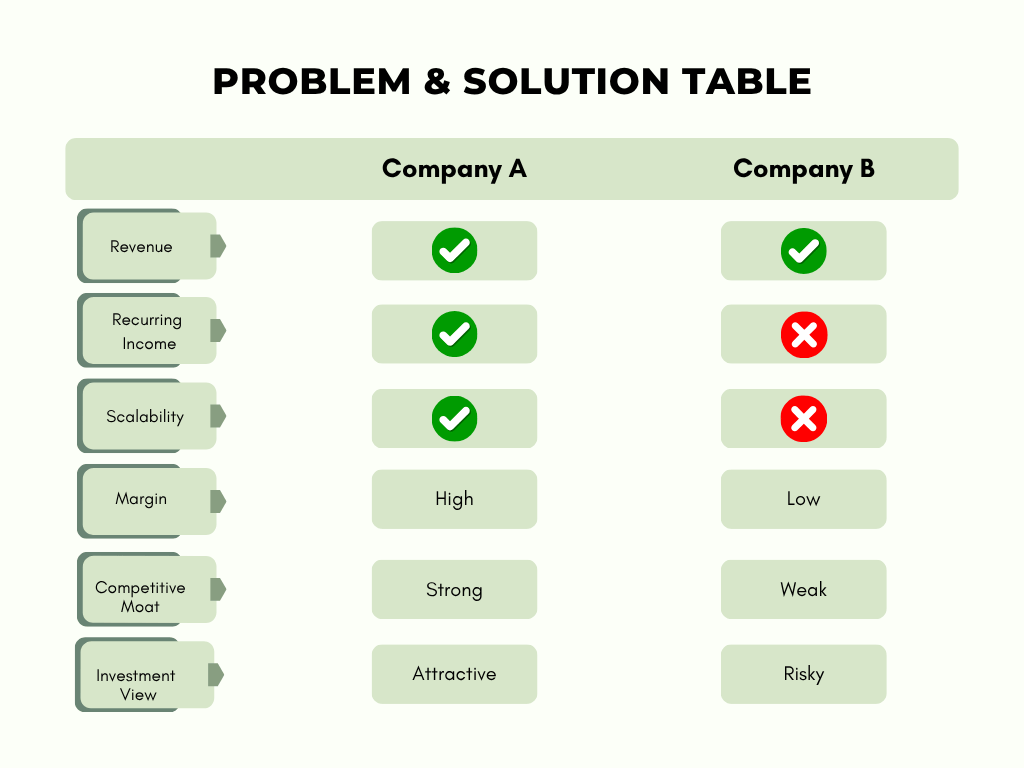
Business model analysis reveals why customers continue choosing one company over another.
Analysts examine competitive strengths including:
- Brand recognition
- Proprietary technology
- Network effects
- Switching costs
- Distribution capabilities
- Cost leadership
Companies with durable competitive advantages are often better positioned to maintain profitability even during challenging market conditions.
It Highlights Business Risks Early
Understanding the business model helps analysts identify potential weaknesses before they appear in financial statements.
Common risks include:
- Customer concentration
- Supplier dependence
- Regulatory changes
- Technology disruption
- Intense competition
- Commodity price exposure
Recognizing these risks early allows investors to make better portfolio decisions.
It Improves Company Comparisons
Business model analysis allows analysts to compare companies beyond revenue and earnings.
For example, two retailers may report similar sales, but one may operate an asset-light e-commerce model while the other depends on expensive physical stores.
These structural differences affect profitability, capital requirements, scalability, and long-term valuation.
It Supports Better Valuation
A company’s valuation depends not only on current earnings but also on future growth potential.
Business model analysis provides important inputs for valuation models by helping analysts assess:
- Revenue sustainability
- Margin expansion
- Capital requirements
- Competitive positioning
- Cash flow stability
- Long-term profitability
This leads to more informed valuation assumptions.
It Strengthens Investment Decisions
Business model analysis connects qualitative insights with quantitative analysis.
Instead of relying only on historical financial data, analysts understand the broader drivers of business performance.
This improves confidence in:
- Stock recommendations
- Portfolio construction
- Risk assessment
- Long-term investment strategies
It enables investors to identify businesses with stronger fundamentals rather than simply focusing on short-term financial performance.
How AI Improves Business Model Analysis
Analyzing business models requires reviewing information from annual reports, earnings calls, investor presentations, financial statements, regulatory filings, and market news.
AI significantly reduces this manual effort by helping analysts:
- Summarize company business models
- Compare competitors
- Identify revenue drivers
- Track strategic changes
- Monitor industry developments
- Analyze management commentary
- Generate structured research reports
This enables faster and more comprehensive company evaluations.
How GenRPT Finance Supports Business Model Analysis
Business model analysis requires combining financial data with strategic and operational insights from multiple sources.
GenRPT Finance uses Agentic AI to analyze annual reports, financial statements, earnings call transcripts, investor presentations, regulatory filings, competitive intelligence, corporate strategy, governance, business quality, and market developments.
It generates institutional-grade equity research reports that help analysts, portfolio managers, wealth managers, asset managers, and financial advisors evaluate business models more efficiently, compare companies consistently, and uncover deeper investment insights.
Conclusion
Business model analysis matters because it helps investors understand how a company creates value, competes in the market, and sustains long-term growth. By evaluating revenue generation, scalability, competitive advantages, operational efficiency, and business risks, analysts build a stronger foundation for financial forecasting, valuation, and investment decisions.
As company data becomes more extensive and complex, AI-powered platforms like GenRPT Financehttps://bit.ly/4pv6wiv help investment professionals automate research, synthesize information from multiple sources, and generate deeper, more consistent investment insights.
FAQs
Business model analysis helps analysts understand how a company generates revenue, creates value, manages costs, and sustains profitability. It provides the foundation for financial forecasting, valuation, and investment decision-making.
It enables investors to assess growth potential, competitive advantages, scalability, operational efficiency, and business risks before making investment decisions, rather than relying only on historical financial performance.
Business model analysis can identify risks such as customer concentration, supplier dependence, regulatory changes, competitive pressure, technological disruption, pricing challenges, and operational inefficiencies that may affect future performance.
Analysts review annual reports, financial statements, earnings call transcripts, investor presentations, regulatory filings, industry reports, market news, and competitor information to understand how a business operates and creates value.
GenRPT Finance uses Agentic AI to evaluate business models, financial performance, corporate strategy, competitive intelligence, governance, and risk factors. It generates institutional-grade equity research reports that help investment professionals analyze companies faster and make better-informed investment decisions.
