
Revenue Quality in Equity Research: A Complete Guide
July 21, 2026 | By GenRPT Finance
Revenue quality measures how sustainable, predictable, and reliable a company’s revenue is over the long term. Two companies may report the same amount of revenue, but the source, consistency, and durability of that revenue can be very different. In equity research, analysts look beyond the top line to understand whether future revenue growth is likely to continue.
A company generating recurring subscription revenue from a diversified customer base is often viewed differently from one relying on a few large customers or one-time transactions. Understanding revenue quality helps analysts build stronger financial forecasts, estimate intrinsic value more accurately, and identify businesses capable of delivering consistent long-term performance.
Revenue quality is therefore one of the most important indicators of business quality and investment potential.
What Is Revenue Quality?
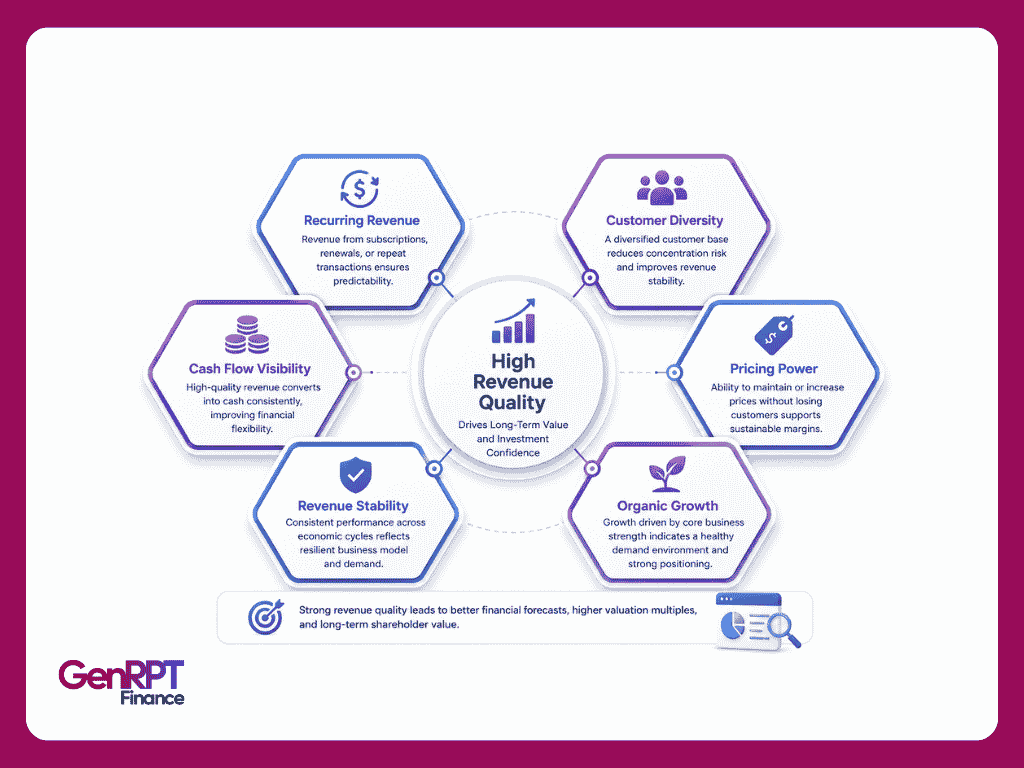
Revenue quality refers to the characteristics that make revenue dependable and capable of supporting long-term growth.
Rather than asking “How much revenue does the company generate?”, analysts ask:
- How predictable is the revenue?
- How recurring is it?
- How diversified are the revenue sources?
- How stable is customer demand?
- Can revenue continue growing sustainably?
The answers help determine whether current financial performance is likely to continue.
Why Revenue Quality Matters
High-quality revenue reduces uncertainty.
Companies with predictable revenue often experience:
- More stable cash flows
- Better earnings visibility
- Higher investor confidence
- Lower business risk
- More reliable financial forecasts
Low-quality revenue may indicate that earnings are heavily influenced by temporary demand, customer concentration, acquisitions, or one-time contracts.
According to McKinsey, companies that consistently generate sustainable organic growth create significantly greater long-term shareholder value than companies relying primarily on acquisitions or short-term growth initiatives.
Characteristics of High-Quality Revenue
Analysts generally associate high-quality revenue with the following characteristics:
- Recurring revenue
- Diversified customer base
- Multiple products or services
- Geographic diversification
- Strong customer retention
- Stable pricing
- Predictable demand
- Consistent organic growth
These characteristics often contribute to stronger financial performance over multiple market cycles.
Characteristics of Low-Quality Revenue
Revenue quality may be weaker when companies depend heavily on:
- One-time sales
- A small number of customers
- Aggressive discounting
- Short-term contracts
- Highly cyclical demand
- Frequent acquisitions to sustain growth
- Unstable pricing
- Volatile markets
These factors increase uncertainty and make forecasting more difficult.
How Analysts Evaluate Revenue Quality
Revenue quality analysis combines financial data with operational insights.
Analysts review:
- Revenue growth trends
- Recurring versus non-recurring revenue
- Customer concentration
- Product diversification
- Geographic exposure
- Customer retention
- Contract duration
- Pricing power
- Organic growth
- Gross margins
They also compare these metrics with industry peers to understand whether a company’s revenue profile is stronger or weaker than competitors.
Revenue Quality Across Different Industries
Revenue quality looks different across sectors.
For example:
Software
Analysts prioritize:
- Annual Recurring Revenue (ARR)
- Customer retention
- Subscription renewals
- Net Revenue Retention (NRR)
Manufacturing
Focus areas include:
- Order backlog
- Customer diversification
- Pricing stability
- Long-term contracts
Banking
Analysts examine:
- Net interest income
- Fee income
- Loan growth
- Deposit stability
Healthcare
Revenue quality depends on:
- Product pipeline
- Patent protection
- Reimbursement policies
- Regulatory approvals
Industry context is therefore essential when evaluating revenue quality.
Best Practices for Revenue Quality Analysis
Analysts generally follow several best practices.
Look Beyond Reported Revenue
Understand where revenue comes from rather than focusing only on headline growth.
Separate Organic and Acquisition Growth
Organic growth often provides a clearer picture of business performance.
Evaluate Customer Diversification
Revenue should not depend excessively on a few customers.
Monitor Pricing Power
Companies that maintain pricing without sacrificing demand often demonstrate stronger business quality.
Track Recurring Revenue
Recurring income generally improves forecasting accuracy.
Compare Industry Peers
Benchmarking helps identify businesses with stronger revenue profiles.
Combine Qualitative and Quantitative Analysis
Financial metrics should be supported by management commentary, earnings calls, annual reports, and industry developments.
Common Challenges in Revenue Quality Analysis
Revenue quality is not always obvious.
Analysts must distinguish between:
- Temporary growth versus sustainable growth
- Volume growth versus pricing growth
- Organic growth versus acquisition-driven growth
- Genuine customer demand versus promotional sales
- Accounting changes versus business improvements
This requires reviewing financial statements alongside qualitative business information.
How AI Improves Revenue Quality Analysis
Evaluating revenue quality involves reviewing annual reports, earnings calls, investor presentations, regulatory filings, financial statements, customer metrics, and market news.
AI helps analysts by:
- Identifying recurring revenue trends
- Detecting customer concentration risks
- Comparing peer companies
- Monitoring pricing changes
- Tracking strategic developments
- Highlighting unusual revenue movements
- Generating structured research summaries
Instead of manually reviewing hundreds of pages of company disclosures, analysts can focus on interpreting the results.
According to the 2024 CFA Institute AI Survey, investment professionals are increasingly using AI to automate research workflows while improving analytical efficiency and consistency.
How GenRPT Finance Supports Revenue Quality Analysis
Revenue quality analysis requires combining financial metrics with strategic and operational insights.
GenRPT Finance uses Agentic AI to analyze annual reports, financial statements, earnings call transcripts, investor presentations, regulatory filings, market news, competitive intelligence, and business quality indicators.
The platform generates institutional-grade equity research reports that help analysts, portfolio managers, wealth managers, asset managers, and financial advisors evaluate revenue quality, benchmark companies against peers, improve financial forecasting, and make more informed investment decisions.
Conclusion
Revenue quality is much more than reported sales. It reflects how dependable, diversified, and sustainable a company’s revenue is over time. By examining recurring income, customer concentration, pricing power, diversification, and industry dynamics, analysts gain deeper insights into business quality and long-term investment potential.
As company disclosures become more extensive and financial data grows more complex, AI-powered platforms like GenRPT Finance help investment professionals automate research, uncover stronger revenue insights, and evaluate companies with greater speed, consistency, and confidence.
FAQs
Revenue quality refers to the sustainability, predictability, and reliability of a company’s revenue. It helps analysts determine whether future revenue growth is likely to continue.
High-quality revenue supports stronger financial forecasting, improves valuation accuracy, reduces business risk, and provides greater confidence in long-term investment decisions.
Analysts evaluate recurring revenue, customer concentration, pricing power, revenue diversification, customer retention, contract duration, organic growth, and industry conditions.
They review financial statements, earnings calls, annual reports, customer metrics, competitive positioning, and peer comparisons to determine whether revenue is sustainable and resilient.
GenRPT Finance uses Agentic AI to analyze financial statements, annual reports, earnings calls, regulatory filings, competitive intelligence, and revenue drivers. It generates institutional-grade equity research reports that help investment professionals evaluate revenue quality faster and make better-informed investment decisions.
