
Profitability Drivers in Equity Research: A Complete Guide
July 23, 2026 | By GenRPT Finance
Profitability is one of the clearest indicators of a company’s ability to create shareholder value. However, experienced analysts rarely stop at earnings or net profit. They ask a more important question: What is actually driving profitability?
Profitability drivers are the operational, financial, and strategic factors that influence how efficiently a company converts revenue into profit. They explain why margins improve, why returns increase, and whether strong financial performance is likely to continue.
Two companies may report identical profit margins, yet the reasons behind those results can be completely different. One may benefit from strong pricing power and efficient operations, while another may rely on temporary cost reductions or one-time gains. Understanding these differences helps analysts separate durable business strength from short-term financial improvements.
According to McKinsey, companies that sustain profitable growth consistently outperform peers in long-term shareholder returns. That makes profitability drivers a critical part of equity research, financial forecasting, and company valuation.
What Are Profitability Drivers?
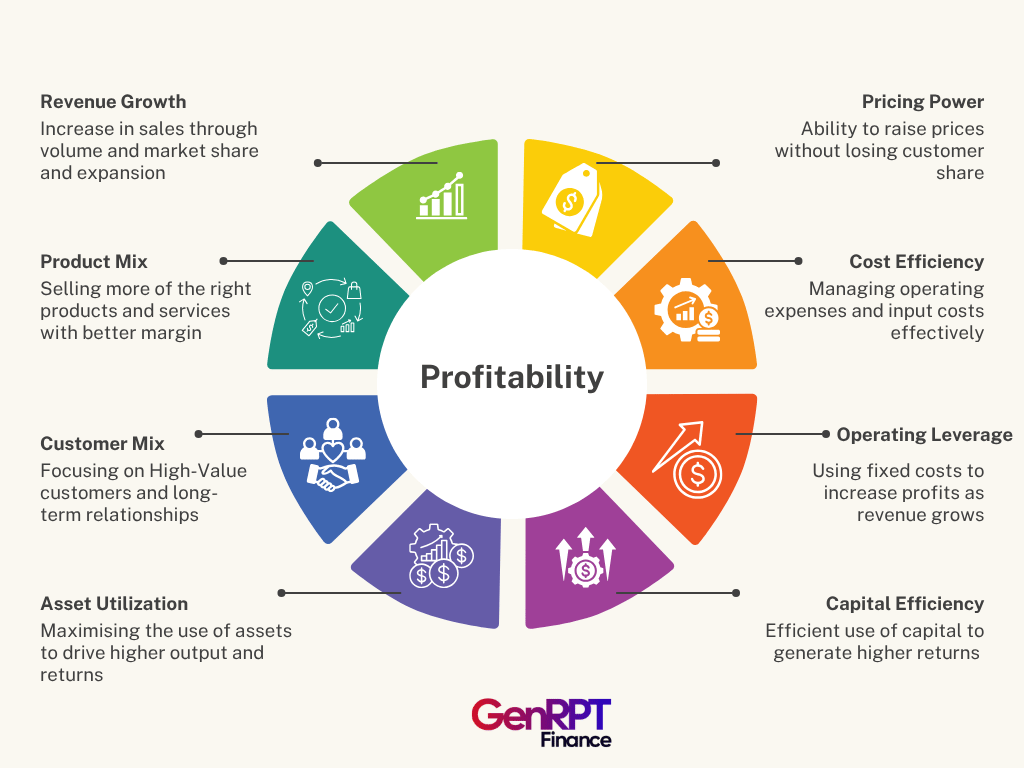
Profitability drivers are the factors that determine how much profit a business generates from its operations.
These drivers can include:
- Revenue growth
- Pricing power
- Cost efficiency
- Gross margins
- Operating leverage
- Product mix
- Customer mix
- Capital allocation
- Asset utilization
- Operational productivity
Rather than looking only at reported earnings, analysts examine these underlying drivers to understand whether profitability is improving because of sustainable business performance or temporary events.
Why Profitability Drivers Matter
Profitability is closely linked to a company’s ability to reinvest, innovate, reduce debt, and generate shareholder returns.
Understanding profitability drivers helps analysts:
- Build more accurate financial forecasts
- Estimate future margins
- Assess operational efficiency
- Evaluate competitive strength
- Compare companies more fairly
- Improve valuation assumptions
Businesses with durable profitability drivers are generally better equipped to navigate economic slowdowns, inflation, and competitive pressure.
The Most Important Profitability Drivers
Although every industry is different, analysts commonly evaluate several core drivers.
Revenue Growth
Healthy revenue growth creates opportunities for higher earnings, provided costs remain under control.
Pricing Power
Companies that can increase prices without reducing demand often maintain stronger margins over time.
Cost Structure
Understanding fixed costs, variable costs, and operating expenses helps determine how efficiently a company converts revenue into profit.
Gross Margin
Gross margin indicates how much profit remains after direct production costs and often reflects operational efficiency or competitive advantages.
Operating Leverage
Businesses with high operating leverage can increase profits faster than revenue once fixed costs are covered.
Product and Customer Mix
Selling higher-margin products or serving more profitable customer segments can improve overall profitability.
Capital Efficiency
Efficient use of assets and invested capital often supports stronger long-term returns.
How Analysts Evaluate Profitability Drivers
Profitability analysis combines financial metrics with business insights.
Analysts review:
- Gross margin
- Operating margin
- EBITDA margin
- Net profit margin
- Return on Equity (ROE)
- Return on Invested Capital (ROIC)
- Operating expenses
- Revenue mix
- Pricing trends
- Cost trends
- Cash flow generation
They also study annual reports, earnings calls, investor presentations, and management commentary to understand what is driving margin expansion or contraction.
Profitability Drivers Across Different Industries
The importance of individual profitability drivers depends on the sector.
Software
Focus areas include:
- Gross margins
- Customer acquisition costs
- Customer lifetime value
- Subscription renewals
- Operating leverage
Manufacturing
Analysts evaluate:
- Production efficiency
- Raw material costs
- Capacity utilization
- Supply chain efficiency
Banking
Profitability depends on:
- Net interest margin
- Credit quality
- Operating efficiency
- Fee income
Healthcare
Key drivers include:
- Product mix
- Patent protection
- Research spending
- Regulatory approvals
Industry context helps analysts understand whether profitability improvements are sustainable.
Challenges in Profitability Analysis
Profitability is influenced by both internal decisions and external factors.
Analysts must distinguish between:
- Sustainable margin improvement and temporary cost reductions
- Organic operational improvements and accounting adjustments
- Pricing power and inflation-driven revenue
- Efficiency gains and one-time restructuring benefits
Looking beyond headline earnings reduces the risk of misinterpreting company performance.
How AI Improves Profitability Analysis
Evaluating profitability drivers requires reviewing financial statements, earnings calls, annual reports, investor presentations, regulatory filings, and market developments.
According to the 2024 CFA Institute AI Survey, investment professionals are increasingly using AI to automate financial research and identify patterns across large datasets.
AI helps analysts:
- Identify margin trends
- Compare profitability across peers
- Detect cost structure changes
- Track pricing strategies
- Analyze management commentary
- Highlight operational improvements
- Generate structured financial summaries
Instead of spending hours gathering information, analysts can focus on interpreting what drives long-term profitability.
How GenRPT Finance Supports Profitability Analysis
Profitability analysis requires combining financial metrics with strategic and operational insights.
GenRPT Finance uses Agentic AI to analyze annual reports, financial statements, earnings call transcripts, investor presentations, regulatory filings, market news, competitive intelligence, corporate strategy, and business quality indicators.
The platform generates institutional-grade equity research reports that help analysts, portfolio managers, wealth managers, asset managers, and financial advisors evaluate profitability drivers, benchmark companies, improve financial forecasting, and make more informed investment decisions.
Conclusion
Profitability drivers explain why companies generate strong earnings and whether those results are likely to continue. By evaluating pricing power, cost efficiency, operating leverage, product mix, revenue growth, and capital efficiency, analysts gain a deeper understanding of business quality than profitability metrics alone can provide.
As businesses become more complex and financial disclosures continue to expand, AI-powered platforms like GenRPT Finance help investment professionals analyze profitability drivers more efficiently, compare companies consistently, and generate stronger, data-backed investment insights.
FAQs
Profitability drivers are the operational, financial, and strategic factors that influence a company’s ability to generate profits. They include pricing power, revenue growth, cost efficiency, operating leverage, product mix, and capital efficiency.
They help analysts understand whether a company’s earnings are sustainable, improve financial forecasting, support more accurate valuations, and identify businesses with strong long-term growth potential.
Common metrics include gross margin, operating margin, EBITDA margin, net profit margin, ROE, ROIC, operating expenses, revenue mix, pricing trends, and cash flow generation.
Yes. Software companies often focus on gross margins and operating leverage, manufacturers on production efficiency and raw material costs, banks on net interest margins, and healthcare companies on product mix and regulatory approvals.
GenRPT Finance uses Agentic AI to analyze financial statements, annual reports, earnings calls, regulatory filings, market news, and profitability indicators. It generates institutional-grade equity research reports that help analysts evaluate profitability drivers faster and make more informed investment decisions.
