
Why Do Profitability Drivers Matter in Equity Research?
July 23, 2026 | By GenRPT Finance
A company’s profitability can improve for many reasons, but not all of them indicate a stronger business. Higher profits may come from better pricing, improved operational efficiency, a favorable product mix, or sustainable revenue growth. They can also result from one-time gains, temporary cost reductions, or accounting adjustments.
This is why analysts focus on profitability drivers rather than profitability alone. Understanding why margins are expanding or declining helps determine whether earnings are sustainable and whether a company can continue creating shareholder value.
According to McKinsey, companies that achieve both profitable growth and efficient capital allocation consistently outperform peers over the long term. Identifying the drivers behind profitability is therefore a key part of equity research and investment analysis.
Profitability Drivers Reveal the Quality of Earnings
Headline earnings can sometimes present an incomplete picture.
A company may report higher profits because it sold an asset, received a tax benefit, or reduced expenses temporarily. These improvements may not continue in future periods.
Analysts look at profitability drivers to determine whether earnings are supported by:
- Strong customer demand
- Better pricing
- Operational improvements
- Higher productivity
- Sustainable cost management
This helps distinguish recurring business performance from short-term financial gains.
They Improve Financial Forecasting
Forecasting future earnings requires understanding what influences profitability.
Analysts evaluate whether profit growth is driven by factors that can continue over the coming years, such as:
- Expanding customer demand
- Higher-margin products
- Operating leverage
- Productivity improvements
- Stable pricing power
Understanding these drivers allows analysts to build more realistic revenue, margin, and cash flow projections.
They Support More Accurate Company Valuations
Company valuation depends on future earnings rather than historical results.
Analysts use profitability drivers to estimate:
- Future operating margins
- EBITDA growth
- Free cash flow
- Return on invested capital
- Long-term earnings potential
If profitability improvements are sustainable, valuation models become more reliable.
They Help Compare Companies Fairly
Two companies may report similar profit margins while operating very differently.
For example:
- One company may generate high margins because of strong pricing power and efficient operations.
- Another may achieve similar margins through aggressive cost-cutting that cannot continue indefinitely.
By examining profitability drivers, analysts can identify which business has stronger long-term fundamentals instead of relying solely on reported profits.
They Highlight Competitive Advantages
Many competitive strengths eventually appear through profitability.
Analysts evaluate whether profits are supported by:
- Brand strength
- Product differentiation
- Economies of scale
- Customer loyalty
- Efficient operations
- Proprietary technology
Businesses with durable competitive advantages often maintain healthy margins even during periods of economic uncertainty.
They Identify Business Risks Earlier
Changes in drivers often appear before earnings decline.
Analysts monitor:
- Rising input costs
- Weakening pricing power
- Higher operating expenses
- Declining productivity
- Lower asset utilization
- Changing customer demand
Detecting these trends early helps investors understand potential risks before they become visible in financial results.
They Improve Capital Allocation Decisions
Companies that generate strong profits can reinvest in growth, reduce debt, return capital to shareholders, or fund innovation.
Analysts assess whether profitability is sufficient to support:
- Research and development
- Business expansion
- Strategic acquisitions
- Dividend payments
- Share buybacks
- Debt reduction
Healthy profitability drivers often provide greater financial flexibility.
Profitability Drivers Vary Across Industries
The factors influencing profitability differ by sector.
Software
Key drivers include:
- Subscription renewals
- Customer retention
- Gross margins
- Operating leverage
Manufacturing
Analysts focus on:
- Capacity utilization
- Raw material costs
- Production efficiency
- Supply chain performance
Banking
Important drivers include:
- Net interest margins
- Credit quality
- Fee income
- Operating efficiency
Healthcare
Profitability depends on:
- Product portfolio
- Patent protection
- Regulatory approvals
- Research productivity
Understanding industry-specific drivers helps analysts make more meaningful comparisons.
AI Makes Profitability Analysis More Efficient
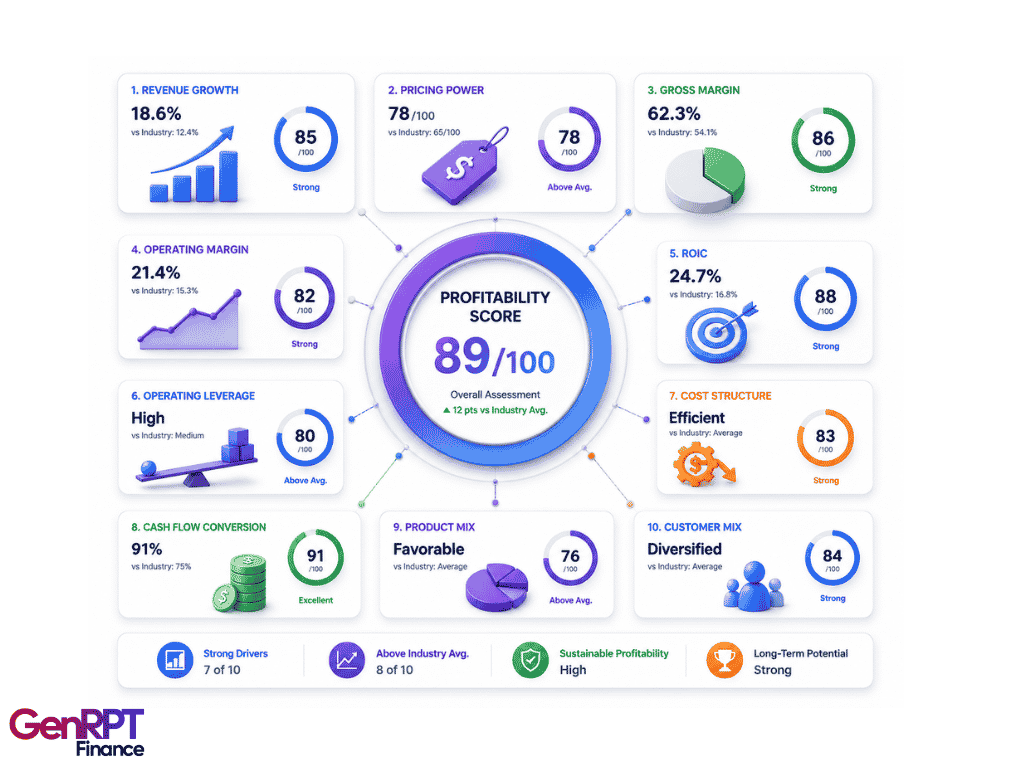
Evaluating profitability drivers requires reviewing annual reports, financial statements, earnings call transcripts, investor presentations, regulatory filings, and market news.
The 2024 CFA Institute AI Survey found that investment professionals are increasingly adopting AI to automate research workflows and improve analytical efficiency.
AI helps analysts:
- Detect margin trends
- Monitor cost changes
- Compare peer companies
- Analyze pricing strategies
- Summarize management commentary
- Identify operational improvements
- Highlight emerging risks
This reduces manual effort while allowing analysts to focus on interpreting business performance.
How GenRPT Finance Helps Evaluate Profitability Drivers
Understanding profitability drivers requires combining quantitative analysis with business context.
GenRPT Finance uses Agentic AI to analyze annual reports, financial statements, earnings call transcripts, investor presentations, regulatory filings, market news, competitive intelligence, and business quality indicators.
The platform generates institutional-grade equity research reports that help analysts, portfolio managers, wealth managers, asset managers, and financial advisors identify the drivers behind profitability, benchmark companies against peers, improve financial forecasting, and make more informed investment decisions.
Conclusion
Profitability drivers explain why a company earns strong returns and whether those returns are likely to continue. They help analysts look beyond reported earnings to understand pricing power, operational efficiency, cost management, capital allocation, and competitive strength. This deeper analysis leads to better forecasts, stronger valuations, and more informed investment decisions.
As financial data becomes more detailed and businesses operate in increasingly complex environments, AI-powered platforms like GenRPT Finance help investment professionals evaluate profitability drivers faster, uncover meaningful patterns, and build research backed by both financial metrics and business fundamentals.
FAQs
Profitability drivers explain the factors behind a company’s earnings, helping analysts determine whether profits are sustainable and supported by strong business fundamentals rather than temporary events.
By understanding what drives margins and earnings, analysts can make more accurate projections for revenue, profitability, cash flow, and future business performance.
Yes. Two companies may report similar profit margins, but one may benefit from sustainable pricing power and operational efficiency while the other relies on temporary cost reductions or one-time gains.
Valuation models depend on future earnings and cash flows. Understanding profitability drivers helps analysts estimate whether current profitability can be maintained over the long term.
GenRPT Finance uses Agentic AI to analyze financial statements, annual reports, earnings calls, regulatory filings, market news, and profitability indicators. It generates institutional-grade equity research reports that help analysts evaluate profitability drivers more efficiently and make better-informed investment decisions.
