
AI for Equity Research in Business Model Classification
May 18, 2026 | By GenRPT Finance
AI is transforming equity research by helping analysts classify business models faster, detect valuation risks earlier, and generate deeper investment insights using large-scale financial and operational data analysis.
Traditional equity research relied heavily on manual interpretation of financial reports, earnings calls, and analyst reports to determine whether a company operated as a pipeline business, platform ecosystem, subscription model, marketplace, infrastructure provider, or hybrid enterprise. Today, AI-driven systems can classify business models faster, more consistently, and with deeper operational analysis.
This shift is becoming critical because business model structure directly affects equity valuation, financial forecasting, profitability analysis, and long-term investment strategy. According to Deloitte, more than 65% of institutional investment research teams are increasing AI adoption to improve operational efficiency and research accuracy.
Why Business Model Classification Matters in Equity Research
Business model classification influences how analysts evaluate:
- Revenue quality
- Margin scalability
- Cost structure
- Capital intensity
- Growth sustainability
- Enterprise Value
- Financial risk assessment
A platform business may deserve higher valuation methods than a traditional pipeline company because of stronger network effects and operating leverage. Similarly, subscription businesses often receive premium equity valuation because recurring revenue improves financial transparency and cash flow predictability.
Without proper classification, investment analysts may apply incorrect assumptions during equity analysis and financial modeling.
The Limitations of Traditional Classification Methods
Historically, analysts manually reviewed:
- Financial reports
- Audit reports
- Earnings transcripts
- Investor presentations
- Segment disclosures
This process was time-consuming and inconsistent.
Many companies also evolved into hybrid structures that became harder to classify. For example:
- Amazon operates as retail, cloud infrastructure, advertising, and marketplace platform.
- Tesla combines manufacturing, software, energy, and AI ecosystem elements.
- Shopify functions as ecommerce software, payments infrastructure, and merchant ecosystem.
Traditional investment research workflows often struggle to track these evolving structures accurately.
How AI Improves Business Model Classification
Modern ai for data analysis systems process large amounts of structured and unstructured information to identify operational patterns more effectively.
AI models now analyze:
- Revenue segmentation
- Product descriptions
- Earnings call language
- Customer behavior
- Market positioning
- Ecosystem participation
- Regulatory filings
- Geographic exposure
This improves equity research automation and allows analysts to classify companies dynamically rather than relying on outdated sector labels.
Key Business Model Categories AI Identifies
Modern equity research software can classify companies into multiple operational models.
Pipeline Businesses
These companies operate through linear product or service delivery systems.
Common industries include:
- Manufacturing
- Industrial goods
- Energy
- Consumer packaged goods
Pipeline firms usually require higher physical infrastructure investment and operational scale.
Platform Businesses
Platform companies connect multiple participants within ecosystems.
Examples include:
- Ecommerce marketplaces
- Payment networks
- Social media platforms
- Ride-sharing ecosystems
Investment research often values these businesses using scalability and network-effect assumptions.
Subscription Businesses
These businesses generate recurring revenue through ongoing customer payments.
Examples include:
- SaaS companies
- Streaming services
- Cloud software providers
Recurring revenue often improves profitability analysis and equity performance stability.
Hybrid Business Models
Many modern firms combine multiple structures simultaneously.
AI-driven equity research reports increasingly separate revenue streams by business model rather than evaluating companies as single-category enterprises.
Why Classification Affects Equity Valuation
Business model structure directly impacts valuation methods.
For example:
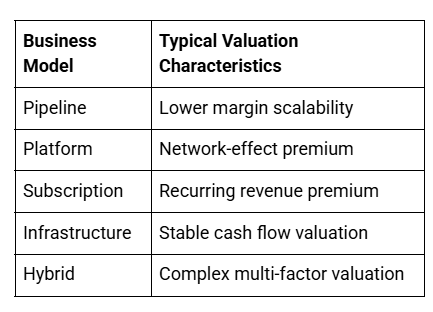
This is why investment analysts and portfolio managers prioritize accurate classification during equity analysis.
AI and Financial Forecasting
Ai report generator systems are improving financial forecasting accuracy by connecting business model characteristics with operational metrics.
For example:
- Subscription businesses prioritize retention analysis.
- Platform companies focus on user engagement and monetization.
- Infrastructure firms emphasize utilization rates and long-term contracts.
This helps wealth managers, financial advisors, and asset managers generate stronger portfolio insights.
AI and Market Sentiment Analysis
AI also improves market sentiment analysis by detecting how investors discuss business model transitions.
For example, analysts may evaluate whether markets are rewarding:
- AI infrastructure companies
- Marketplace ecosystems
- Cloud subscription providers
- Financial technology platforms
Changes in investor sentiment often influence equity market outlook trends and capital allocation strategies.
How AI Detects Business Model Transition Risks
Many companies attempt platform or subscription transitions to improve equity valuation.
However, these transitions carry operational and financial risk.
AI systems monitor signals such as:
- Margin deterioration
- User retention changes
- Ecosystem participation
- Monetization efficiency
- Customer concentration risk
This improves financial risk mitigation and risk analysis accuracy.
Geographic Exposure and Business Model Scalability
Geographic exposure affects how scalable business models become across global markets.
For example:
- Platform businesses may scale rapidly in digitally mature economies.
- Subscription adoption varies across regions.
- Regulatory restrictions may affect ecosystem expansion.
Emerging Markets Analysis has become increasingly important in AI-driven investment research because monetization quality differs significantly between regions.
The Role of AI in Competitive Benchmarking
AI tools can compare companies operating under similar business models more efficiently.
Equity research automation platforms now benchmark:
- Gross margins
- Revenue growth
- Customer retention
- Market Share Analysis
- Profitability Analysis
- Cost of capital efficiency
This improves financial research quality and helps portfolio managers identify relative valuation opportunities.
Why Institutional Investors Are Increasing AI Adoption
Institutional investors are adopting ai for equity research because business models are becoming more complex.
Modern equity markets now include:
- AI infrastructure ecosystems
- Embedded finance platforms
- Digital commerce ecosystems
- Blockchain-based networks
- Cloud marketplaces
Traditional manual workflows struggle to analyze these structures at scale.
AI-driven financial research tool systems improve operational efficiency while supporting faster investment insights generation.
Risks of Overreliance on AI Classification
Although AI improves classification accuracy, analysts still need human oversight.
Several risks remain:
- Misinterpreting management language
- Overfitting operational patterns
- Missing strategic context
- Ignoring macroeconomic outlook conditions
- Underestimating geopolitical factors
Strong investment strategy development still requires experienced investment analysts and financial consultants.
The Future of AI in Equity Research
Over the next decade, AI-driven business model classification will likely become standard across equity research reports and investment banking workflows.
Future systems may automatically detect:
- Ecosystem evolution
- Monetization shifts
- Platform transition stages
- Revenue quality deterioration
- Competitive positioning changes
This will improve equity analysis precision across global equity markets.
FAQs
What is business model classification in equity research?
Business model classification identifies how companies generate revenue, scale operations, and create long-term value.
Why is AI useful for business model classification?
AI processes large operational datasets quickly and identifies patterns that manual research workflows may miss.
How does classification affect valuation?
Different business models have different scalability, profitability, and risk characteristics, which influence valuation methods.
Can companies operate under multiple business models?
Yes. Many modern firms combine platform, subscription, infrastructure, and pipeline operations simultaneously.
Why do institutional investors use AI in equity research?
AI improves research speed, operational efficiency, financial forecasting, and portfolio insights generation.
Conclusion
AI for equity research is reshaping how investment research teams classify and evaluate business models across global industries. Analysts are moving beyond traditional sector labels and focusing more on operational structures, monetization quality, scalability, and ecosystem dynamics.
As ai for data analysis, equity research automation, and equity search automation continue evolving, analysts can generate deeper equity analysis and stronger investment insights with greater speed and consistency. Asset managers, wealth managers, financial advisors, and investment analysts increasingly rely on AI-powered financial research tool systems to improve valuation accuracy and market positioning analysis.
GenRPT Finance supports this transformation by helping organizations generate scalable equity research reports, faster investment research workflows, and AI-powered business model intelligence for modern financial markets.
