
Capital Efficiency: Is the Company Creating Value From Its Assets?
October 29, 2026 | By GenRPT Finance
A company can generate strong revenue, report increasing profits, and continue expanding its operations without necessarily creating meaningful value from the assets it owns. For equity research analysts, understanding how efficiently a business uses its capital is essential to evaluating financial performance and long-term investment potential.
Capital efficiency measures how effectively a company uses its financial and operating resources to generate revenue, profits, and cash flow. It helps analysts determine whether management is allocating capital productively or investing substantial resources without generating adequate returns.
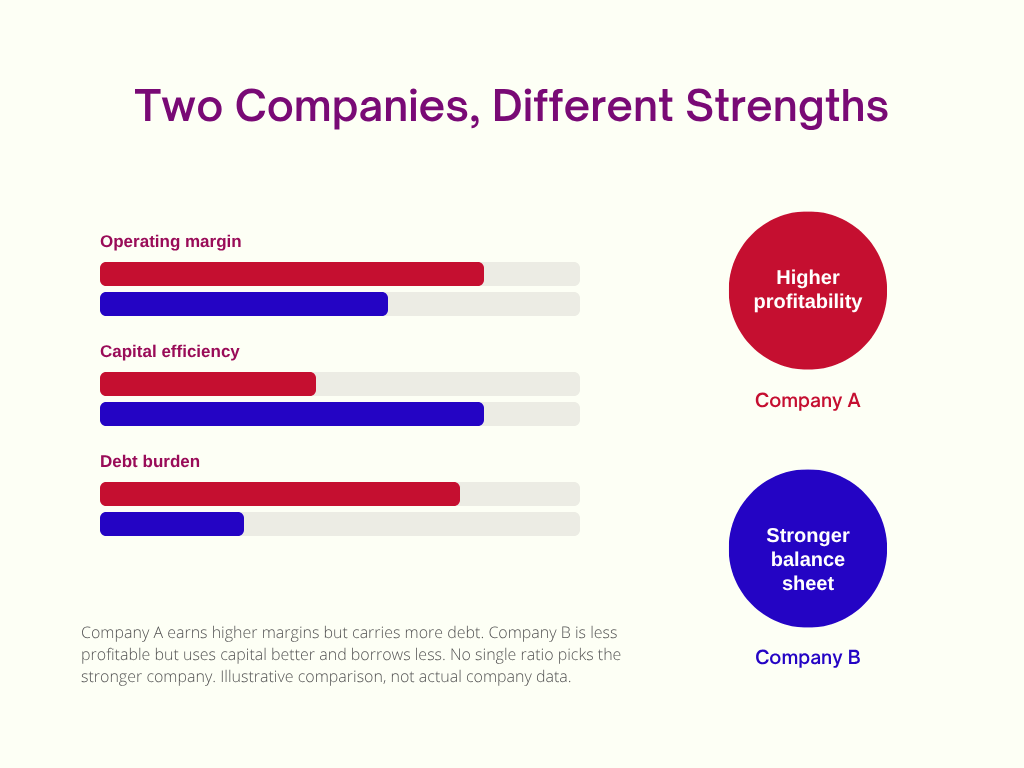
Consider two manufacturing companies operating in the same industry. Both generate similar revenue and operating profits, but one requires significantly greater investment in factories, equipment, inventory, and working capital.
Although their reported profitability may appear comparable, the company requiring less capital may have a more efficient business model.
However, capital efficiency is not simply about minimizing investment. Companies often need to invest in infrastructure, technology, employees, and expansion opportunities to support future growth.
The important question is whether those investments generate returns that justify the capital committed.
For institutional investors, asset managers, and equity research analysts, capital efficiency analysis provides insight into business quality, management effectiveness, financial resilience, and sustainable value creation.
What Is Capital Efficiency in Equity Research?
Capital efficiency refers to a company’s ability to generate economic returns from the capital invested in its operations.
Businesses require different forms of capital to function. Manufacturers invest in production facilities and equipment, retailers maintain stores and inventory, and technology companies invest in software development, infrastructure, and customer acquisition.
These investments are intended to support revenue generation and future profitability.
However, the amount of capital required to generate earnings varies significantly across businesses.
A company that produces attractive operating profits with relatively modest capital requirements may have greater financial flexibility than a competitor requiring continuous investment to maintain similar results.
Capital efficiency analysis helps analysts understand these differences.
It also provides insight into whether management is creating value through investment decisions.
A business may increase its total profits by expanding operations, but if the additional capital generates inadequate returns, the expansion may not create economic value.
This distinction is important because growth and value creation are not always the same.
Why Higher Revenue Does Not Always Mean Better Capital Efficiency
Revenue growth is frequently used to evaluate business expansion.
However, increasing sales does not necessarily indicate that a company is using its resources efficiently.
For example, a manufacturing company may double its production capacity to support expected demand.
The expansion may generate higher revenue, but it also requires substantial investment in machinery, facilities, raw materials, and employees.
If the additional revenue produces relatively modest operating profits, the company may experience declining capital efficiency.
Another manufacturer may achieve similar revenue growth by improving production utilization and optimizing existing facilities.
This company may generate stronger returns because it does not require the same level of additional investment.
The difference becomes particularly important when analysts evaluate long-term financial performance.
Revenue growth supported by efficient capital utilization may contribute to stronger cash generation and more attractive returns.
Growth that requires disproportionately large investment can create pressure on cash flow and financing requirements.
Analysts therefore examine the relationship between business expansion and the capital required to support it.
Return on Invested Capital and Value Creation
Return on invested capital, commonly known as ROIC, is one of the most important measures used to evaluate capital efficiency.
It helps analysts assess how effectively a company generates operating returns from the capital invested in its business.
ROIC is particularly useful because it focuses on the economic productivity of the capital supporting operations.
For example, two companies may report similar operating profits.
However, one may have invested substantially more capital to generate those profits.
The company with the higher return on invested capital may have a more efficient operating structure.
A consistently attractive ROIC can indicate several business strengths, including pricing power, efficient operations, disciplined investment decisions, or competitive advantages.
However, the interpretation requires context.
A company with older assets may report a higher ROIC partly because depreciation has reduced the accounting value of its asset base.
Similarly, acquisitions, goodwill, and differences in accounting treatment can influence invested capital.
Analysts therefore examine the underlying business drivers rather than relying exclusively on the reported ratio.
Why the Cost of Capital Matters
A company does not create economic value simply because it generates a positive accounting profit.
The capital invested in a business has an economic cost.
Shareholders expect returns for accepting investment risk, while lenders require compensation for providing financing.
The weighted average cost of capital, or WACC, is commonly used to represent the blended required return associated with a company’s financing structure.
Comparing returns on invested capital with the cost of capital helps analysts evaluate whether the business is generating sufficient returns.
For example, a company may report a return on invested capital of 14% while its estimated cost of capital is 9%.
Under these assumptions, the business is generating returns above its capital cost, indicating positive economic value creation.
Another company may generate a return of 7% against an estimated cost of capital of 10%.
Although it may report accounting profits, its operating returns would be insufficient to cover the estimated economic cost of capital.
This distinction helps analysts evaluate the quality of growth and management’s capital allocation decisions.
However, the cost of capital is itself an estimate and can change with market conditions, financing structures, and perceived business risk.
Asset Turnover and the Productivity of Business Assets
Asset turnover provides insight into how effectively a company uses its asset base to generate revenue.
It is particularly relevant when comparing businesses with similar operating models.
For example, a retailer may generate strong sales from a relatively small network of stores and distribution facilities.
A competitor may require significantly more physical infrastructure to generate comparable revenue.
The first business may demonstrate stronger asset productivity.
However, higher asset turnover does not automatically mean greater value creation.
A company may generate substantial revenue while operating with very low profit margins.
Another may have lower asset turnover but benefit from premium pricing and stronger profitability.
Analysts therefore evaluate asset turnover alongside operating margins and returns on capital.
Asset turnover can also be influenced by the age of assets, accounting policies, and recent investment activity.
A company that has recently built new facilities may temporarily report weaker asset utilization before those facilities reach full operating capacity.
Understanding the investment cycle is essential when interpreting the ratio.
How Operating Margins Influence Capital Efficiency
Capital efficiency depends not only on how much revenue a company generates from its assets but also on how much operating profit it earns from that revenue.
Operating margins help analysts evaluate the profitability of business activities.
A company with strong asset utilization but weak margins may generate limited returns on invested capital.
For example, a logistics company may operate its facilities at high capacity but face intense pricing competition.
Although its assets are heavily utilized, profitability may remain relatively low.
Another company may generate lower revenue relative to its asset base but maintain stronger margins through specialized services or premium pricing.
Both operating efficiency and profitability influence capital returns.
Analysts therefore examine how asset utilization and operating margins interact.
Improvements in capital efficiency may come from generating more revenue using existing assets, improving profitability, or combining both approaches.
However, analysts must determine whether these improvements are sustainable.
Temporary cost reductions or unusually favourable market conditions may not represent lasting changes in business economics.
Working Capital Efficiency and Cash Generation
Working capital is an important component of capital efficiency because it represents resources committed to everyday business operations.
Companies may need to finance inventory, customer receivables, and other short-term operating requirements.
The amount of working capital required varies across industries and business models.
For example, a retailer may receive payment from customers immediately while negotiating longer payment periods with suppliers.
This structure can reduce the amount of capital tied up in operations.
A manufacturing company may need to purchase raw materials, maintain inventory, and provide credit to customers before collecting payment.
These requirements can increase the capital needed to support revenue growth.
Analysts examine inventory turnover, receivable collection periods, and supplier payment practices to understand working capital efficiency.
However, reducing working capital is not always beneficial.
Insufficient inventory may disrupt operations, while overly restrictive customer payment terms may affect sales.
The objective is to maintain an appropriate balance between operational requirements and financial efficiency.
Capital Expenditure and the Cost of Maintaining Growth
Capital expenditure is another important factor in evaluating capital efficiency.
Companies invest in equipment, infrastructure, technology, and facilities to maintain existing operations or expand their businesses.
These investments can support future profitability, but they also require cash.
For example, a manufacturing company may report strong operating profits while investing heavily in machinery replacement and facility upgrades.
If these investments are necessary simply to maintain existing production levels, the business may have limited cash available for other purposes.
Another company may generate comparable operating profits with lower recurring capital expenditure requirements.
This business may have greater flexibility to fund expansion, reduce debt, or return capital to shareholders.
Analysts therefore distinguish between investment required to maintain operations and investment intended to support future growth.
The distinction is not always clearly disclosed, and estimates may be necessary.
Capital expenditure should also be evaluated over several years because investment requirements can fluctuate significantly.
When Capital-Intensive Businesses Can Still Create Strong Value
Capital-intensive businesses are not necessarily inefficient.
Industries such as utilities, telecommunications, manufacturing, transportation, and infrastructure often require substantial investment in physical assets.
The important consideration is whether those assets generate adequate returns over their economic lives.
For example, an infrastructure company may invest heavily in a project that takes several years to become operational.
During construction, capital is committed without generating substantial revenue.
Once the project becomes operational, it may produce relatively predictable cash flows over an extended period.
Evaluating such a business requires understanding project timelines, asset utilization, financing costs, and expected returns.
Similarly, a manufacturer may invest in automation that initially increases capital expenditure but eventually reduces operating costs.
These investments may improve long-term capital efficiency even if short-term financial ratios weaken.
Analysts should therefore avoid assuming that businesses with lower capital requirements are always superior.
Capital efficiency must be evaluated relative to industry economics and the expected returns from investment.
The Relationship Between Capital Efficiency and Competitive Advantage
Sustained capital efficiency can provide evidence of a company’s competitive strengths.
Businesses with strong brands, customer relationships, proprietary technology, or efficient operating systems may generate attractive returns without requiring proportionate increases in capital.
For example, a company with established distribution networks may expand sales through existing infrastructure.
A competitor entering the same market may need to invest heavily in facilities, marketing, and customer acquisition.
The established company may therefore achieve stronger returns on incremental investment.
However, competitive advantages are not permanent.
Technological disruption, changing customer preferences, and new market entrants can weaken previously attractive business economics.
Analysts examine whether high returns on capital are supported by durable advantages or temporary market conditions.
A company that consistently generates returns above its cost of capital may have an attractive business model.
But the sustainability of those returns depends on how effectively it can defend its competitive position.
Why Incremental Returns on Capital Matter
Historical return on invested capital provides insight into how efficiently a company has used its existing capital base.
However, investors are also interested in the returns generated by new investment.
Incremental returns on capital help analysts evaluate whether additional capital is producing attractive operating results.
For example, a company may have historically generated strong returns because of its established operations.
Management may then invest in a new business segment that requires substantial capital but produces relatively weak profits.
The company’s overall return on capital may remain attractive for some time because of its existing operations.
However, the returns on new investment may indicate that future growth is becoming less valuable.
Conversely, a company may experience improving capital efficiency as newer investments begin generating stronger returns.
Analysts therefore examine changes in operating profits relative to changes in invested capital over time.
This helps assess whether management is allocating additional resources productively.
How Acquisitions Affect Capital Efficiency
Acquisitions can significantly influence a company’s capital efficiency.
A business may acquire another company to expand its market presence, gain access to technology, or strengthen its competitive position.
However, acquisitions require capital and may introduce goodwill, additional debt, and integration expenses.
For example, a company may report higher revenue and operating profits after acquiring a competitor.
The increase in earnings may appear attractive, but analysts must evaluate the price paid for the acquisition.
If the acquired business generates inadequate returns relative to its purchase price, the transaction may reduce overall capital efficiency.
Acquisition accounting can also complicate financial comparisons.
Goodwill, intangible assets, and purchase price adjustments may influence reported invested capital and profitability.
Analysts therefore examine acquisition performance, integration progress, and the returns generated from the capital committed.
The objective is to determine whether acquisitions are creating economic value rather than simply increasing the company’s size.
Capital Allocation and Management Quality
Capital efficiency is closely connected to management’s investment decisions.
Management teams determine how a company allocates financial resources across business expansion, acquisitions, debt repayment, dividends, and share repurchases.
These decisions influence long-term shareholder value.
For example, a company generating substantial free cash flow may choose to reinvest in projects with attractive expected returns.
If suitable investment opportunities are limited, returning excess capital to shareholders may be more appropriate.
However, companies sometimes continue expanding into businesses that generate weak returns.
Such investments may increase revenue and reported assets without improving economic value.
Analysts evaluate whether management has demonstrated discipline in allocating capital.
They examine historical investment decisions, acquisition performance, capital expenditure outcomes, and shareholder distributions.
Management teams that consistently prioritize attractive risk-adjusted returns may be better positioned to create sustainable value.
How Capital Efficiency Influences Free Cash Flow
Capital efficiency has an important relationship with free cash flow.
A company that generates strong operating profits while requiring relatively modest reinvestment may produce substantial cash flow.
This provides flexibility to finance growth, reduce borrowing, or distribute cash to shareholders.
For example, a business may increase revenue through existing facilities without needing significant additional capital expenditure.
The resulting growth may contribute to stronger free cash flow.
Another company may need to invest heavily in equipment and working capital to achieve similar revenue expansion.
Although both companies may report comparable earnings growth, their cash generation can differ substantially.
Analysts therefore evaluate capital efficiency alongside operating cash flow and capital expenditure.
However, short-term free cash flow can be affected by investment timing.
A company undertaking a major expansion may temporarily report weak free cash flow even when the project is expected to generate attractive future returns.
The sustainability and purpose of investment are important considerations.
Why Capital Efficiency Matters in Company Valuation
Company valuation depends on expectations about future earnings, cash flow, growth, and risk.
Capital efficiency influences these expectations because it determines how much investment a company requires to support future growth.
A business generating strong returns on invested capital may be able to expand while creating economic value.
However, a company generating returns below its cost of capital may destroy value through additional investment, even when revenue and earnings increase.
This distinction is important in Discounted Cash Flow analysis.
Analysts must estimate not only future operating profits but also the capital required to generate those profits.
For example, two companies may be expected to achieve similar earnings growth.
If one requires substantially less reinvestment, it may generate greater free cash flow over time.
That difference can materially influence intrinsic value.
Capital efficiency also helps analysts evaluate whether premium market valuations are supported by underlying business economics.
Why High Capital Efficiency Does Not Always Mean an Attractive Investment
A company can have excellent capital efficiency and still represent an unattractive investment at a particular market price.
Business quality and stock attractiveness are related but distinct concepts.
For example, a company may generate consistently high returns on invested capital, maintain strong profitability, and possess durable competitive advantages.
However, investors may already recognize these strengths and assign the company a high valuation.
If the market price assumes unusually strong future growth, the potential investment return may be limited.
Conversely, a company with weaker current capital efficiency may offer an attractive opportunity if its operations are improving and its valuation adequately reflects existing risks.
Analysts therefore evaluate capital efficiency alongside growth expectations, financial risk, and market valuation.
The objective is not simply to identify companies with strong financial ratios.
It is to determine whether the expected future performance justifies the price investors must pay.
How Analysts Evaluate Capital Efficiency Across Different Industries
Capital efficiency varies considerably across industries.
Manufacturing companies often require substantial investment in production facilities, equipment, and inventory.
Retail businesses depend on store productivity, inventory management, and distribution efficiency.
Technology companies may have relatively limited physical asset requirements but significant investment in research, development, and customer acquisition.
Utilities and infrastructure businesses may operate with large asset bases that generate cash flows over extended periods.
These differences affect how analysts interpret financial ratios.
For example, comparing the asset turnover of a software company with that of a power generation company may provide limited insight because their operating models are fundamentally different.
Accounting treatment also matters.
Some investments in intangible capabilities are expensed immediately, while certain other expenditures are capitalized.
This can influence reported assets, operating profits, and returns on capital.
Meaningful comparisons therefore require appropriate industry benchmarks and an understanding of financial reporting differences.
Warning Signs of Weak Capital Efficiency
Weak capital efficiency may become visible through several financial and operational developments.
A company may continue increasing capital expenditure without achieving corresponding improvements in operating profitability.
Its asset base may expand while revenue growth slows.
Working capital requirements may rise faster than sales, reducing cash conversion.
Acquisitions may increase reported revenue but fail to generate adequate returns relative to their purchase prices.
A company may also experience declining returns on invested capital despite reporting higher total earnings.
However, these developments require careful interpretation.
A temporary decline in capital efficiency may reflect investment in new facilities or business capabilities that have not yet reached full utilization.
The important question is whether the company has a credible path toward generating attractive returns from those investments.
Analysts examine historical performance, management explanations, project economics, and industry conditions before reaching conclusions.
How Capital Efficiency Changes Across a Company’s Life Cycle
Capital efficiency can change as a company develops.
Early-stage businesses may require substantial investment in infrastructure, product development, and customer acquisition before generating meaningful profits.
During rapid expansion, companies may increase capital expenditure and working capital to support future demand.
As operations mature, existing assets may become more productive, improving capital efficiency.
However, mature companies can also experience declining returns if growth opportunities become limited or competitive conditions weaken.
For example, a manufacturing company may initially invest heavily in new production facilities.
During the early years, utilization may remain relatively low.
As production increases and fixed costs are spread across greater output, returns on capital may improve.
Analysts therefore consider the company’s development stage and investment cycle when evaluating capital efficiency.
A single reporting period may not accurately represent the long-term economics of the business.
How AI Supports Capital Efficiency Analysis
Capital efficiency analysis requires analysts to examine financial statements, historical investment patterns, operating performance, and management disclosures.
These activities can become time-consuming when comparing multiple companies across several reporting periods.
AI-supported research tools can assist with extracting financial information, organizing historical datasets, and identifying trends in capital utilization.
For example, automated analysis may highlight situations where invested capital increases faster than operating profits.
It may also help analysts compare asset turnover, working capital requirements, and returns on invested capital across relevant companies.
AI can support scenario analysis by examining how changes in revenue growth, operating margins, or capital expenditure assumptions influence future financial performance.
However, capital efficiency analysis involves more than calculating financial ratios.
Analysts must understand the economic purpose of investments and evaluate whether expected returns are realistic.
Automated findings therefore require validation against company disclosures and business conditions.
How GenRPT Finance Supports Capital Efficiency Analysis
GenRPT Finance supports institutional equity research through Agentic AI-driven financial statement analysis, peer benchmarking, financial modelling, valuation, and research report generation.
Its research workflows can help analysts examine relationships between operating profitability, invested capital, asset utilization, working capital, and cash generation.
For example, financial statement analysis can support the evaluation of historical returns on capital, while peer benchmarking provides context for comparing capital efficiency across relevant businesses.
Financial modelling and scenario analysis can also help analysts assess how changes in capital expenditure, operating margins, and growth assumptions may influence future returns.
These findings can contribute to valuation analysis and investment thesis development.
By reducing repetitive data processing and report preparation, GenRPT Finance can help investment professionals dedicate more time to understanding capital allocation decisions and evaluating whether business growth is creating economic value.
However, analysts remain responsible for validating financial information, selecting appropriate comparisons, and assessing the sustainability of projected returns.
Conclusion
Capital efficiency provides an important perspective on company performance because it connects profitability with the resources required to generate it.
A business may report strong revenue growth and increasing earnings, but those results become more meaningful when analysts understand how much capital was required to achieve them.
Return on invested capital, asset turnover, operating margins, working capital efficiency, and free cash flow help reveal how effectively a company uses its resources.
However, capital efficiency must be evaluated within the context of industry economics, investment cycles, accounting practices, and future growth opportunities.
A company that consistently generates returns above its cost of capital may be creating economic value, while one that expands through low-return investments may weaken long-term shareholder returns.
The real measure of capital efficiency is not how much a company owns or how quickly it grows, but how effectively it converts invested resources into sustainable economic value.
For equity research analysts, understanding this relationship is essential when evaluating business quality, management performance, and long-term investment potential.
FAQs
Capital efficiency measures how effectively a company uses invested capital and operating assets to generate revenue, profits, and cash flow. It helps analysts evaluate business productivity and economic value creation.
Common measures include return on invested capital, return on assets, asset turnover, operating profit margin, working capital efficiency, and free cash flow measures.
Return on invested capital helps analysts evaluate how effectively a company generates operating returns from its invested capital. Comparing ROIC with the cost of capital can provide insight into economic value creation.
Yes. Revenue growth may require substantial additional investment. If the returns generated by that investment are insufficient relative to the cost of capital, growth may not create economic value.
Not necessarily. Higher asset turnover may indicate efficient asset utilization, but analysts must also consider profitability, asset age, accounting practices, and the capital requirements of the industry.
Capital efficiency influences the amount of reinvestment required to support future growth. Companies that generate attractive returns with lower incremental capital requirements may produce stronger free cash flow and support higher intrinsic valuations, all else equal.
AI can assist with financial data extraction, historical ratio analysis, peer benchmarking, and scenario modelling. Analysts remain responsible for evaluating the economic significance of the findings.
