
Competitive Intelligence in Equity Research: A Complete Guide
July 8, 2026 | By GenRPT Finance
Competitive intelligence is the process of collecting, analyzing, and interpreting information about competitors, industry dynamics, customer behavior, and market developments to support better business and investment decisions. In equity research, it helps analysts understand how a company performs relative to its peers, where its competitive advantages lie, and what external factors may influence its future growth. Rather than evaluating a company in isolation, competitive intelligence places business performance within the broader competitive landscape.
A company can report strong revenue growth, expanding margins, and healthy cash flow while still losing market share to faster-growing competitors. Another business may experience slower earnings growth because it is investing heavily in innovation that strengthens its long-term competitive position. Financial statements alone rarely provide this context.
This is why competitive intelligence has become an essential part of investment research, equity analysis, and long-term investment strategy. Analysts use it to understand why companies outperform or underperform their peers, how industries evolve over time, and where future opportunities and risks may emerge.
According to Crayon’s State of Competitive Intelligence Report, more than 90% of organizations say competitive intelligence directly influences strategic decision-making. While this research focuses on businesses, the same principle applies to institutional investing. Understanding competitors often explains future business performance better than historical financial results alone.
What Is Competitive Intelligence in Equity Research?
Competitive intelligence is much more than monitoring competing companies.
It involves gathering publicly available information from multiple sources and transforming it into actionable investment insights.
Research teams analyze:
- Competitor financial performance
- Product launches
- Pricing strategies
- Customer trends
- Industry developments
- Regulatory changes
- Market share movements
- Technological innovation
Instead of simply collecting information, analysts identify relationships between these factors to understand how they may affect future earnings and shareholder value.
For example, if a company maintains stable revenue while several competitors report accelerating growth, analysts investigate whether the business is losing market share, facing pricing pressure, or operating in slower-growing customer segments.
This broader perspective strengthens equity research and improves investment recommendations.
Why Looking Only at One Company Creates Blind Spots
Financial statements explain how a business has performed.
Competitive intelligence explains whether that performance is strong relative to the rest of the industry.
Consider two software companies.
Both report annual revenue growth of 18%.
At first glance, they appear equally attractive.
However, industry research shows that one company’s market is expanding by 30% annually while the other operates in a mature market growing at only 8%.
Although their reported growth is identical, their competitive positions are very different.
The first company may actually be losing market share despite impressive financial performance.
The second may be outperforming nearly every competitor.
Without competitive intelligence, these important differences remain hidden.
The Core Components of Competitive Intelligence
Professional investment analysts evaluate competitive intelligence across several interconnected areas.
Competitor Performance
The first step involves understanding how competing businesses perform financially.
Analysts compare:
- Revenue growth
- Profitability Analysis
- Operating margins
- Earnings growth
- Cash flow
- Return on capital
Peer benchmarking provides valuable context that individual company analysis cannot deliver.
Market Position
Financial performance alone does not determine market leadership.
Analysts also evaluate:
- Market Share Analysis
- Customer base
- Geographic presence
- Distribution networks
- Brand recognition
- Pricing power
Businesses with strong market positions often maintain profitability even during economic slowdowns.
Understanding market position also supports stronger Equity Valuation assumptions.
Product Innovation
Innovation often determines future competitiveness.
Research teams monitor:
- New product launches
- Research and development spending
- Patent activity
- Technology investments
- Digital transformation initiatives
Companies consistently introducing successful products often strengthen their competitive advantages over time.
Innovation also influences financial forecasting because it affects future revenue growth and profitability.
Pricing Strategy
Pricing decisions reveal important information about competitive pressure.
If companies repeatedly reduce prices to maintain market share, margins may decline across the industry.
Conversely, businesses with strong pricing power often demonstrate durable competitive advantages.
Analysts evaluate:
- Pricing changes
- Gross margins
- Customer retention
- Premium positioning
- Discounting activity
These indicators help explain long-term earnings performance beyond quarterly financial results.
Customer and Industry Trends
Customer preferences constantly evolve.
Analysts monitor changing demand by evaluating:
- Consumer behavior
- Industry reports
- Customer reviews
- Subscription growth
- Enterprise adoption
- Emerging technologies
Understanding customer trends helps explain why some businesses gain market share while others struggle to maintain relevance.
Industry developments also influence broader market trends, creating opportunities for companies capable of adapting quickly.
How Analysts Turn Competitive Intelligence Into Investment Decisions
Collecting competitive information is only the first step.
The real value comes from interpreting that information alongside financial performance.
Professional analysts combine competitor data with fundamental analysis, management commentary, industry reports, and market developments to determine whether a company’s competitive position is strengthening or weakening.
For example, a company reporting stable revenue may initially appear to be performing well.
However, if competitors are growing significantly faster, analysts investigate whether the business is losing customers, facing pricing pressure, or falling behind in innovation.
Similarly, temporary earnings declines may not always be a negative signal. If the company is investing heavily in research, expanding manufacturing capacity, or entering new markets while competitors reduce investment, those decisions may strengthen its long-term position.
This broader analysis produces stronger investment insights and more balanced investment recommendations.
Competitive Intelligence Improves Equity Valuation
Competitive intelligence directly influences how analysts value companies.
Valuation depends on assumptions about future revenue growth, profitability, competitive positioning, and market opportunities.
Analysts use competitor benchmarking to evaluate whether those assumptions are realistic.
Important areas include:
- Revenue growth compared with industry peers
- Profit margins
- Customer acquisition
- Pricing power
- Product innovation
- Market expansion
These comparisons influence:
- Equity Valuation
- Financial modeling
- Revenue projections
- Long-term profitability
- cost of capital
For example, if one company consistently outperforms competitors while maintaining higher margins and stronger customer retention, analysts may assign higher valuation multiples because its competitive advantages appear more sustainable.
Competitive Intelligence Strengthens Business Quality Assessment
Business quality and competitive intelligence work together.
A business may appear financially strong, but competitive analysis determines whether those strengths are durable.
For example, analysts evaluate whether a company’s:
- Competitive advantages remain difficult to replicate.
- Market share continues to grow.
- Product portfolio keeps pace with industry innovation.
- Management responds effectively to competitive threats.
- Customers remain loyal despite increasing competition.
These insights strengthen business quality frameworks by placing internal performance within the context of the broader industry.
Instead of evaluating management decisions independently, analysts assess how those decisions compare with competitors facing similar market conditions.
Real-World Examples of Competitive Intelligence
Competitive intelligence is visible across almost every industry.
In the semiconductor industry, companies are evaluated not only on revenue growth but also on technology leadership, manufacturing capacity, AI investments, and customer demand. Comparing these factors helps analysts understand why certain businesses maintain stronger competitive positions than others.
The global beverage industry provides another example.
Companies compete using brand recognition, pricing strategies, product innovation, distribution strength, and regional market presence. Financial performance alone cannot explain long-term market leadership without understanding these competitive dynamics.
The same principle applies across banking, healthcare, manufacturing, retail, and technology.
The strongest investment decisions are based on understanding how companies compete, not simply how they performed during the last quarter.
AI Is Transforming Competitive Intelligence
Competitive intelligence requires reviewing enormous amounts of information.
Analysts study annual reports, earnings call transcripts, investor presentations, product announcements, regulatory filings, market news, analyst reports, and industry publications before forming an investment opinion.
Modern ai for equity research significantly improves this process.
Using ai data analysis, AI platforms automatically collect, organize, compare, and summarize information across multiple competitors.
Instead of manually reading hundreds of documents, analysts receive structured insights highlighting:
- Competitive positioning
- Market share changes
- Product launches
- Pricing developments
- Governance updates
- Industry trends
- Regulatory changes
An ai report generator combines these insights with financial analysis to produce comprehensive equity research reports, allowing analysts to spend more time interpreting opportunities and risks instead of gathering information.
Common Mistakes Investors Make
Competitive intelligence is valuable only when applied correctly.
One common mistake is evaluating companies using only financial statements.
Another is focusing exclusively on market share without considering profitability or innovation.
Some investors compare businesses operating in completely different competitive environments, leading to unrealistic conclusions.
Others rely on outdated competitor information even though industries evolve rapidly.
Professional analysts avoid these mistakes by continuously monitoring competitors, benchmarking performance against appropriate peer groups, and combining quantitative financial data with qualitative business analysis.
Instead of a workflow, place Competitive Intelligence in the centre as a hub.
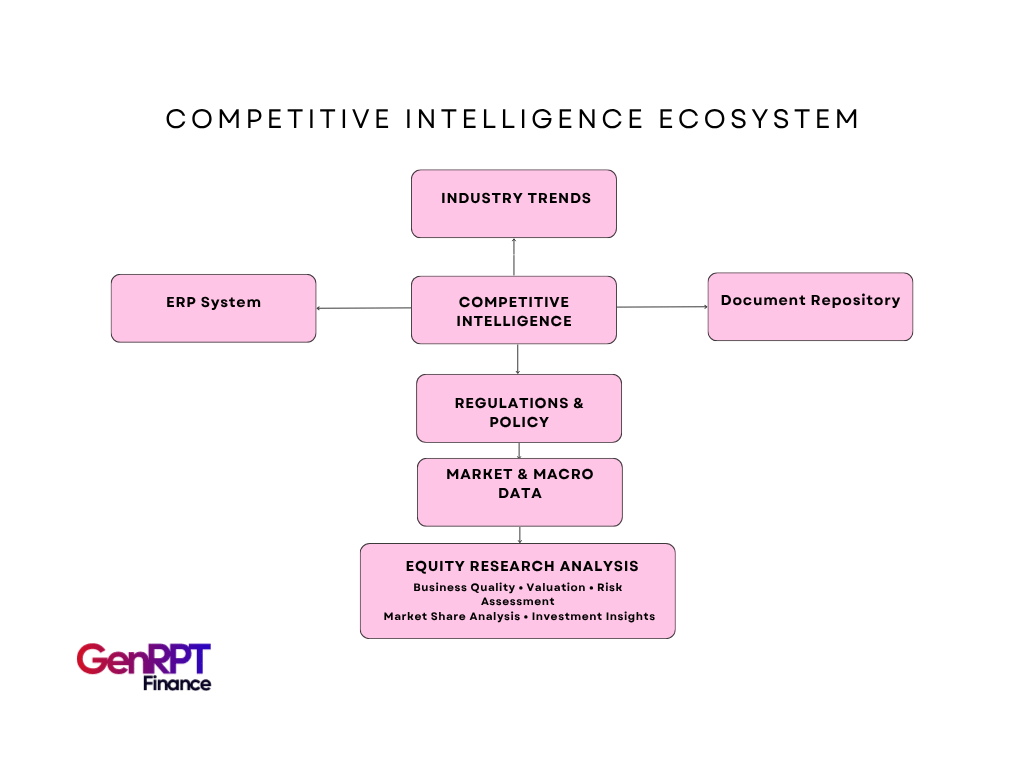
Around it, create five connected circles:
- Competitors
- Customers
- Industry Trends
- Regulations
- Market & Macroeconomic Data
At the bottom, show the outputs:
- Equity Research
- Business Quality
- Valuation
- Risk Assessment
- Portfolio Strategy
This creates an ecosystem rather than a process flow and visually reinforces that competitive intelligence combines multiple information sources.
Conclusion
Competitive intelligence enables investors to understand not only how a company performs but also why it performs that way compared with its competitors. By combining competitor benchmarking, industry analysis, customer trends, market developments, and financial performance, analysts develop a more complete understanding of long-term business quality and investment potential. This broader perspective improves valuation, strengthens risk assessment, and supports more confident investment decisions.
GenRPT Finance simplifies competitive intelligence by bringing together financial statements, annual reports, earnings calls, regulatory filings, market news, and peer comparisons into comprehensive AI-powered research reports. Powered by Yodaplus Agentic AI services, the platform helps investment professionals automate competitor analysis, identify emerging market trends, benchmark business performance, and generate deeper investment insights with greater speed and consistency.
FAQs
Competitive intelligence is the process of collecting and analyzing information about competitors, industry developments, customer behavior, and market trends to support investment research and decision-making.
It helps investors understand a company’s competitive position, identify long-term growth opportunities, evaluate risks, and compare business performance against industry peers.
Analysts use annual reports, earnings calls, investor presentations, regulatory filings, market news, industry reports, customer data, and competitor disclosures to evaluate competitive positioning.
Competitive intelligence provides context for revenue growth, profitability, market share, and competitive advantages, helping analysts build more realistic valuation models and financial forecasts.
Yes. AI analyzes large volumes of financial and market data, compares competitors, identifies emerging trends, summarizes insights, and supports faster, more consistent equity research.
GenRPT Finance combines competitor benchmarking, financial analysis, market intelligence, earnings call analysis, regulatory monitoring, and AI-powered research automation into comprehensive equity research reports, helping investment teams make faster and better-informed decisions.
