
Corporate Governance in Equity Research: A Critical Investment Signal
July 1, 2026 | By GenRPT Finance
Corporate governance is one of the strongest investment signals because it reveals how a company is managed, how decisions are made, how risks are controlled, and whether leadership is acting in the interests of shareholders. Strong governance often translates into better capital allocation, higher financial transparency, lower operational risk, and more sustainable long-term returns. Weak governance, on the other hand, has repeatedly been responsible for some of the largest corporate failures despite impressive revenue growth and attractive financial statements.
For anyone involved in equity research, governance is no longer just a compliance checklist. It has become an important part of fundamental analysis, Equity Valuation, portfolio risk assessment, and long-term investment strategy. Institutional investors increasingly evaluate governance alongside earnings growth, competitive positioning, and financial accounting quality before making investment decisions.
According to the CFA Institute, governance quality has become one of the most widely incorporated Environmental, Social, and Governance (ESG) factors in investment decisions. PwC’s Global Investor Survey found that over 70% of institutional investors believe poor governance significantly increases investment risk, while McKinsey research has shown investors are willing to pay a premium for companies with strong governance practices.
For investment analysts, portfolio managers, asset managers, wealth managers, and financial advisors, governance has become an early warning system that often identifies problems long before they appear in financial statements.
Why Corporate Governance Matters More Than Ever
Financial statements only show what has already happened.
Corporate governance provides clues about what may happen next.
A company with excellent quarterly performance but poor governance may still destroy shareholder value through questionable acquisitions, aggressive accounting, executive misconduct, or poor risk management.
History offers numerous examples.
Enron appeared financially strong until governance failures surfaced.
Wirecard maintained impressive growth before massive accounting fraud emerged.
Satyam Computer Services collapsed despite healthy reported earnings due to corporate misconduct.
In each case, governance weaknesses existed well before the financial collapse.
Strong governance helps answer questions that numbers alone cannot.
- Does management allocate capital responsibly?
- Are executive incentives aligned with shareholders?
- Does the board challenge leadership decisions?
- Are auditors truly independent?
- Are minority shareholders protected?
- Is disclosure timely and transparent?
These questions increasingly appear in every comprehensive equity research report produced by institutional research teams.
Governance as a Leading Indicator Instead of a Lagging Metric
Traditional financial metrics are historical.
Revenue growth reflects past sales.
Margins represent previous operating efficiency.
Cash flow summarizes completed business activity.
Corporate governance, however, is forward-looking.
Governance influences future strategic decisions, future capital allocation, future acquisitions, future financing, and future shareholder returns.
This makes governance one of the few investment variables capable of improving financial forecasting and Scenario Analysis before financial deterioration begins.
Investment firms now combine governance analysis with:
- Financial modeling
- Sensitivity analysis
- Ratio Analysis
- Profitability Analysis
- Market Sentiment Analysis
- market risk analysis
- financial risk assessment
Together, these create much stronger investment insights than financial data alone.
The Governance Factors That Investors Actually Measure
Corporate governance extends far beyond board independence.
Professional investment research evaluates governance across multiple dimensions.
Board Structure
Analysts examine:
- Independent directors
- Board diversity
- Director expertise
- Committee independence
- Attendance records
- CEO-Chairperson separation
Companies with independent boards generally demonstrate stronger oversight and lower governance risk.
Executive Compensation
Investors evaluate whether management compensation rewards long-term value creation instead of short-term earnings.
Questions include:
- Are bonuses tied to sustainable growth?
- Are incentives linked to shareholder returns?
- Are executives rewarded despite poor performance?
Misaligned incentives often encourage aggressive accounting or excessive risk-taking.
Capital Allocation
Good governance becomes visible through capital allocation.
Research teams study whether management:
- Invests in productive assets
- Avoids unnecessary acquisitions
- Controls debt responsibly
- Maintains healthy cash reserves
- Returns excess capital efficiently
Poor capital allocation frequently destroys shareholder value despite growing revenues.
Financial Transparency
Transparent companies communicate openly.
Analysts examine:
- Earnings quality
- Accounting consistency
- Audit reports
- Regulatory disclosures
- Management commentary
- Investor presentations
Greater financial transparency reduces uncertainty and improves valuation confidence.
Real Case Study: Microsoft’s Governance Premium
Microsoft has consistently ranked among companies with strong governance practices.
Its governance strengths include:
- Independent board oversight
- Consistent shareholder communication
- Transparent capital allocation
- Disciplined acquisitions
- Long-term executive incentives
Combined with operational performance, these governance qualities have contributed to sustained investor confidence.
Between 2014 and 2025, Microsoft’s market capitalization increased by several trillion dollars while maintaining strong institutional ownership and relatively stable governance scores.
Governance alone did not create shareholder value, but it significantly reduced uncertainty surrounding management decisions.
Governance in Emerging Markets
Governance analysis becomes even more important when investing internationally.
Many institutional investors adjust required returns based on governance quality across different regions.
During Emerging Markets Analysis, analysts evaluate:
- Ownership concentration
- Family-controlled businesses
- Regulatory enforcement
- Minority shareholder protection
- Political influence
- Disclosure standards
Poor governance increases the cost of capital, reducing company valuations.
Strong governance lowers perceived investment risk and attracts global institutional capital.
This directly influences global exposure decisions for diversified portfolios.
How Governance Improves Equity Valuation
Governance affects almost every component of Equity Valuation.
Better governance often results in:
- Lower discount rates
- Lower equity risk premium
- More reliable revenue projections
- Higher valuation multiples
- Reduced uncertainty
For example, when performing Discounted Cash Flow analysis, analysts may reduce the required return for companies demonstrating consistently strong governance.
Likewise, weak governance often requires valuation discounts due to higher uncertainty.
Governance therefore influences both assumptions and final valuation.
Governance and Portfolio Risk Analysis
Good governance contributes significantly to portfolio risk analysis.
Instead of simply evaluating volatility, investors increasingly examine governance risk alongside:
- Credit risk
- Liquidity risk
- Operational risk
- Regulatory risk
- Cybersecurity risk
- Reputational risk
This broader risk assessment provides more complete portfolio insights.
For institutional investors managing billions in assets, avoiding governance failures often proves more valuable than identifying the next high-growth company.
How AI Is Changing Governance Research
Governance analysis traditionally required enormous manual effort.
Analysts reviewed thousands of pages including:
- Annual reports
- Proxy statements
- Board disclosures
- Earnings call transcripts
- Regulatory filings
- Audit reports
- News coverage
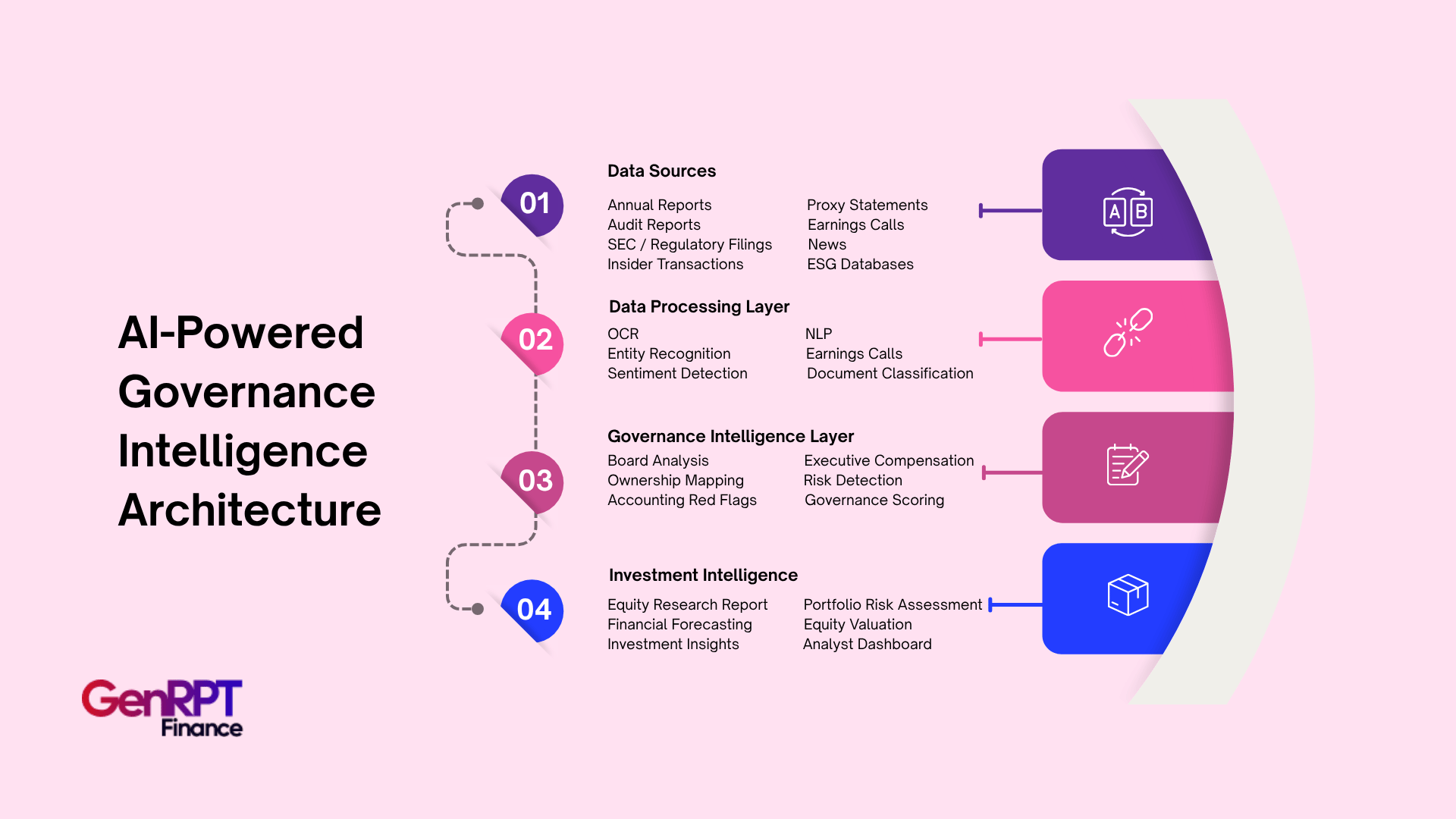
Modern ai for equity research dramatically accelerates this process.
AI systems automatically identify:
- Governance controversies
- Executive changes
- Board restructuring
- Insider transactions
- Regulatory actions
- Accounting policy changes
Using ai data analysis, analysts can continuously monitor governance developments instead of reviewing reports quarterly.
An advanced ai report generator also summarizes governance developments into structured sections within equity research reports, significantly reducing manual effort.
This allows financial data analyst teams to spend more time interpreting governance signals instead of collecting data.
Governance Combined With Fundamental Analysis
Governance works best when integrated with broader equity analysis.
Professional research teams combine governance with:
- Industry positioning
- Competitive advantages
- Market Share Analysis
- geographic exposure
- market trends
- macroeconomic outlook
- financial forecasting
- Financial modeling
- valuation methods
- performance measurement
A company with excellent governance but declining competitive position may still struggle.
Likewise, strong growth with weak governance introduces substantial investment uncertainty.
Combining governance with traditional fundamental analysis produces a much stronger investment framework.
Best Practices for Analysts Evaluating Governance
Professional research teams typically follow several best practices:
- Compare governance across industry peers rather than in isolation.
- Study governance trends over multiple years instead of a single reporting period.
- Read management commentary alongside financial statements.
- Examine board independence and executive incentives together.
- Monitor regulatory investigations, auditor changes, and insider transactions continuously.
- Incorporate governance scores into risk analysis, valuation assumptions, and investment strategy rather than treating governance as a separate checklist.
When governance becomes an integrated part of the research process, it provides stronger conviction behind investment recommendations and reduces the likelihood of overlooking structural risks.
Conclusion
Corporate governance is no longer viewed as a soft qualitative factor. It has become a measurable investment signal that influences valuation, financial risk mitigation, portfolio at risk, capital allocation decisions, and long-term shareholder returns. Companies with transparent leadership, disciplined boards, responsible capital allocation, and strong disclosure practices consistently inspire greater investor confidence and often command valuation premiums.
As the volume of financial disclosures continues to grow, manual governance analysis is becoming increasingly difficult. AI-driven research platforms now help analysts process governance data at scale by combining equity research automation, financial research, financial research tool capabilities, and continuous monitoring into a single workflow.
GenRPT Finance by Yodaplus helps institutional investors, research teams, and advisory firms automate governance analysis by synthesizing annual reports, audit reports, earnings calls, regulatory filings, and market developments into comprehensive research outputs. Combined with Yodaplus Agentic AI services, organizations can build faster, more consistent, and more data-driven investment research while improving governance monitoring, portfolio decision-making, and enterprise-scale financial intelligence.
FAQs
Corporate governance in equity research refers to evaluating how a company’s leadership, board structure, executive compensation, transparency, and internal controls influence investment quality, risk, and long-term shareholder value.
Governance provides insight into management quality, capital allocation, and risk controls. Strong governance often indicates lower investment risk and more sustainable long-term performance.
Governance influences discount rates, the cost of capital, valuation multiples, and assumptions used in financial models. Companies with stronger governance often receive higher valuations due to lower perceived risk.
Analysts commonly review board independence, executive compensation, audit quality, ownership structure, shareholder rights, disclosure practices, insider transactions, and capital allocation decisions.
AI automates the review of annual reports, audit reports, regulatory filings, earnings call transcripts, and news to identify governance risks, detect trends, and generate structured governance summaries for analysts.
Governance helps identify strategic, operational, and reputational risks that may not yet appear in financial statements. Including governance in portfolio risk analysis improves long-term investment decisions.
Yes. Numerous studies have shown that companies with strong governance often experience lower risk, greater investor confidence, better capital allocation, and stronger long-term shareholder returns compared with poorly governed peers.
