
Equity Research Analysis: A Complete Guide for Investment Analysts
September 30, 2026 | By GenRPT Finance
Equity research analysis considers a company’s financial performance, competitive position, risks, growth prospects, valuation, and other factors that determine its potential as a profitable investment. It is a detailed process that combines fundamental analysis, financial modelling, industry research, and qualitative assessment to help investment analysts, asset managers, portfolio managers, and wealth managers make informed investment decisions.
Rather than focusing solely on market movements, equity research aims to understand the underlying drivers of a company’s performance and how they are likely to create long-term value for shareholders.
As financial markets become increasingly data-driven, analysts need to evaluate more information than ever before. A single company can publish hundreds of pages of financial reports, earnings call transcripts, regulatory filings, investor presentations, and market analyses every quarter. According to McKinsey, generative AI could contribute between $200 billion and $340 billion annually in productivity gains for the banking sector by improving research and other knowledge-intensive activities. As a result, investment firms are increasingly adopting AI to support equity research.
What is equity research analysis?
Equity research analysis involves collecting, analysing, and interpreting financial and business information to estimate a company’s intrinsic value.
The objective is to answer questions such as:
- Is the company fundamentally healthy?
- Can the company sustain future growth?
- Is the stock fairly valued?
- What risks could affect future performance?
- How does the company compare with its competitors?
Professional equity research goes beyond reviewing annual reports. It combines quantitative analysis with qualitative judgement to develop a well-supported investment thesis.
Who uses equity research analysis?
Equity research is used by a wide range of financial professionals, including:
- Asset managers
- Portfolio managers
- Investment analysts
- Wealth managers
- Financial advisors
- Financial consultants
- Investment banking professionals
- Pension funds
- Sovereign wealth funds
- Family offices
Although each group has different responsibilities, they all rely on equity research to make informed financial decisions.
The objectives of equity research analysis
The primary objective of research is to reduce uncertainty.
Analysts aim to:
- Estimate intrinsic value
- Identify investment opportunities
- Assess business quality
- Understand competitive advantages
- Measure financial risk
- Improve portfolio risk assessment
- Support long-term investment strategies
Research does not eliminate uncertainty. Instead, it enables analysts to make evidence-based decisions rather than relying on assumptions or speculation.
The building blocks of equity research
Professional equity research combines several analytical disciplines to develop a complete understanding of a business.
Financial statement analysis
Every research process begins with a detailed review of the company’s financial statements.
Analysts examine:
- Income statements
- Balance sheets
- Cash flow statements
- Notes to accounts
- Auditor’s observations
These documents provide the foundation for financial accounting, ratio analysis, and profitability analysis.
Business quality assessment
Financial performance is only one part of the picture. Analysts also assess whether the business can continue creating value over the long term.
Areas of focus include:
- Business model
- Customer economics
- Pricing power
- Innovation capabilities
- Market position
- Operational performance
Businesses with strong fundamentals are generally better positioned to perform well under changing market conditions.
Industry analysis
A company should always be analysed within the context of its industry.
Research analysts evaluate:
- Industry growth
- Market size
- Industry structure
- Competitive landscape
- Regulatory environment
- Technology trends
This provides valuable context for estimating future revenue growth and long-term performance.
Competitive analysis
Comparing a company with its competitors helps analysts understand its relative strengths and weaknesses.
Common comparison metrics include:
- Revenue growth
- Profit margins
- Return on Equity (ROE)
- Enterprise Value
- Market share
- Capital allocation
These comparisons show whether the company is outperforming or underperforming its peers.
Financial metrics analysts monitor
Institutional analysts closely monitor financial metrics because they provide objective measures of business performance.
Some of the most important metrics include:
- Revenue growth
- EBITDA
- Earnings Per Share (EPS)
- Return on Equity (ROE)
- Return on Invested Capital (ROIC)
- Gross Margin
- Operating Margin
- Free Cash Flow
- Debt-to-Equity Ratio
- Enterprise Value
- Price-to-Earnings (P/E) Ratio
- Price-to-Book (P/B) Ratio
Together, these metrics provide insights into profitability, operational efficiency, liquidity, and valuation.
The importance of valuation
Even an excellent company may not be a good investment if it is significantly overvalued.
Valuation analysis helps analysts estimate what a company is worth based on expected future cash flows and required rates of return.
Common valuation methods include:
- Discounted Cash Flow (DCF)
- Comparable Company Analysis
- Precedent Transactions
- Dividend Discount Model
- Sum-of-the-Parts Valuation
Most analysts use multiple valuation approaches to improve confidence in their conclusions.
Risk analysis is equally important
Every investment carries some degree of risk.
Professional analysts evaluate:
- Financial risk
- Operational risk
- Industry risk
- Regulatory risk
- Currency risk
- Geographic exposure
- Interest rate risk
- Market risk
Understanding these risks is essential for making informed investment decisions and strengthening portfolio risk assessment.
Macroeconomic analysis
The broader economic environment has a significant influence on business performance.
Analysts monitor factors such as:
- Macroeconomic outlook
- Inflation
- Interest rates
- GDP growth
- Consumer spending
- Commodity prices
- Government policies
These factors directly influence financial forecasts, valuation assumptions, and long-term investment decisions.
Behavioural factors
Institutional investors recognise that markets are influenced by both data and investor psychology.
Analysts therefore monitor:
- Market sentiment analysis
- Investor positioning
- Earnings expectations
- Analyst consensus
- Behavioural biases
This helps distinguish temporary market reactions from genuine changes in a company’s long-term value.
How AI is transforming equity research
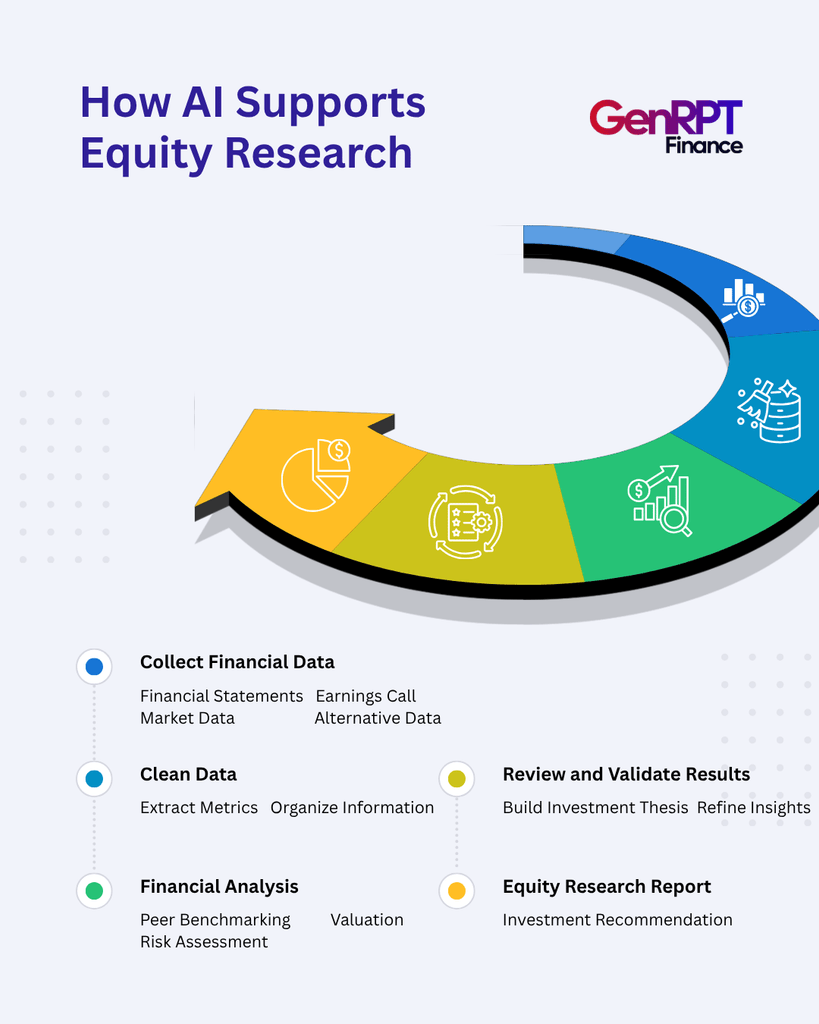
Modern equity research automation allows analysts to process much larger volumes of information efficiently.
AI can support:
- Financial statement analysis
- Earnings call summarisation
- Alternative data analysis
- Competitor benchmarking
- Scenario analysis
- Sensitivity analysis
- Financial forecasting
- Equity research report generation
Rather than replacing analysts, AI reduces repetitive work and allows research teams to focus on higher-value activities such as interpreting results, refining investment theses, and making informed investment decisions.
Institutional equity research workflow
Institutional research follows a disciplined process rather than ad hoc analysis. Every company is evaluated using a repeatable workflow that improves consistency across analysts and sectors.
A typical workflow includes:
- Company screening
- Data collection
- Financial statement analysis
- Industry and competitor analysis
- Financial modelling
- Valuation
- Risk assessment
- Investment thesis development
- Internal review
- Equity research report publication
Following a structured workflow reduces errors and makes investment recommendations easier to validate.
Building an investment thesis
The investment thesis is one of the most important outputs of investment research.
A strong thesis explains:
- Why the company is attractive.
- What competitive advantages it has.
- Which risks investors should monitor.
- What assumptions support the valuation.
- What events could change the recommendation?
Rather than summarising financial results, analysts explain the factors expected to drive future performance.
Decision frameworks used by institutional analysts
Professional research teams rarely rely on a single framework.
They combine multiple approaches such as:
- SWOT Analysis
- Porter’s Five Forces
- Industry Structure Analysis
- Economic Moat Analysis
- Scenario Analysis
- Sensitivity Analysis
- Quality Assessment Frameworks
- Capital Allocation Reviews
Each framework answers different questions and strengthens the overall investment process.
The growing role of alternative data
Traditional financial reports remain the foundation of research, but many firms now use alternative datasets to gain additional insights.
Examples include:
- Credit card transaction data
- Website traffic
- Mobile app usage
- Satellite imagery
- Shipping activity
- ESG data
- Job postings
- Consumer reviews
Alternative data helps analysts identify business trends before they appear in quarterly financial statements.
Research automation is changing analyst workflows.
Modern research teams spend less time gathering information and more time interpreting it.
Automation now supports:
- Financial data collection
- Company screening
- Earnings call summaries
- Peer benchmarking
- Financial modelling updates
- Draft report generation
This allows analysts to cover more companies while maintaining research quality.
Cloud collaboration improves research quality
Large research teams often work across multiple locations.
Cloud-based research platforms improve collaboration by providing:
- Shared financial models
- Centralised research notes
- Version control
- Secure document storage
- Real-time updates
This reduces duplicate work and improves consistency across research teams.
Measuring research quality
Institutional firms regularly evaluate the quality of their research.
Common performance measures include:
- Forecast accuracy
- Report turnaround time
- Investment performance
- Model accuracy
- Research consistency
- Portfolio performance
- Analyst productivity
Reviewing these metrics helps firms continuously improve their research processes.
Common challenges in equity research
Despite advances in technology, research teams still face several challenges.
These include:
- Increasing data volumes
- Information overload
- Market volatility
- Short reporting timelines
- Changing regulations
- Behavioural bias
- Maintaining data quality
- Forecast uncertainty
Managing these challenges requires disciplined workflows and continuous improvement.
Best practices followed by leading research teams
Successful institutional research teams follow several principles.
They:
- Standardise research methodologies.
- Validate every financial assumption.
- Use multiple valuation methods.
- Compare companies with industry peers.
- Monitor macroeconomic developments.
- Review risks continuously.
- Maintain transparent documentation.
- Combine quantitative and qualitative analysis.
- Update research after every material event.
- Use AI to improve efficiency while keeping analysts responsible for final recommendations.
These practices improve research consistency and reduce decision-making bias.
The future of equity research analysis
The next generation of equity research will combine analyst expertise with intelligent automation.
Emerging trends include:
- Multi-agent AI research systems
- Continuous company monitoring
- Real-time valuation updates
- Automated financial modelling
- Natural language processing for earnings calls
- Alternative data integration
- Predictive financial forecasting
- AI-assisted investment insights
Although technology will continue to evolve, institutional investors will still rely on experienced analysts to interpret information, challenge assumptions, and make final investment decisions.
Conclusion
Equity research analysis remains one of the most important disciplines in professional investing. It helps investment analysts, asset managers, wealth managers, and portfolio managers evaluate businesses, estimate intrinsic value, assess equity risk, and develop well-supported investment recommendations. By combining fundamental analysis, financial modeling, market sentiment analysis, valuation methods, scenario analysis, and financial forecasting, analysts can build a complete picture of a company’s long-term potential.
Technology is making this process faster, but the objective remains unchanged: making informed, evidence-based investment decisions. AI can automate repetitive work, process large datasets, and improve productivity, while analysts continue to provide judgment, context, and strategic thinking.
GenRPT Finance is built to support modern institutional equity research through Agentic AI. It automates financial statement analysis, earnings call interpretation, peer benchmarking, valuation modelling, scenario analysis, AI data analysis, and report generation within a unified workflow. This enables research teams to produce institutional-grade equity research reports faster while maintaining transparency, governance, and analyst oversight.
FAQs
Equity research analysis is the structured evaluation of a company’s financial performance, competitive position, valuation, and risks to determine its investment potential.
Analysts need strong financial modelling, accounting knowledge, valuation expertise, industry analysis, critical thinking, and communication skills to produce high-quality research.
Financial modelling helps analysts estimate future revenue, earnings, cash flows, and intrinsic value, supporting more informed investment decisions.
AI automates data collection, financial analysis, earnings call summarisation, peer benchmarking, and report generation, allowing analysts to focus on higher-value analysis and investment strategy.
GenRPT Finance uses Agentic AI to automate financial analysis, valuation modelling, earnings call analysis, peer benchmarking, forecasting, and institutional-grade equity research report generation, helping analysts improve productivity while maintaining research quality.
