
What Is Customer Economics in Equity Research?
August 3, 2026 | By GenRPT Finance
Customer growth is often seen as a sign of business success, but it does not always translate into profitable growth. A company can acquire thousands of new customers every year and still struggle financially if acquisition costs are too high or customers leave quickly. This is why customer economics has become an essential part of equity research.
Customer economics examines how efficiently a business acquires, retains, and monetises its customers. Instead of focusing only on revenue growth, analysts evaluate whether each customer creates long-term value and contributes to sustainable profitability. Understanding customer economics allows investment analysts to assess business quality, forecast future performance, and make better investment decisions.
What does customer economics mean?
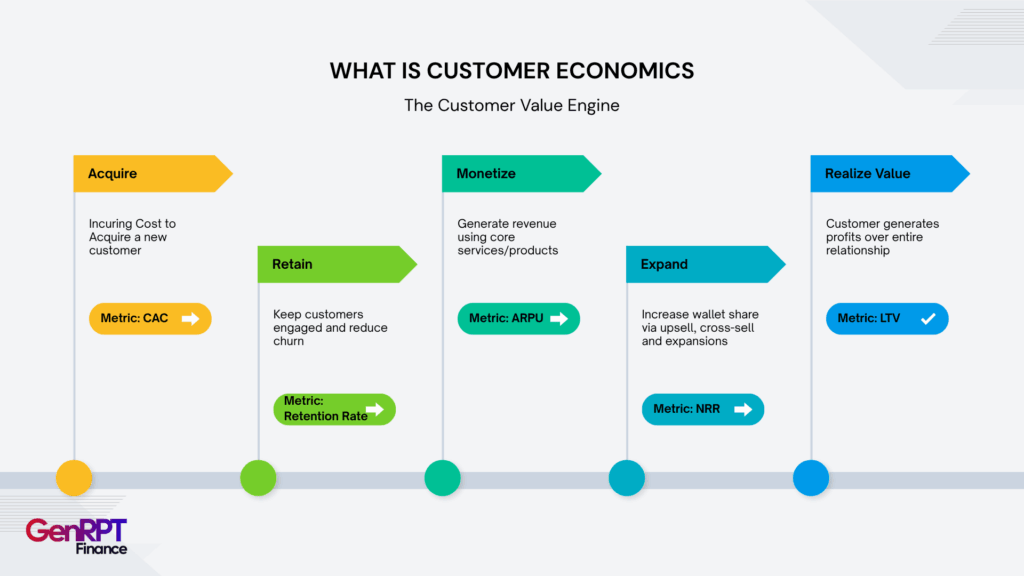
Customer economics refers to the financial relationship between a company and its customers throughout the customer lifecycle.
It answers questions such as:
- How much does it cost to acquire a customer?
- How much profit does each customer generate?
- How long do customers stay with the company?
- Are customers becoming more valuable over time?
- Can the business grow profitably?
By answering these questions, analysts gain a better understanding of whether a company’s growth strategy is sustainable.
Why customer economics is important
Revenue growth alone does not guarantee business success.
For example, two companies may each increase revenue by 20%, but one could spend significantly more on sales and marketing to achieve that growth. The business with healthier customer economics is likely to generate stronger long-term returns.
According to Bain & Company, increasing customer retention by just 5% can increase profits by 25% to 95% in many industries, highlighting why customer economics is closely linked to business performance.
Key components of customer economics
Customer Acquisition Cost (CAC)
Customer Acquisition Cost measures how much a company spends to acquire a new customer.
It includes expenses such as:
- Marketing campaigns
- Sales salaries
- Advertising
- Promotions
- Customer onboarding
Lower acquisition costs generally improve profitability if customer value remains high.
Customer Lifetime Value (LTV)
Customer Lifetime Value estimates the total profit a company expects to earn from a customer throughout the relationship.
A higher LTV indicates that customers continue generating revenue over a longer period.
Customer retention
Retention measures how successfully a company keeps existing customers.
High retention usually reflects:
- Strong products
- Good customer experience
- Brand loyalty
- Switching costs
Companies with high retention often require less spending on acquiring replacement customers.
Customer churn
Churn measures the percentage of customers who stop using a product or service.
High churn can reduce profitability by increasing customer acquisition costs and lowering recurring revenue.
Net Revenue Retention (NRR)
NRR measures how revenue from existing customers changes over time after considering renewals, upgrades, expansions, and cancellations.
A Net Revenue Retention above 100% often indicates that existing customers are increasing their spending.
How customer economics supports equity research
Customer economics helps analysts understand whether revenue growth is supported by strong business fundamentals.
It improves:
- Equity analysis
- Business quality assessment
- Financial forecasting
- Valuation assumptions
- Long-term profitability analysis
- Competitive positioning
Instead of relying solely on historical financial performance, analysts evaluate whether customer relationships can support future growth.
Industries where customer economics matters most
Customer economics is particularly important in businesses with recurring customer relationships.
These include:
- SaaS companies
- FinTech platforms
- E-commerce businesses
- Telecommunications providers
- Subscription services
- Consumer technology companies
However, customer economics is increasingly relevant across many industries as businesses focus more on customer retention and recurring revenue.
Challenges in evaluating customer economics
Analysts often face several challenges when reviewing customer metrics.
These include:
- Limited disclosure of customer data
- Different reporting methods across companies
- Changing pricing strategies
- Industry-specific performance measures
- Differences in customer behaviour
To overcome these challenges, analysts combine customer metrics with financial reports, industry research, and competitive benchmarking.
How AI improves customer economics analysis
Modern equity research automation helps analysts evaluate customer economics more efficiently by processing large volumes of structured and unstructured information.
AI can:
- Analyse financial reports
- Monitor customer growth trends
- Compare customer metrics across competitors
- Review earnings calls
- Detect changes in pricing strategies
- Identify customer behaviour patterns
- Support AI for equity research through advanced AI data analysis
Automating these tasks enables analysts to focus on understanding how customer behaviour affects long-term business performance.
Conclusion
Customer economics helps analysts evaluate whether a company’s growth is efficient, profitable, and sustainable. By analysing customer acquisition, retention, lifetime value, churn, and recurring revenue, analysts gain valuable insights into business quality and future growth potential. Combining customer economics with financial analysis strengthens equity research, improves financial forecasting, and supports better investment decisions.
GenRPT Finance enhances customer economics analysis through Agentic AI that analyses financial statements, earnings calls, customer metrics, competitor performance, and industry trends. By automating benchmarking and research, it helps analysts generate institutional-grade equity research reports with greater speed, consistency, and depth.
FAQs
Customer economics evaluates how efficiently a company acquires, retains, and monetises customers to generate sustainable long-term value.
It helps analysts determine whether business growth is profitable, scalable, and supported by strong customer relationships.
Key metrics include Customer Acquisition Cost (CAC), Customer Lifetime Value (LTV), customer churn, retention rate, Net Revenue Retention (NRR), and payback period.
Customer economics is especially important for SaaS, fintech, retail, telecommunications, subscription-based businesses, and consumer technology companies.
GenRPT Finance uses Agentic AI to analyse financial statements, customer metrics, earnings calls, competitor performance, and market trends, helping analysts generate institutional-grade equity research reports more efficiently.
