
Why Does Industry Structure Matter in Equity Research?
July 29, 2026 | By GenRPT Finance
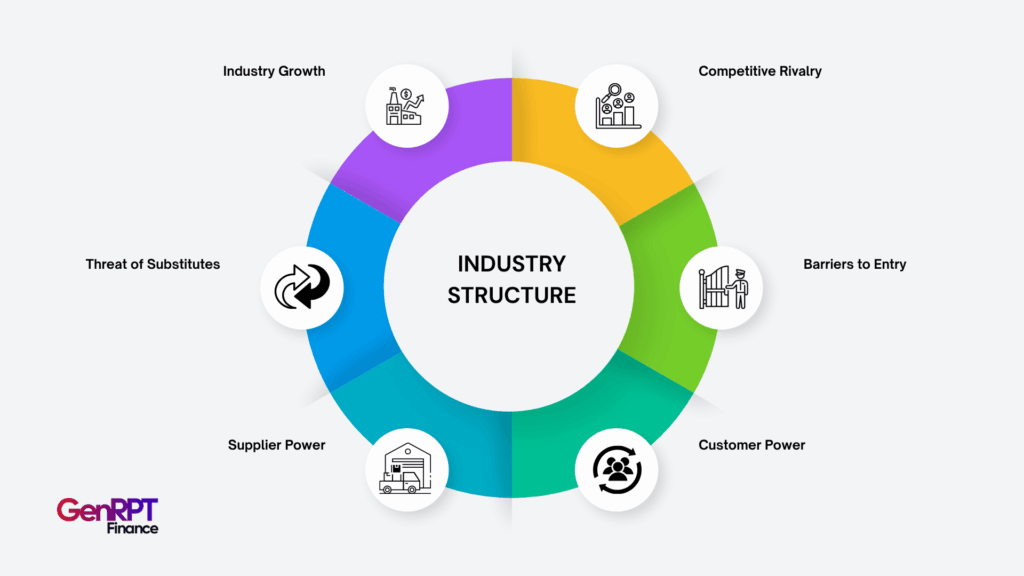
A company’s financial performance is shaped not only by its strategy and execution but also by the industry in which it operates. Even well-managed businesses can struggle if they compete in highly fragmented or low-margin industries, while companies in favourable industries often enjoy stronger profitability and sustainable growth. This is why understanding industry structure is an essential part of equity research.
Industry structure provides the context behind a company’s financial results. It helps investment analysts assess competitive pressures, estimate future earnings, evaluate business quality, and build more reliable valuation models. Without understanding the industry environment, financial metrics alone can present an incomplete picture.
According to McKinsey, industry effects account for a significant portion of the differences in company profitability across markets, making industry analysis a critical step in investment research.
It helps analysts understand profitability
Industry structure directly influences a company’s ability to generate profits.
For example, industries with:
- High barriers to entry
- Limited competition
- Strong customer loyalty
- Few substitute products
often allow companies to maintain healthy margins and stable earnings.
In contrast, industries with intense competition and frequent price wars typically experience lower profitability, regardless of how efficiently individual companies operate.
Understanding these differences helps analysts determine whether current earnings are sustainable.
It improves valuation accuracy
Valuation depends on future expectations rather than historical performance alone.
Industry structure influences:
- Revenue growth potential
- Profit margins
- Capital requirements
- Cash generation
- Long-term returns
Businesses operating in attractive industries often receive higher valuation multiples because investors expect stronger future performance and lower competitive risk.
Industry analysis therefore strengthens equity valuation and supports more realistic financial forecasting.
It explains competitive advantages
A company’s competitive position becomes easier to evaluate when analysts understand its industry.
They examine whether the company benefits from:
- Strong pricing power
- Brand recognition
- Economies of scale
- Network effects
- Proprietary technology
- Distribution advantages
These factors help explain why some businesses consistently outperform competitors.
Industry structure also helps distinguish temporary success from sustainable competitive advantages.
It helps assess investment risk
Different industries carry different levels of risk.
Analysts evaluate risks such as:
- New competitors entering the market
- Regulatory changes
- Technological disruption
- Changing customer preferences
- Supplier dependence
- Commodity price volatility
Understanding these risks allows analysts to produce more balanced risk analysis and make better-informed investment recommendations.
It supports industry benchmarking
Financial metrics become more meaningful when companies are compared with their peers.
Industry benchmarking allows analysts to compare:
- Revenue growth
- Operating margins
- Return on invested capital
- Market share
- Free cash flow
- Capital allocation
A company may appear profitable in isolation but underperform significantly when compared with competitors operating in the same industry.
Benchmarking improves the quality of equity analysis by placing financial performance in the proper competitive context.
It reveals long-term growth opportunities
Industry structure helps analysts identify industries with stronger long-term growth potential.
They consider factors such as:
- Market demand
- Industry maturity
- Innovation
- Customer adoption
- Regulatory support
- Global expansion opportunities
Companies operating in growing industries often have greater opportunities to increase revenue and market share than businesses in declining sectors.
It strengthens forecasting
Forecasts become more reliable when they account for industry conditions.
Analysts incorporate industry trends into financial forecasting by evaluating:
- Market growth rates
- Competitive intensity
- Pricing trends
- Cost pressures
- Customer demand
- Capital investment requirements
This leads to more realistic earnings projections and valuation models.
It helps identify economic resilience
Not all industries respond equally to economic changes.
Some sectors remain relatively stable during economic slowdowns, while others experience significant fluctuations in demand.
Analysts evaluate industry resilience by considering:
- Cyclical versus defensive demand
- Dependence on consumer spending
- Exposure to interest rates
- Regulatory stability
- Global supply chain risks
Understanding resilience helps investors build stronger portfolios across different market conditions.
It provides context for company performance
Strong financial results do not always indicate superior management.
Sometimes performance reflects favourable industry conditions rather than exceptional execution.
Likewise, businesses operating in difficult industries may demonstrate excellent operational performance despite modest financial results.
Industry structure helps analysts separate company-specific strengths from industry-wide influences, leading to more balanced investment decisions.
How AI improves industry structure analysis
Modern equity research automation enables analysts to evaluate industries more efficiently by processing large volumes of structured and unstructured information.
AI can:
- Analyse competitor financial reports
- Monitor market share changes
- Track industry news and regulatory developments
- Compare operating performance across peer companies
- Identify emerging competitive threats
- Detect long-term industry trends
- Support AI for equity research through automated AI data analysis
By automating data collection and benchmarking, AI allows analysts to spend more time interpreting competitive dynamics and developing investment insights.
Conclusion
Industry structure provides the foundation for understanding how businesses compete, generate profits, and create long-term shareholder value. It helps analysts evaluate profitability, competitive advantages, investment risks, valuation, and growth opportunities while placing financial performance in the proper market context. Combining industry analysis with company fundamentals results in stronger equity research, more accurate forecasts, and better investment decisions.
GenRPT Finance enhances industry analysis through Agentic AI that evaluates financial statements, earnings calls, competitor performance, market data, and macroeconomic developments. It automates benchmarking, competitive analysis, and institutional-grade equity research reports, enabling analysts to produce deeper insights with greater speed and consistency.
FAQs
Industry structure helps analysts understand competition, profitability, growth potential, and risks, leading to more accurate valuations and investment decisions.
Industries with high barriers to entry, limited competition, and strong pricing power generally enable companies to achieve higher and more sustainable profit margins.
Comparing peers helps analysts assess whether a company’s financial performance reflects operational strength or simply favourable industry conditions.
Yes. Technological innovation, regulation, customer preferences, new competitors, and economic conditions can all change an industry’s competitive dynamics.
GenRPT Finance uses Agentic AI to analyse financial statements, competitor data, earnings calls, and market trends, helping analysts generate institutional-grade equity research reports with deeper industry and competitive insights.
