
How Do Analysts Evaluate Industry Structure in Equity Research?
July 29, 2026 | By GenRPT Finance
A company’s financial performance can only be fully understood when viewed in the context of the industry in which it operates. Strong revenue growth or healthy profit margins may look impressive, but they do not always indicate a sustainable competitive advantage. This is why analysing industry structure is a key step in equity research. It helps analysts understand the competitive forces that influence profitability, growth, and long-term shareholder value.
By evaluating industry structure, investment analysts can identify opportunities, assess risks, compare companies more effectively, and build stronger valuation models. Instead of focusing only on financial statements, they examine the broader market environment that shapes a company’s future performance.
Analyse competitive rivalry
The first step is understanding how intensely companies compete within an industry.
Analysts assess:
- Number of competitors
- Market concentration
- Price competition
- Product differentiation
- Innovation
- Market share distribution
Industries with fewer competitors and differentiated products generally offer stronger pricing power and higher profit margins than highly fragmented markets.
Evaluate barriers to entry
Barriers to entry determine how easily new competitors can enter the market.
Analysts examine:
- Capital investment requirements
- Government regulations
- Intellectual property
- Brand recognition
- Distribution networks
- Technology requirements
High barriers reduce competitive pressure and often support long-term profitability.
Assess customer bargaining power
Customers influence pricing and revenue stability.
Analysts evaluate:
- Customer concentration
- Switching costs
- Price sensitivity
- Contract duration
- Availability of alternatives
Companies with diversified customer bases and higher switching costs generally have stronger pricing power and more predictable revenue.
Assess supplier bargaining power
Suppliers also affect profitability by influencing input costs and operational flexibility.
Analysts review:
- Supplier concentration
- Dependence on key suppliers
- Availability of substitute suppliers
- Raw material costs
- Long-term supplier agreements
Higher supplier bargaining power can reduce operating margins and increase business risk.
Evaluate the threat of substitutes
Substitute products or services can limit a company’s growth potential.
Analysts examine:
- Emerging technologies
- Alternative products
- Consumer behaviour
- Product differentiation
- Switching costs
Industries with limited substitutes usually experience more stable demand and stronger profitability.
Study market concentration
Market concentration helps analysts understand how industry profits are distributed.
They analyse:
- Market share of leading companies
- Industry fragmentation
- Dominant players
- Competitive positioning
Highly concentrated industries often provide greater pricing stability than fragmented markets with numerous competitors.
Compare industry profitability
Industry structure is closely linked to financial performance.
Analysts compare companies using financial reports and evaluate metrics such as:
- Operating margin
- Gross margin
- EBITDA margin
- Return on invested capital (ROIC)
- Free cash flow
- Revenue growth
Peer comparisons help determine whether strong financial performance is driven by company execution or favourable industry conditions.
Examine industry growth
The future outlook of an industry is just as important as its current structure.
Analysts assess:
- Market size
- Growth rate
- Customer demand
- Technology adoption
- Regulatory support
- Global expansion opportunities
Growing industries often offer better long-term investment opportunities than mature or declining markets.
Consider macroeconomic and regulatory factors
External conditions can reshape industry structure over time.
Analysts evaluate:
- Interest rates
- Inflation
- Trade policies
- Government regulations
- Environmental requirements
- Geopolitical developments
These factors influence competition, profitability, and future growth prospects.
Benchmark against competitors
Industry analysis is incomplete without benchmarking.
Analysts compare companies across multiple dimensions, including:
- Revenue growth
- Market share
- Profitability
- Cash generation
- Capital allocation
- Valuation multiples
Benchmarking strengthens equity analysis by identifying businesses that consistently outperform industry peers.
Use recognised industry frameworks
To make industry evaluations more consistent, analysts often apply established strategic frameworks.
Common approaches include:
- Porter’s Five Forces to assess competitive intensity and profitability.
- PESTLE Analysis to evaluate political, economic, social, technological, legal, and environmental factors.
- SWOT Analysis to identify a company’s strengths, weaknesses, opportunities, and threats within its industry.
These frameworks complement financial analysis and help analysts build a broader understanding of competitive dynamics.
How AI improves industry structure evaluation
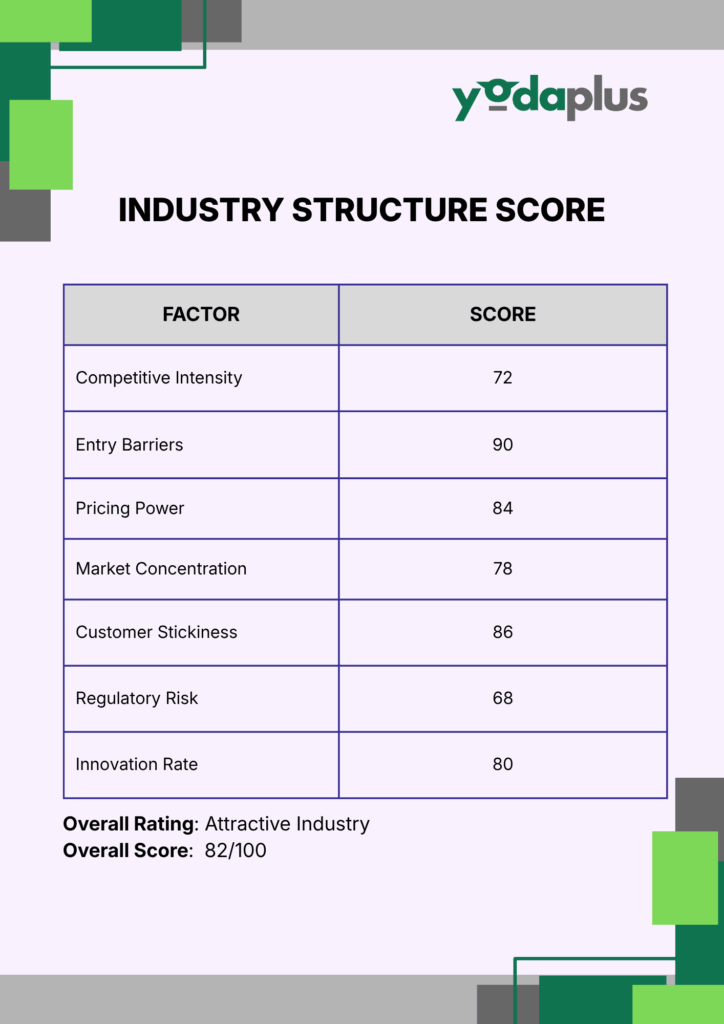
Modern equity research automation allows analysts to evaluate industries more efficiently by analysing large volumes of financial and market information.
AI can:
- Analyse competitor financial reports
- Track market share changes
- Summarise earnings calls
- Monitor regulatory developments
- Identify emerging competitive threats
- Benchmark financial performance automatically
- Support AI for equity research through advanced AI data analysis
According to the CFA Institute’s Global AI Survey, investment professionals are increasingly using AI to improve research productivity while focusing more on interpretation and investment decision-making.
Conclusion
Evaluating industry structure requires more than reviewing financial statements. Analysts study competitive rivalry, barriers to entry, bargaining power, substitute products, market concentration, industry growth, and macroeconomic influences to understand the environment in which a company operates. Combining these insights with company fundamentals results in stronger equity research, more accurate financial forecasting, and better investment decisions.
GenRPT Finance enhances this process through Agentic AI that analyses financial statements, earnings calls, competitor data, market trends, and macroeconomic developments. By automating benchmarking, competitive analysis, and institutional-grade equity research reports, it enables analysts to generate deeper insights with greater speed and consistency.
FAQs
Analysts evaluate industry structure by examining competitive rivalry, barriers to entry, customer and supplier bargaining power, substitute products, market concentration, and industry growth.
It helps analysts understand profitability, competitive advantages, investment risks, and future growth potential before making investment recommendations.
Analysts commonly use Porter’s Five Forces, PESTLE Analysis, SWOT Analysis, peer benchmarking, and financial analysis to evaluate industry structure.
Companies operating in attractive industries with sustainable competitive advantages often receive higher valuation multiples because they have stronger long-term earnings potential.
GenRPT Finance uses Agentic AI to analyse financial statements, competitor data, earnings calls, and industry trends, helping analysts generate institutional-grade equity research reports with deeper competitive and market insights.
