
Why Does Customer Economics Matter in Equity Research?
August 3, 2026 | By GenRPT Finance
Customer growth can make a company look successful, but growth alone does not determine business quality. A company may add thousands of new customers every quarter, yet still struggle to generate profits if acquisition costs continue rising or customers leave after a short period. This is why customer economics has become a key part of equity research.
Customer economics helps analysts understand whether growth is sustainable, profitable, and capable of creating long-term shareholder value. By evaluating how efficiently a company acquires, retains, and monetises its customers, investment analysts can build stronger valuation models, improve forecasts, and make better investment decisions.
According to Bain & Company, increasing customer retention by just 5% can increase profits by 25% to 95%, demonstrating why customer behaviour is one of the strongest indicators of long-term business performance.
It separates profitable growth from expensive growth
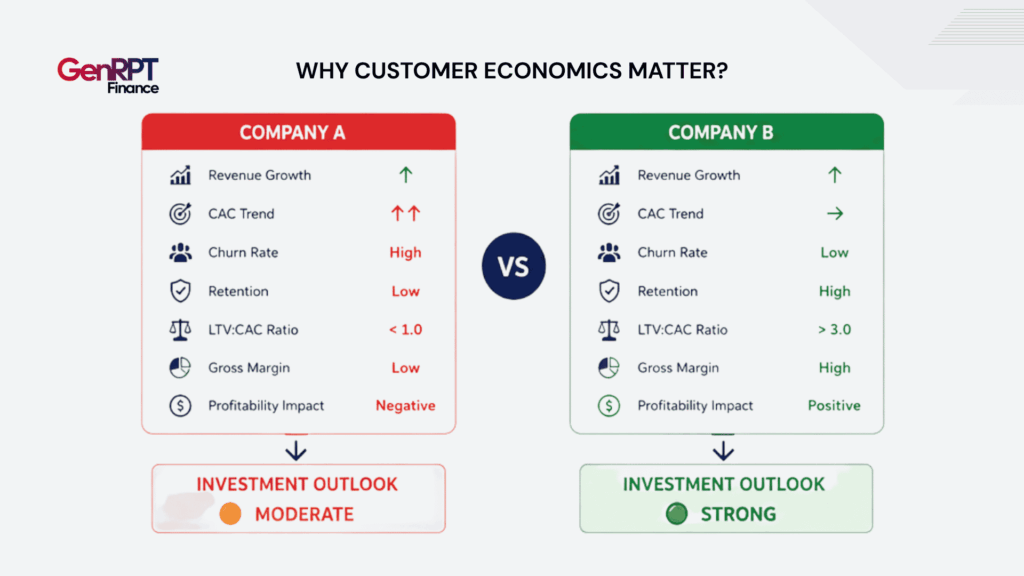
Revenue growth often receives the most attention, but not all growth creates value.
Some companies achieve impressive revenue increases by spending aggressively on marketing and sales. If customer acquisition costs continue rising while customer lifetime value remains unchanged, profitability can eventually decline.
Customer economics helps analysts answer questions such as:
- Is growth generating profits?
- Are customers becoming more valuable over time?
- Can the company continue growing efficiently?
Answering these questions allows analysts to distinguish between businesses that are scaling sustainably and those relying on costly expansion.
It improves financial forecasting
Future financial performance depends heavily on customer behaviour.
Analysts use customer economics to estimate:
- Future revenue growth
- Customer retention
- Pricing power
- Customer expansion
- Recurring revenue
- Long-term profitability
These insights improve financial forecasting because they focus on the drivers of future earnings rather than historical financial performance alone.
It strengthens valuation analysis
Company valuations depend on expectations about future cash flows.
Businesses with strong customer economics often generate:
- Stable recurring revenue
- Higher operating margins
- Lower acquisition costs over time
- Better cash generation
- Predictable earnings
These characteristics reduce uncertainty and can justify higher valuation multiples during equity valuation.
Analysts therefore use customer economics to refine valuation assumptions and improve investment models.
It highlights competitive advantages
Customer behaviour often reflects the strength of a company’s competitive position.
Businesses with healthy customer economics usually benefit from:
- High customer loyalty
- Strong brand recognition
- Better customer experience
- Higher switching costs
- Pricing power
These advantages make it more difficult for competitors to win customers and often contribute to stronger long-term financial performance.
It identifies business risks early
Customer metrics often reveal problems before they appear in financial statements.
Analysts monitor indicators such as:
- Rising Customer Acquisition Cost (CAC)
- Increasing customer churn
- Falling retention rates
- Slower customer growth
- Declining Net Revenue Retention (NRR)
These trends may indicate weakening demand, stronger competition, or ineffective pricing strategies.
Identifying these risks early strengthens risk assessment and supports better investment decisions.
It improves peer comparisons
Customer economics becomes more meaningful when companies are compared with their competitors.
Analysts benchmark:
- Customer Acquisition Cost
- Customer Lifetime Value
- Customer retention
- Churn rates
- Gross margins
- Revenue growth
Peer comparisons help analysts identify companies with stronger business models and more efficient growth strategies.
It supports long-term investment decisions
Many successful businesses create value by keeping customers rather than constantly acquiring new ones.
Companies with healthy customer economics are generally more likely to:
- Maintain recurring revenue
- Increase customer spending
- Improve operating margins
- Generate stronger free cash flow
- Deliver sustainable long-term growth
These characteristics make customer economics an important input for investment research and portfolio construction.
Customer economics varies across industries
The metrics analysts prioritise depend on the business model.
For example:
- SaaS companies focus on Customer Lifetime Value (LTV), Customer Acquisition Cost (CAC), and Net Revenue Retention (NRR).
- Retail businesses evaluate repeat purchases and customer loyalty.
- FinTech companies monitor acquisition efficiency and customer profitability.
- Telecommunications providers closely analyse subscriber churn.
- Consumer brands focus on retention and brand loyalty.
Understanding these industry differences helps analysts make more meaningful comparisons.
AI makes customer economics analysis faster
Modern equity research automation allows analysts to evaluate customer economics at a much larger scale.
AI can:
- Analyse financial reports
- Track customer acquisition trends
- Compare customer metrics across competitors
- Review earnings calls
- Monitor pricing strategies
- Identify customer behaviour patterns
- Support AI for equity research using advanced AI data analysis
Instead of manually gathering customer information from multiple reports, analysts can spend more time understanding how customer behaviour affects long-term company performance.
Conclusion
Customer economics matters because it reveals whether a company’s growth is efficient, profitable, and sustainable. By analysing customer acquisition, retention, lifetime value, pricing power, and recurring revenue together, analysts gain insights that traditional financial statements cannot provide on their own. Combined with financial analysis and industry benchmarking, customer economics strengthens equity research, improves financial forecasting, and leads to more informed investment decisions.
GenRPT Finance enhances customer economics analysis through Agentic AI that analyses financial statements, earnings calls, customer metrics, competitor performance, and industry trends. By automating benchmarking, financial modelling, and research workflows, it helps analysts generate institutional-grade equity research reports faster while delivering deeper insights into customer-driven business performance.
FAQs
Customer economics helps analysts determine whether business growth is profitable, scalable, and supported by efficient customer acquisition and strong retention.
Healthy customer economics supports stronger recurring revenue, predictable cash flows, and sustainable profitability, which can improve valuation assumptions.
Analysts commonly evaluate Customer Acquisition Cost (CAC), Customer Lifetime Value (LTV), retention, churn, Net Revenue Retention (NRR), and customer profitability.
Benchmarking helps identify companies with stronger growth efficiency, customer loyalty, pricing power, and long-term competitive advantages.
GenRPT Finance uses Agentic AI to analyse financial statements, customer metrics, earnings calls, competitor performance, and market trends, helping analysts generate institutional-grade equity research reports more efficiently
