Research Automation Workflows in Equity Research: A Complete Guide
August 18, 2026 | By GenRPT Finance
Investment research has become significantly more data-intensive over the past decade. Every quarter, analysts review annual reports, quarterly filings, earnings call transcripts, macroeconomic indicators, industry reports, market news, and alternative datasets before publishing an investment recommendation. While the quality of research remains the priority, the growing volume of information has made traditional manual workflows increasingly difficult to scale.
This is where research automation workflows have become an important part of modern equity research.
A research automation workflow is a structured process that automates repetitive research activities such as collecting financial data, analysing company disclosures, benchmarking competitors, updating financial models, and generating reports. Instead of spending hours gathering information, analysts can focus on evaluating businesses, testing assumptions, and making investment decisions.
Automation does not replace professional judgement. It gives analysts more time to perform the work that creates the greatest value.
Industry research from Deloitte shows that financial institutions continue expanding AI investments because automation improves productivity, operational efficiency, and decision-making. As research teams cover more companies with leaner teams, automation is becoming a competitive advantage rather than simply a productivity tool.
What are research automation workflows?
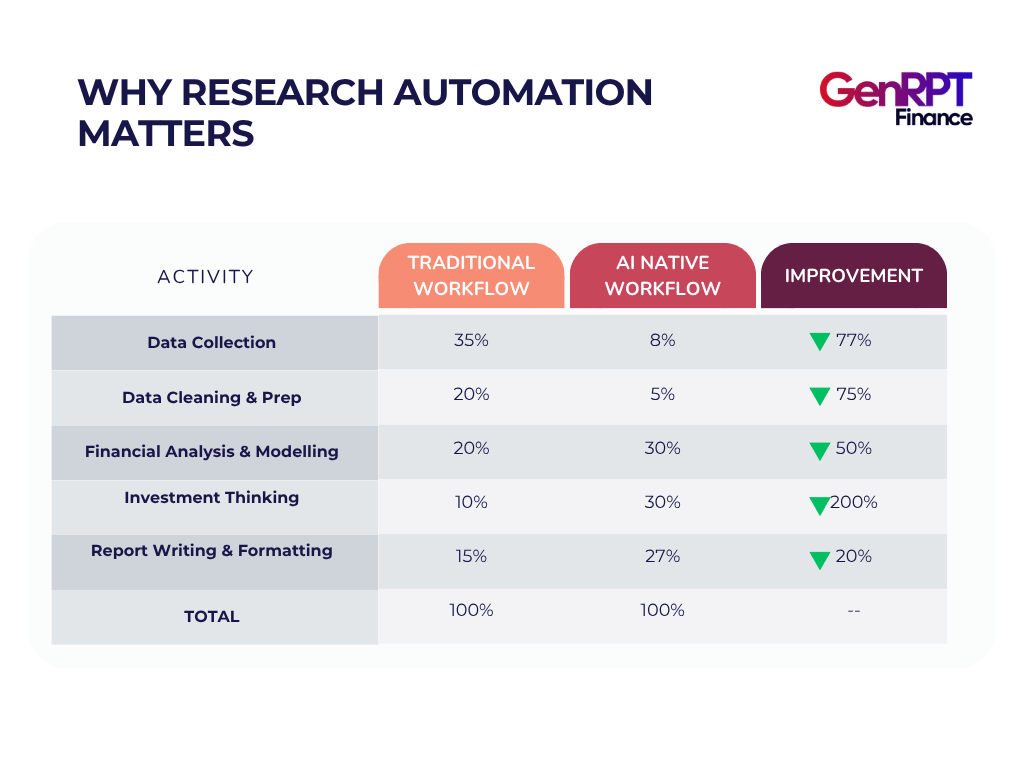
Research automation workflows are structured sequences of automated tasks that support the investment research lifecycle.
Instead of manually performing every activity, software and AI handle repetitive processes while analysts review, validate, and interpret the results.
Typical workflows include:
- Financial data collection
- Company screening
- Financial statement analysis
- Earnings call summarisation
- Peer benchmarking
- Valuation model updates
- Scenario analysis
- Investment report generation
The objective is to reduce manual effort while improving research consistency.
Why research automation is becoming essential
Modern analysts work with far more information than ever before.
A single company may generate:
- Hundreds of pages of annual reports
- Quarterly earnings releases
- Conference call transcripts
- Investor presentations
- Regulatory filings
- News articles
- Alternative datasets
- ESG disclosures
Reviewing this information manually consumes valuable time.
Automation allows analysts to process more information without sacrificing research quality.
Components of a research automation workflow
Most institutional research workflows follow similar stages.
Data collection
Financial information is gathered from multiple trusted sources.
This includes:
- Financial statements
- Market data
- Company disclosures
- Earnings transcripts
- Industry research
- Economic indicators
Automation eliminates repetitive data gathering.
Data validation
Collected information is checked for:
- Accuracy
- Completeness
- Consistency
- Timeliness
High-quality data produces more reliable analysis.
Financial analysis
Automation calculates:
- Financial ratios
- Growth trends
- Profitability metrics
- Cash flow analysis
- Balance sheet changes
Analysts review the outputs rather than performing every calculation manually.
Peer benchmarking
Companies are automatically compared across:
- Revenue growth
- Margins
- Valuation multiples
- Market share
- Capital allocation
Benchmarking becomes faster and more consistent.
Valuation support
Automation updates:
- DCF assumptions
- Comparable company analysis
- Scenario analysis
- Sensitivity models
Analysts can then focus on interpreting valuation outcomes.
Report generation
Research findings are organised into structured equity research reports, reducing document preparation time.
Benefits of research automation workflows
Automation improves nearly every stage of investment research.
Benefits include:
- Faster report preparation
- Better research consistency
- Reduced manual work
- Improved collaboration
- Better financial forecasting
- Faster reaction to market events
- Higher analyst productivity
- Broader company coverage
Rather than replacing analysts, automation expands their analytical capacity.
Challenges of implementing research automation
Automation also requires careful implementation.
Research teams should consider:
- Data quality
- Workflow design
- Model transparency
- Integration with existing platforms
- User adoption
- Regulatory compliance
- Information security
Strong governance ensures automation improves research instead of introducing new risks.
The role of AI in research automation
Modern equity research automation goes beyond simple rule-based processes.
Agentic AI can:
- Analyse financial reports
- Interpret earnings calls
- Compare competitors
- Detect emerging risks
- Build financial models
- Draft research reports
- Monitor market developments
- Support AI for equity research
This allows research teams to spend more time evaluating investment opportunities instead of collecting information.
Best practices for research automation workflows
Leading research teams typically follow several principles:
- Automate repetitive tasks only.
- Keep analysts responsible for final decisions.
- Validate every automated output.
- Use trusted financial data sources.
- Maintain transparent workflows.
- Monitor workflow performance.
- Protect confidential research.
- Continuously improve automation processes.
These practices help organisations maintain research quality while increasing efficiency.
The future of research automation
Research automation continues to evolve rapidly.
Future workflows are expected to include:
- Multi-agent AI research systems
- Continuous financial monitoring
- Automated valuation updates
- Real-time portfolio analysis
- Intelligent research assistants
- Alternative data integration
- Predictive investment insights
These capabilities will enable analysts to produce faster, more comprehensive, and more accurate research while maintaining professional oversight.
Conclusion
Research automation workflows are reshaping how modern equity research is performed. By automating repetitive tasks such as data collection, financial analysis, benchmarking, and report preparation, analysts can devote more time to valuation, strategic thinking, and investment decision-making. The firms that combine automation with strong governance and experienced analysts will be better positioned to deliver faster, more consistent, and higher-quality investment research.
GenRPT Finance is built around this approach. Its Agentic AI automates financial statement analysis, earnings call interpretation, peer benchmarking, valuation modelling, scenario analysis, and report generation within a unified workflow. This enables research teams to create institutional-grade equity research reports faster while maintaining analyst oversight, transparency, and research quality.
FAQs
Research automation workflows are structured processes that automate repetitive investment research tasks such as data collection, financial analysis, benchmarking, and report generation.
They improve analyst productivity, reduce manual effort, increase research consistency, and enable faster investment decisions.
No. Automation handles repetitive tasks, while analysts remain responsible for interpreting results, validating assumptions, and making investment recommendations.
Research teams commonly use AI, machine learning, natural language processing, workflow automation platforms, financial databases, and cloud collaboration tools.
GenRPT Finance uses Agentic AI to automate financial analysis, earnings call interpretation, valuation modelling, peer benchmarking, and institutional-grade equity research report generation within a unified research workflow.
