
What Are the Best Practices for AI-Native Investment Research?
August 18, 2026 | By GenRPT Finance
The best practices for AI-native investment research focus on combining artificial intelligence with human expertise to produce faster, more accurate, and more reliable investment analysis. In equity research, AI should automate repetitive tasks such as data collection, document analysis, and report drafting, while analysts remain responsible for validating insights, interpreting financial information, and making investment recommendations. A well-designed AI-native workflow improves efficiency without compromising research quality or transparency.
As investment firms adopt AI across their research operations, the organisations that achieve the best outcomes are those that treat AI as an analytical partner rather than a replacement for experienced analysts.
Start with high-quality data
AI is only as effective as the information it receives.
Research teams should ensure that data is:
- Accurate
- Complete
- Timely
- Consistent
- Verified
Reliable inputs lead to more dependable financial forecasting, valuation models, and investment recommendations.
Keep analysts in the decision-making process
AI can analyse large volumes of information quickly, but investment decisions still require human judgment.
Analysts should remain responsible for:
- Validating AI-generated insights
- Challenging assumptions
- Assessing business quality
- Evaluating management performance
- Approving final equity research reports
Human oversight improves research quality and reduces the risk of incorrect conclusions.
Combine AI with traditional research
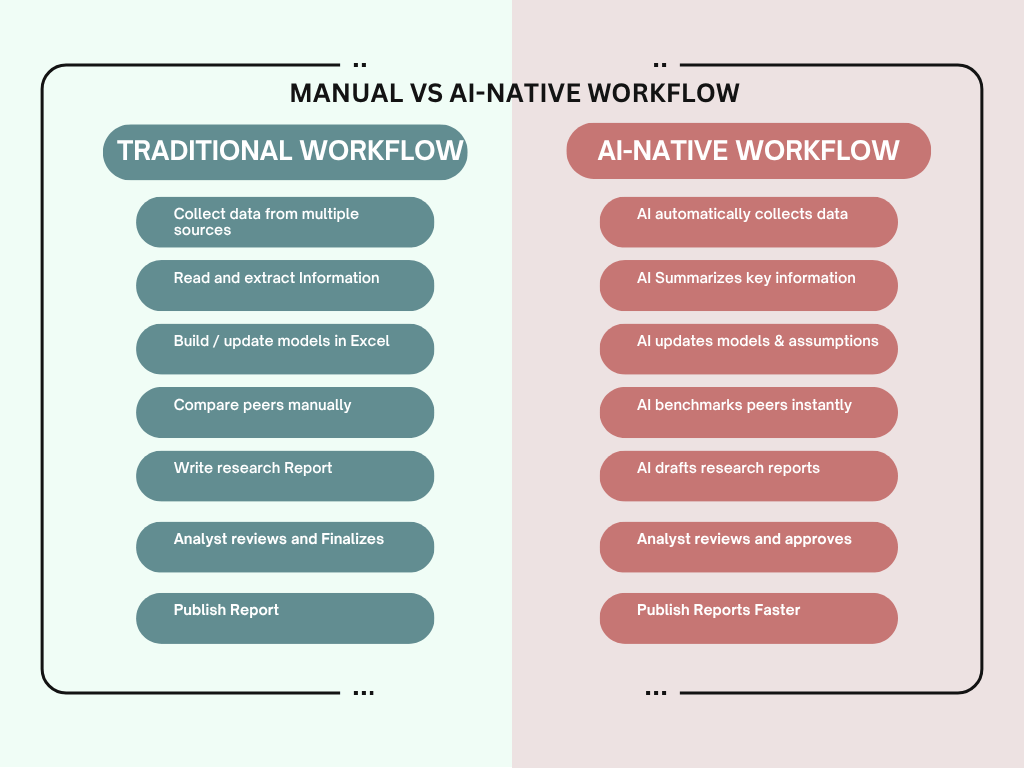
AI-native investment research should strengthen—not replace—fundamental analysis.
Analysts should integrate AI insights with:
- Financial reports
- Earnings call transcripts
- Regulatory filings
- Industry research
- Company guidance
- Macroeconomic indicators
Combining multiple sources creates stronger and more balanced investment analysis.
Automate repetitive workflows
The greatest value of AI comes from eliminating repetitive work.
Research teams should automate tasks such as:
- Data collection
- Financial statement analysis
- Ratio calculations
- Peer benchmarking
- Document summarisation
- Draft report generation
This allows analysts to focus on valuation, investment strategy, and risk assessment.
Maintain transparency
Every AI-generated insight should be traceable.
Research platforms should provide:
- Source references
- Supporting calculations
- Document citations
- Version history
- Audit trails
Transparent research improves confidence and simplifies internal reviews.
Continuously validate AI outputs
AI models should be reviewed regularly.
Analysts should compare AI-generated results against:
- Historical performance
- Published financial results
- Analyst expectations
- Company guidance
- Existing valuation models
Regular validation ensures AI continues to produce reliable insights.
Build strong governance
AI-native research requires clear governance policies.
Research teams should define:
- User permissions
- Data access controls
- Model approval processes
- Compliance requirements
- Documentation standards
Strong governance protects confidential financial information and supports regulatory compliance.
Update models continuously
Markets change every day.
AI-native research platforms should automatically incorporate:
- Earnings releases
- Financial statement updates
- Macroeconomic developments
- Industry news
- Regulatory changes
- Alternative data
Keeping research current improves forecast accuracy and investment recommendations.
Measure performance regularly
Research teams should evaluate whether AI is delivering measurable value.
Common metrics include:
- Time saved
- Forecast accuracy
- Report turnaround time
- Research consistency
- Analyst productivity
- Coverage expansion
Measuring outcomes helps firms refine their AI-native workflows over time.
Prioritise security and collaboration
Investment research contains confidential information that must remain protected.
AI-native platforms should support:
- Role-based access
- Data encryption
- Secure cloud collaboration
- Version control
- Activity monitoring
Strong security enables teams to collaborate efficiently while protecting sensitive research data.
The future of AI-native investment research
AI capabilities continue to evolve rapidly.
Future best practices are likely to include:
- Multi-agent research workflows
- Continuous company monitoring
- Automated valuation updates
- Real-time portfolio analysis
- Intelligent research assistants
- Predictive investment insights
Firms that establish strong AI governance today will be better positioned to adopt these capabilities as they mature.
Conclusion
The best AI-native investment research combines automation, high-quality data, transparent workflows, and experienced analyst oversight. AI improves efficiency by handling repetitive analytical tasks, while analysts provide context, judgment, and strategic thinking. Following these best practices enables research teams to improve equity research, strengthen financial forecasting, and produce more consistent, institutional-grade investment analysis.
GenRPT Finance is designed around these principles. Its Agentic AI automates financial statement analysis, earnings call interpretation, peer benchmarking, valuation modelling, scenario analysis, and report generation within a secure, transparent workflow. By combining AI automation with analyst oversight, GenRPT Finance helps firms produce institutional-grade equity research reports faster while maintaining accuracy, governance, and research quality.
FAQs
Best practices include using high-quality data, maintaining human oversight, automating repetitive workflows, validating AI outputs, ensuring transparency, and implementing strong governance.
Human oversight ensures analysts validate AI-generated insights, assess business context, challenge assumptions, and make final investment recommendations.
Firms typically measure forecast accuracy, analyst productivity, report turnaround time, research consistency, coverage expansion, and time saved through automation.
No. AI should complement traditional financial analysis by automating repetitive tasks while analysts continue to apply valuation techniques, financial modelling, and professional judgment.
GenRPT Finance uses Agentic AI to automate financial analysis, valuation modelling, earnings call analysis, peer benchmarking, and report generation, enabling analysts to create institutional-grade equity research reports with greater speed, consistency, and transparency.
