
How GenRPT Finance Supports End-to-End Equity Research Analysis
October 15, 2026 | By GenRPT Finance
Equity research analysis involves much more than reviewing financial statements and estimating a company’s value. Analysts need to understand the business, assess its financial performance, compare industry peers, build valuation models, identify risks, and develop an investment thesis. Each stage requires accurate information, detailed analysis, and careful judgement.
For institutional research teams, managing this entire process can be time-consuming. Financial information is spread across annual reports, quarterly filings, earnings call transcripts, investor presentations, and market databases. Analysts often spend considerable time collecting, verifying, and organizing this information before they can begin their actual research.
GenRPT Finance supports end-to-end equity research analysis through Agentic AI, helping investment analysts, asset managers, portfolio managers, and financial institutions automate repetitive research activities. It brings financial analysis, peer benchmarking, valuation modelling, risk assessment, and research report generation into a structured workflow.
The objective is to reduce the manual effort involved in investment research while allowing analysts to focus on evaluating companies and making investment decisions.
What is end-to-end equity research analysis?
End-to-end equity research analysis refers to the complete process of evaluating a company, beginning with information collection and ending with a detailed investment research report.
A typical institutional equity research workflow includes:
- Company screening and research planning
- Financial data collection
- Business and industry analysis
- Financial statement analysis
- Peer benchmarking
- Financial modelling and forecasting
- Company valuation
- Risk and scenario analysis
- Investment thesis development
- Research report preparation and review
These activities are closely connected. For example, revenue forecasts influence valuation models, while industry conditions and competitive advantages affect assumptions about future growth.
When analysts manage these activities separately, updating information across financial models and research reports can become difficult.
An integrated research workflow helps maintain consistency between the underlying data, financial assumptions, analysis, and final report.
Why traditional equity research workflows are time-consuming
Institutional analysts work with large volumes of structured and unstructured financial information.
Structured information includes revenue, expenses, profit margins, cash flows, and balance sheet figures. Unstructured information includes management commentary, earnings call discussions, business strategies, risk disclosures, and industry research.
Before developing an investment recommendation, analysts must bring these different sources together.
Some common challenges include:
- Manually extracting financial information from reports
- Comparing financial data across reporting periods
- Maintaining financial models
- Identifying relevant information in lengthy documents
- Conducting peer comparisons
- Updating valuation assumptions
- Preparing research reports under tight deadlines
These tasks are essential, but they can reduce the time available for deeper analysis.
Research automation helps address this problem by handling repeatable activities while keeping analysts involved in interpretation and decision-making.
How GenRPT Finance supports the equity research workflow
GenRPT Finance uses a multi-agent AI approach to support different stages of institutional investment research.
Instead of treating financial analysis, valuation, and report preparation as completely separate activities, the platform organizes them within a broader research process.
The following sections explain how this supports analysts throughout the research lifecycle.
1. Financial data collection and organization
Every equity research report begins with reliable financial information.
Analysts collect data from sources such as:
- Annual reports
- Quarterly financial statements
- Regulatory filings
- Earnings call transcripts
- Investor presentations
- Historical financial disclosures
Collecting this information manually requires significant effort, particularly when analysts cover multiple companies.
GenRPT Finance helps automate financial information collection and organization, reducing the effort involved in preparing data for analysis.
This gives analysts a more structured starting point for examining a company’s performance.
2. Financial statement analysis
Financial statement analysis is one of the most important stages of equity research.
Analysts examine the income statement, balance sheet, and cash flow statement to understand the company’s financial health.
Key areas include:
- Revenue growth
- Operating expenses
- EBITDA
- Net income
- Earnings per share
- Debt and liquidity
- Operating cash flow
- Free cash flow
GenRPT Finance supports the analysis of financial statements and helps organize financial performance across reporting periods.
For example, analysts examining a company over several quarters can use automated analysis to identify changes in profitability, expenses, and cash generation.
The findings provide a foundation for further investigation into the company’s business performance.
3. Business quality and fundamental analysis
Financial numbers explain what has happened, but they do not always explain why.
A company may report increasing revenue while experiencing declining customer retention, weakening competitive advantages, or rising operating costs.
This is why fundamental analysis includes qualitative factors alongside financial performance.
Analysts examine:
- Business model
- Revenue quality
- Competitive advantages
- Management quality
- Capital allocation
- Industry position
- Long-term growth opportunities
GenRPT Finance supports business quality assessment by bringing together financial information and relevant company disclosures.
This helps analysts develop a broader understanding of the business before making assumptions about its future performance.
4. Earnings call analysis
Earnings calls often provide information that is not immediately visible in financial statements.
Management may discuss changes in customer demand, pricing, capital expenditure, business strategy, or operational challenges.
However, earnings call transcripts can be lengthy, particularly when analysts need to compare management commentary across several quarters.
GenRPT Finance helps automate earnings call analysis and organize relevant information for investment research.
Analysts can use these findings to examine management expectations, understand business developments, and compare commentary with reported financial performance.
For example, if management repeatedly discusses improving margins but financial statements show continued margin pressure, the difference may require closer investigation.
5. Peer benchmarking and competitive analysis
A company’s performance becomes more meaningful when compared with similar businesses.
A 15% operating margin may be attractive in one industry but below average in another.
Professional analysts therefore compare companies using financial and operational benchmarks.
Common metrics include:
- Revenue growth
- EBITDA margins
- Return on Equity (ROE)
- Return on Invested Capital (ROIC)
- Debt ratios
- Valuation multiples
- Market position
GenRPT Finance supports peer benchmarking by helping analysts compare company performance against relevant competitors.
These comparisons can highlight differences in profitability, growth, financial efficiency, and valuation.
Peer analysis also helps analysts determine whether a company’s performance reflects its own competitive strengths or broader industry conditions.
6. Financial modelling and forecasting
Financial modelling connects historical performance with expectations about future business results.
Analysts develop forecasts for revenue, expenses, profitability, cash flow, and other financial metrics.
These forecasts depend on assumptions about:
- Sales growth
- Operating margins
- Capital expenditure
- Working capital
- Industry conditions
- Macroeconomic developments
GenRPT Finance supports financial modelling and forecasting activities as part of its equity research workflow.
By organizing historical financial information and supporting financial projections, the platform helps analysts spend more time evaluating the assumptions behind their forecasts.
However, analysts remain responsible for assessing whether those assumptions are realistic.
7. Equity valuation analysis
A company can have strong fundamentals and still represent an unattractive investment if its market valuation is too high.
Valuation analysis helps analysts estimate a company’s intrinsic value and compare it with the prevailing market price.
Common valuation approaches include:
- Discounted Cash Flow (DCF)
- Comparable Company Analysis
- Price-to-Earnings (P/E)
- EV/EBITDA
- Price-to-Book (P/B)
GenRPT Finance supports valuation modelling and comparative analysis within the research process.
Analysts can use valuation outputs alongside financial forecasts, business quality assessments, and peer comparisons to develop a more balanced view of investment potential.
Valuation remains sensitive to assumptions, particularly future cash flows, growth rates, and discount rates. These inputs require careful review before an investment conclusion is reached.
8. Scenario analysis and risk assessment
Investment research must account for uncertainty.
Even detailed financial forecasts cannot predict every change in business performance or market conditions.
Institutional analysts therefore evaluate multiple scenarios to understand how different assumptions could affect company valuation.
These commonly include:
- Bull case: Stronger growth, improving margins, or favourable industry conditions.
- Base case: The most reasonable outcome based on available information.
- Bear case: Weaker demand, rising costs, or unfavourable economic conditions.
GenRPT Finance supports scenario and sensitivity analysis, allowing research teams to examine the potential impact of changing financial assumptions.
Risk assessment may also consider financial leverage, competitive pressure, regulatory developments, geographic exposure, and macroeconomic conditions.
The purpose is not to eliminate uncertainty but to understand how different outcomes could affect an investment.
9. Investment thesis development
An investment thesis brings together the findings of the entire equity research process.
It explains why a company may represent an attractive investment, what could drive its future performance, and which risks investors should consider.
A well-supported investment thesis typically addresses:
- Business quality
- Financial performance
- Competitive positioning
- Growth opportunities
- Valuation
- Investment risks
- Potential catalysts
GenRPT Finance helps analysts organize research findings that contribute to investment thesis development.
However, the final interpretation remains an analyst’s responsibility.
An AI-generated analysis may identify financial trends or valuation differences, but determining their investment significance requires professional judgement.
10. Institutional equity research report generation
Preparing the final research report can be one of the most time-consuming parts of investment research.
Analysts need to combine financial tables, company analysis, valuation models, risk assessments, and supporting explanations into a consistent document.
GenRPT Finance uses Agentic AI to support the generation of comprehensive institutional equity research reports.
The platform is designed to produce reports exceeding 200 pages, with a typical generation timeframe of approximately 48–72 hours, depending on research scope and requirements.
Reports can include:
- Company and business analysis
- Financial statement analysis
- Historical financial performance
- Peer benchmarking
- Valuation models
- Scenario and sensitivity analysis
- Risk assessments
- Financial tables and charts
- Supporting citations
This helps research teams reduce the manual work involved in assembling detailed reports while retaining the ability to review the underlying analysis.
Why a multi-agent approach matters in equity research
Equity research involves several specialized activities that require different types of analysis.
Financial statement interpretation is different from industry research. Valuation modelling requires different inputs than earnings call analysis.
GenRPT Finance uses a multi-agent architecture, with approximately 13–20 specialized agents supporting different research activities, depending on the workflow.
The advantage of this approach is that separate research tasks can be organized as part of a coordinated process.
For example, financial analysis can inform forecasting, forecasting can support valuation, and valuation findings can contribute to the investment thesis.
This reduces the need to repeatedly organize the same information across separate research activities.
Human oversight remains essential
Automation can improve the speed and consistency of research, but it does not eliminate the need for verification.
Analysts must still review:
- Financial data accuracy
- Forecasting assumptions
- Valuation inputs
- Peer selection
- Risk assessments
- Investment conclusions
This is particularly important in institutional investing, where research findings may influence significant capital allocation decisions.
AI-generated outputs should be treated as research inputs rather than automatically accepted investment recommendations.
The value of research automation lies in supporting analysts, not removing their responsibility for investment decisions.
Benefits of end-to-end equity research automation
For institutional research teams, bringing multiple research activities into a coordinated workflow offers several practical advantages.
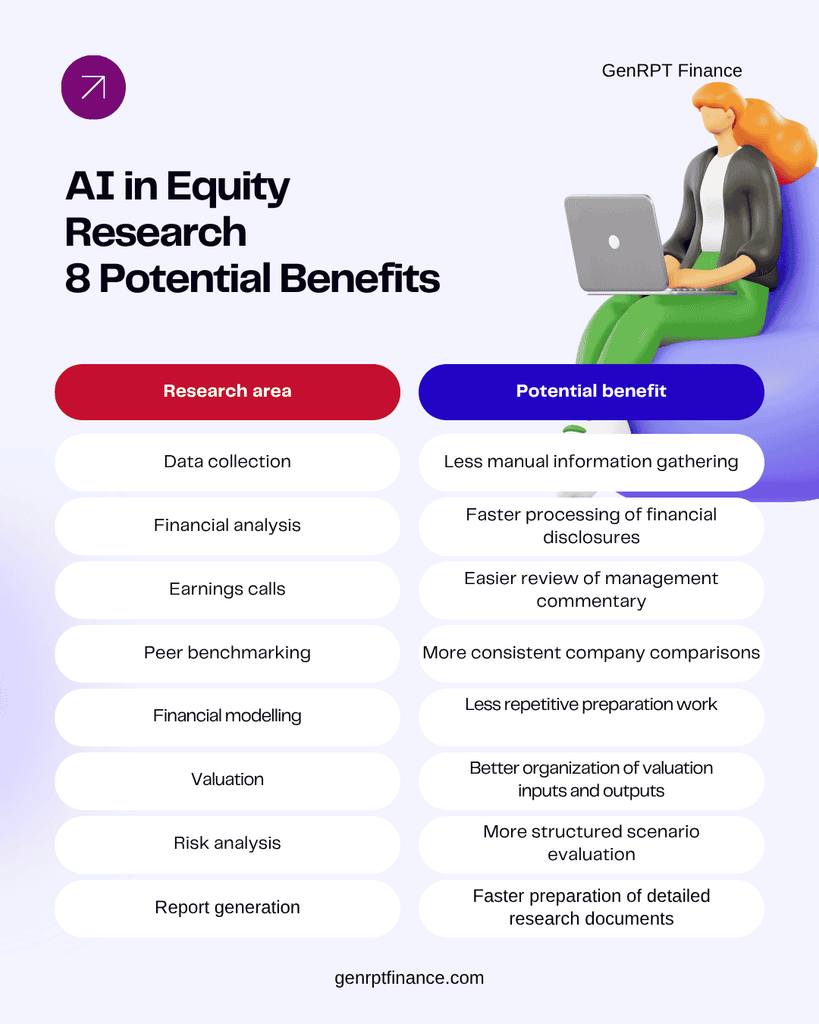
These improvements can help analysts cover more companies, maintain research consistency, and allocate more time to activities requiring deeper judgement.
Who can benefit from GenRPT Finance?
End-to-end equity research automation is relevant to several types of financial institutions and research professionals.
These include investment analysts preparing company research reports, asset managers evaluating investment opportunities, portfolio managers monitoring holdings, wealth managers assessing investment options, and financial consultants conducting company and industry analysis.
Institutional research departments can also use automation to standardize workflows and reduce repetitive work across teams.
The benefits depend on the organization’s research process, data requirements, and level of analyst oversight.
Conclusion
End-to-end equity research analysis requires analysts to connect financial information, business fundamentals, industry research, valuation, and risk assessment before reaching an investment conclusion. Managing these activities manually can be demanding, particularly when research teams cover multiple companies and need to update reports regularly.
GenRPT Finance brings these activities into a coordinated research workflow using Agentic AI. By supporting financial statement analysis, earnings call interpretation, peer benchmarking, financial modelling, valuation, scenario analysis, and report generation, the platform helps analysts reduce repetitive work and concentrate on the findings that matter.
The goal is not simply to produce reports faster. It is to give investment professionals more time to examine assumptions, challenge conclusions, and build well-supported investment theses.
FAQs
End-to-end equity research analysis covers the complete process of evaluating a company, including financial data collection, fundamental analysis, peer benchmarking, financial modelling, valuation, risk assessment, and research report preparation.
GenRPT Finance uses Agentic AI to support financial statement analysis, earnings call interpretation, peer benchmarking, valuation modelling, scenario analysis, and institutional research report generation.
GenRPT Finance is designed to generate comprehensive institutional equity research reports, often exceeding 200 pages, in approximately 48–72 hours. Actual turnaround depends on the scope of research and data requirements.
No. GenRPT Finance supports research activities and automates repetitive tasks, but analysts remain responsible for validating financial assumptions, interpreting findings, and making investment decisions.
Investment analysts, asset managers, portfolio managers, wealth managers, financial consultants, and institutional research teams can benefit from automated equity research workflows.
Multi-agent AI allows specialized research activities, such as financial analysis, benchmarking, forecasting, and valuation, to be organized within a coordinated workflow, reducing repetitive work and improving research efficiency