
How Do Analysts Evaluate AI-Native Investment Research?
August 18, 2026 | By GenRPT Finance
Analysts evaluate AI-native investment research by measuring whether AI improves the quality, speed, accuracy, and consistency of investment analysis while maintaining human oversight. In equity research, AI should help analysts analyse more information, improve financial forecasting, strengthen valuation models, and reduce manual work. Rather than asking whether AI can replace analysts, firms evaluate whether it helps research teams make better-informed investment decisions.
AI-native investment research is judged by outcomes. If it improves research quality without compromising transparency or analytical rigour, it delivers measurable value.
According to Deloitte, most financial institutions are expanding AI investments because of improvements in productivity, decision-making, and operational efficiency. This is encouraging research teams to assess AI platforms as strategic research tools rather than simple automation software.
Evaluate research accuracy
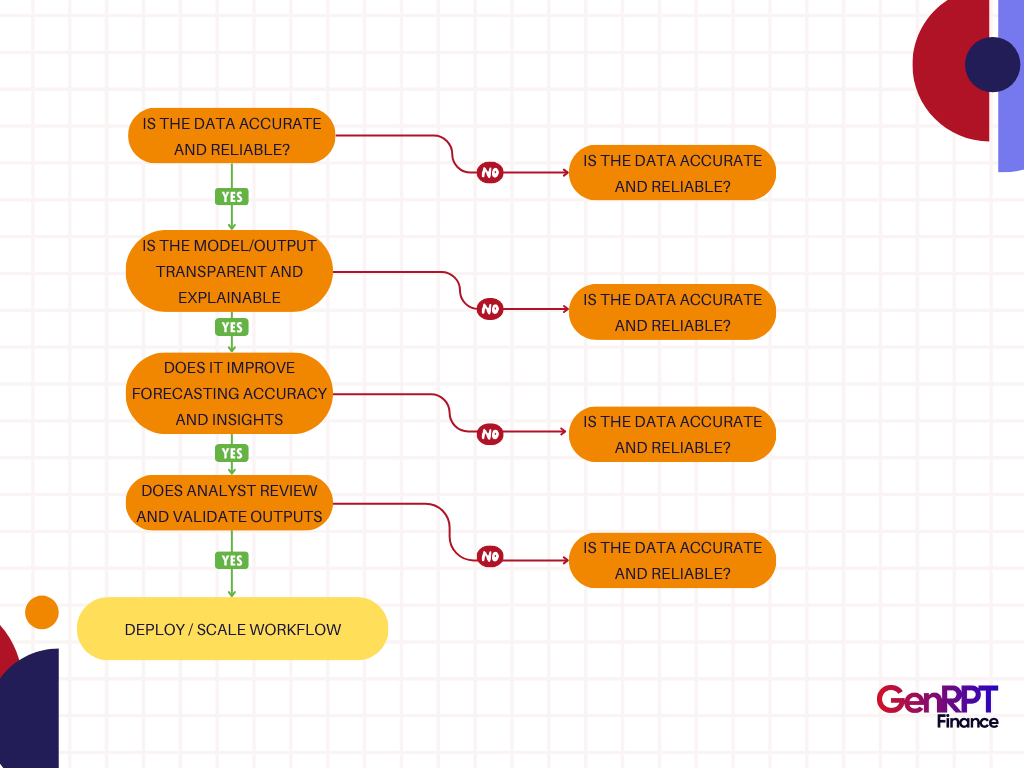
The first question analysts ask is whether AI improves research quality.
They compare AI-generated insights against:
- Financial statements
- Company filings
- Earnings calls
- Historical performance
- Published research
- Market data
Reliable AI should produce accurate summaries, identify key trends, and reduce manual errors without changing the underlying financial facts.
Assess forecasting capabilities
Forecasting is one of the most important parts of investment research.
Analysts evaluate whether AI improves:
- Revenue projections
- Earnings forecasts
- Cash flow estimates
- Growth assumptions
- Scenario analysis
- Sensitivity analysis
Better forecasting directly supports stronger equity valuation and investment recommendations.
Measure data coverage
Modern research requires information from multiple sources.
Analysts assess whether AI can analyse:
- Financial reports
- Earnings call transcripts
- Regulatory filings
- Industry research
- Alternative data
- Macroeconomic indicators
- Market news
The broader the coverage, the more comprehensive the research process becomes.
Evaluate automation quality
Not every automated workflow improves productivity.
Analysts determine whether AI successfully automates tasks such as:
- Data collection
- Financial statement analysis
- Peer benchmarking
- Ratio calculations
- Report drafting
- Data extraction
Automation should reduce repetitive work while allowing analysts to focus on higher-value activities.
Test transparency
AI-generated insights should always be explainable.
Research teams evaluate whether AI provides:
- Source references
- Supporting calculations
- Traceable assumptions
- Clear reasoning
- Audit trails
Transparency allows analysts to verify findings before using them in equity research reports.
Validate financial models
Financial models remain central to investment analysis.
Analysts examine whether AI improves:
- Discounted Cash Flow (DCF) models
- Comparable company analysis
- Scenario analysis
- Sensitivity analysis
- Revenue modelling
The goal is not to replace financial modelling but to improve its speed and consistency.
Compare AI output with analyst judgment
Experienced analysts remain responsible for final investment decisions.
Research teams compare AI-generated conclusions with analyst assessments to determine:
- Agreement levels
- Missed risks
- New opportunities
- Areas requiring further investigation
This helps organisations understand where AI adds value and where human expertise remains essential.
Assess scalability
Research teams often cover hundreds of companies.
Analysts evaluate whether AI can:
- Analyse multiple sectors
- Monitor large portfolios
- Track market developments continuously
- Produce consistent research across companies
Scalable AI allows firms to expand coverage without increasing manual workloads.
Evaluate security and governance
AI-native investment research must meet institutional standards.
Analysts assess:
- Data security
- Access controls
- Regulatory compliance
- Model governance
- Version control
- Confidentiality
Strong governance ensures AI supports research without creating operational or compliance risks.
Measure business impact
Ultimately, firms evaluate whether AI delivers measurable improvements.
Common performance indicators include:
- Faster report generation
- Improved forecast accuracy
- Increased analyst productivity
- Better research consistency
- Reduced manual effort
- Faster response to market events
These metrics demonstrate whether AI-native research provides meaningful business value.
The role of AI in future investment research
AI capabilities continue to evolve.
Future evaluation frameworks are expected to include:
- Multi-agent research systems
- Continuous financial monitoring
- Automated valuation updates
- Real-time portfolio analysis
- Predictive investment insights
As these technologies mature, analysts will continue to evaluate AI based on its ability to strengthen—not replace—professional investment research.
Conclusion
Evaluating AI-native investment research requires more than measuring automation. Analysts assess research accuracy, forecasting quality, transparency, scalability, governance, and business impact to determine whether AI genuinely improves investment decisions. The most successful AI-native platforms combine automation with analyst expertise, enabling faster, more comprehensive, and more reliable equity research.
GenRPT Finance follows this AI-native approach by combining Agentic AI with financial statement analysis, earnings call interpretation, peer benchmarking, valuation modelling, and report generation within a unified workflow. It helps research teams produce institutional-grade equity research reports faster while maintaining transparency, analyst oversight, and research quality.
FAQs
Analysts evaluate AI-native investment research by measuring research accuracy, forecasting quality, automation efficiency, transparency, scalability, governance, and overall impact on investment decision-making.
Transparency allows analysts to verify AI-generated insights, understand supporting assumptions, and maintain confidence in investment recommendations.
Yes. AI analyses financial statements, market data, earnings calls, and historical performance to support more accurate revenue, earnings, and valuation forecasts.
No. AI automates repetitive research tasks, but analysts remain responsible for interpreting results, assessing risks, validating insights, and making final investment recommendations.
GenRPT Finance uses Agentic AI to automate financial analysis, valuation modelling, earnings call analysis, peer benchmarking, and report generation, helping analysts create institutional-grade equity research reports with greater speed, consistency, and accuracy.
